PRP – magic bullet, or damp squib?

I’m guessing that not many of you will have seen the Academy Award-nominated biographical movie ‘Dr Ehrlich’s Magic Bullet’ starring Edward G Robinson. It outlines part of the career of the famous German scientist  Dr Paul Ehrlich, who popularised the concept of the ‘magic bullet’ therapy for the treatment of specific diseases. The film focuses on arsphenamine, ‘compound 606,’ and Ehrlich’s cure for syphylis.

The concept of the ‘magic bullet’ is rather older however, dating back at least to the 1800’s and deriving from the histochemical staining of tissues. It was Ehrlich’s opinion that, if a chemical could be found that targeted a pathogen, then a toxin could be delivered along with that chemical and hence a ‘magic bullet’ would be created that would destroy the pathogen leading to the elimination of a disease state. The concept was later realised following the discovery of monoclonal antibodies for which Köhler, Milstein and Jerne shared a Nobel Prize in 1984.

So-called ‘targeted therapies’ do not necessarily destroy their target as such, but may act to cause some form of modification, for example to a cell membrane via second messenger cascades or within the cell nucleus itself, leading to alterations in cellular genetic expression which then lead to a sequence of events that ultimately results in healing or an improvement in clinical symptoms.

Platelet-rich plasma (PRP) has been perhaps the most widely investigated preparation of late. PRP contains a number of growth factors including PDGF, IL-8, and CTGF, which have a number of different effects on different cells. Many of these actions are poorly understood, despite much basic science research, yet this has not prevented the clinical application of PRP for tendinopathies which is perhaps not surprising given the search for effective therapies for tendinopathies and the drive for ‘cutting-edge’ therapies in Sports Medicine.

However, when one stops to consider the knowledge gaps we have concerning the pathophysiology of tendinopathies, and our lack of understanding of the complex interactions involved in cellular healing mechanisms, then perhaps one may not be surprised to see the heterogeneity of results from clinical trials using PRP in the treatment of these conditions. The three main theories for the genesis of tendinopathy, namely overuse, overload and thermal stress, are still open to debate and there is a very wide range of possible actions of PRP on tendinopathic tendons.

Well-conducted clinical trials such as this one by de Jong et al on PRP for achilles tendinopathy, and systematic reviews such as this one by de Vos and colleagues ,have failed to find a positive clinical effect when using PRP use for the treatment of tendinopathies.

In this month’s systematic review in CJSM on the use of PRP in Sports Medicine as a new treatment for tendon and ligament injuries, Taylor and colleagues concluded that, despite several possible theoretical advantages to the use of PRP, there are very few well-conducted prospective studies and clinical trials available with which to inform clinical practice.

The recent IOC consensus paper on the use of PRP in sports medicine published in BJSM also highlighted the limited amount of basic science research, the paucity of well-conducted clinical studies on PRP, and the heterogeneity of methodological issues between different studies making comparisons of clinical effects difficult to judge. The IOC group’s recommendation was that clinicans should proceed with caution in the clinical use of PRP.

The debate is on as to whether there is a true lack of efficacy of PRP in the treatment of tendinopathies, or whether we simply need more well-designed clinical research.

What do you think? Where do we need to focus our research efforts? Should we forget the idea of ‘targeted therapies’ such as PRP and ‘magic bullets’ for tendinopathies?

CJSM would like to hear your views.

Leave a Comment

Leave a Comment

France, Le Tour, cycling injuries and cycle helmets

Welcome back following a short break in France, during which I spent a week in the Languedoc admiring the scenery and enjoying the French hospitality. Not everyone was as lucky as I was to be taking things easy, however, and Le Tour was in full swing during my time there, this being the 98th edition of the race since it was first held in 1903. The gruelling 21 stages run over 23 days covers a distance of 3430 km, and the race is a real test with a chequered and interesting history.

This year’s Tour was won by an Australian for the first time, Cadel Evans, who gained the lead on the penultimate day.

As usual, there were a number of casualties, mostly from crashes involving some high profile riders. These included Britain’s Bradley Wiggins who crashed out on stage 7 of Le Tour with a fractured clavicle during a pile-up which can be seen in this Guardian UK video footage . Others injured during the race included Andreas Klöden, Alexandre Vinokourov, Janez Brajcovic, Jurgen Van Den Broeck and Chris Horner who were all unable to continue the race due to their injuries.

Again this year, a large proportion of serious  injuries were caused by collisions with vehicles, including an incident with a car involved with TV coverage which resulted in injuries to Juan Antonia Flecha and Johnny Hoogerland and led to Christian Prudhomme, Tour organiser, to say ‘It’s a scandal.’ Hoogerland’s dramatic lacerations following his collision with barbed wire can be seen in this image. In addition, Nikki Sorensen was struck by a photographer on his motorbike.

For a useful review of injuries associated with cycling, see this 2001 article by Thompson and Rivara published in American Family Physician.

Those of us who are perhaps more used to keeping safe whilst cycling in the streets might be more interested in this article published earlier this year in Injury Prevention by Lusk and colleagues, based on regional data from Montreal, which highlights the differences in injury rates between cycling on cycle tracks compared with comparable reference streets. The study found that the relative risk of injury on cycle tracks was 0.72 (95% CI 0.60 to 0.85) compared with cycling in reference streets, suggesting that the risk of injury from cycling on tracks is less than cycling in the streets.

A key element of road cycle safety surely has to be legislation for the mandatory use of helmets which still hasn’t found it’s way here in the UK. This is perhaps regretful – especially following the introduction of the London Cycle Hire Scheme which merely advises riders to consider wearing a cycle helmet . The British Medical Association currently supports the introduction of legislation, but this is opposed by the Transport and Health Study Group. Whether or not the position on mandatory laws for cycle helmets in the UK will change in the future may well depend on reaction following  the recent publication of the ‘Health on the Move 2’ report .

Historically, Australia has taken the lead Internationally on compulsory cycle helmet laws which have been enforced there since 1990, with New Zealand following suit in 1994. Read more about issues related to cycle helmets in Australia and Internationally on this interesting Australian website.

A recent bmj.com poll on the compulsory wearing of helmets by adult cyclists resulted in 68% of respondents (n=1439) voting no to the idea of mandatory wearing of helmets. The BMJ blog led to a lively debate on the topic. Despite the controversy, I for one will continue to wear my cycle helmet whilst cycling on the roads.

Do you think that there should be world-wide mandatory legislation for cycle helmet wear for road cyclists? CJSM would like to hear your thoughts on this – feel free to post your comments on the blog.

Vote on our quick poll on the issue on our website front page here.

(Pictures from mIKL194FV and AFP) 

Atoms and Pee Wees – age classification nomenclature in Ice Hockey

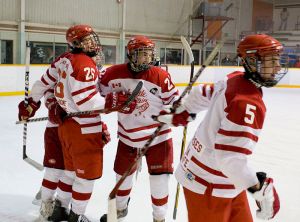
Raaii and colleagues’ article in this month’s CJSM concerning patterns of mouthguard utilisation in minor hockey players introduced me to the terms ‘Atom’ and ‘Pee Wee’ as applied to Ice Hockey.

I had heard of ‘Pee-Wee Herman’ before, Paul Rubens’ fictional comedic character, and ‘The Mighty Atom,’ Sydney Charles Wooderson MBE who was one of Britain’s greatest middle-distance runners in the 1930s and 40s,  but had not heard of the terms ‘Atom’ and ‘Pee Wee’ as applied to Ice Hockey. After a little research, I was able to find out that they refer to specific age categories.

The relevant age categories in Canada are as follows – Mini-mite (1-2 years old), Mite (3-4), Tyke (5-6), Novice (7-8), Atom (9-10), Pee Wee (11-12), Bantam (13-14), Midget (15-17), and Juvenile (18-20).

Interestingly, the nomenclature is quite different between Countries. In the United States, for example, the Mini-mites category of players are aged 5-6 years old, with Mites from 7-8, Squirts 9-10, Pee-Wees 11-12, Bantams 13-14, Midget-minors 15-16, Midget-majors 15-18, and Juniors of ages 16 and over.

In France, there are moustiques aged 9 and under, Poussins 10-11, Benjamins 12-13, Minimes 14-15, and cadets 16-18. The relevant age categories as defined by the German Ice Hockey Federation in Germany consist of Kleinstschüler (bambini) aged 8 and younger, Kleinschüler 9-10 years old, Knaben 11-12, Schüler 13-14, Jugend 15-16, and Junioren 17-18.

In Switzerland, the Schweizerischer Eishockeyverband (Swiss Ice Hockey Federation) defines ages categories for Bambini (9 years old and younger), piccolo (10-11), Moskito (12-13), Mini (14-15), Novizen (16-18), and Junioren (19-20).

The Swedish Ice Hockey Federation defines perhaps more conventional nominal age categories of U11 (11 and younger) and above for each age from U12-U16, with U18 and U20s categories.

A few issues come to mind here. One relates to the differences in the age categories for the same named categories in different Countries which could be confusing to some. For example, the Mite category in Canada describes those aged 3-4, but in the US the term would refer to the 7-8 year old category.

Another issue concerns the names for the age categories themselves. Whilst some of them might be considered as quaint by some, and might indeed possess a certain National and cultural heritage, to others the age category names might appear to be strange or at worst, even insulting. For example, the term ‘squirt’ is defined in the Oxford English Dictionary as a ‘puny or insignificant person,’ or in the US Oxford English Dictionary as an ‘insignificant, impudent or presumptious’ person, and as such would be seen as an insult to many people.

Should we be moving towards using an accepted International standard nomenclature for age categories in Ice Hockey based perhaps on the Swedish system, or do you think that we should continue to encourage the use of regional nomenclature? Let us know your thoughts. In the meantime, it would seem that it pays to know your Pee Wees from your Midget-majors !

(Original photographs by Thund3rh3art and Jason Bain)

Rodeo Catastrophic Injuries – ESPN video special

Some of you will have read this study by Butterwick and colleagues in last month’s CJSM entitled ‘Rodeo Catastrophic Injuries and Registry: Initial Retrospective and Prospective Report’ which highlighted the epidemiology of catastrophic injuries and fatalities over a 20 year period from 1989 to 2009.

The study found an incidence rate of catastrophic injury of 19.81 per 100 000 (19/95 892), with an incidence rate of fatality from 4.05 per 100 000 (21/518 286). The most devastating injuries in rodeo and bull riding were found to be due to thoracic compression injuries.


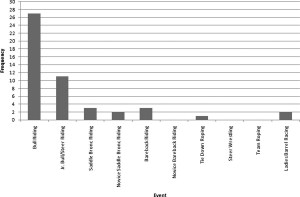
This graph, reproduced from the study, shows the distribution of injuries by rodeo event, highlighting that the greatest number of catastrophic injuries had occurred during either bull riding or junior bull riding/steer riding events (38 of 49; 77.5%).


Interestingly, the study concluded that there was no evidence that rodeo vests have any protective effect in preventing some of these catastrophic thoracic injuries, but that helmet use in bull riding and rodeo events did seem to offer some level of protection in preventing catastrophic injuries and fatalities.

The study by Butterwick and colleagues was recently presented and discussed on the ESPN website here with comments from Cody Lambert, a retired bull rider who designed the first vest used in professional bull riding some 20 years ago, mentioning that these have changed little in design over this period of time.

The website also has a link to a video interview with one of the co-authors of the CJSM article, Dr Tandy Freeman, Medical Director for the Professional Bull Riders Inc and for the Justin Sportsmedicine team. Dr Freeman gives a graphic description of what happens during the evolution of some of these injuries, which is accompanied by some startling film footage of some of these catastrophic events in the making.

Those of you involved in the management of rodeo injuries will also be interested to read this retrospective study by Sinclair and Smidt published in CJSM in 2009 which analysed some 10 years’ of injuries in high school rodeo, finding a total of 354 injury incidents from 43,168 competitor exposures (CEs).

Having reflected on these studies and having viewed the video footage for myself, I can safely say that I think that I will be sticking with soccer and golf as the sports in which I will be choosing to participate. I should also add that my last effort on a mechanical bucking bronco during a summer ball many years ago at medical school was particularly weak. Justin McBride has nothing to fear…

(photograph of rodeo event taken at the Calgary Stampede Rodeo by James Teterenko and graph reproduced from Butterwick DJ et al. Rodeo Catastrophic Injuries and Registry: Initial Retrospective and Prospective Report. Clin J Sport Med. 2011;21:243-248)