World Cup time in Germany for the International Women’s Football Teams

It’s an exciting time in Germany right now as the Women’s Football World Cup kicked off today with the hosts off to a winning start against Canada, and with France beating Nigeria.

Since 1991, the tournament has been held every 4 years, this being only the second time that the tournament has been staged in Europe since it was last hosted by Sweden in 1995. Germany will be looking to win the Cup for the third time running, and as hosts are the current favourites and the team to beat according to most commentators. There are 16 teams competing for the title, with the final taking place on the 17th of July in Frankfurt.

Having had the privilege of working with the England Women’s under 23’s team for a few years prior to taking on my current role with Leyton Orient FC, I am taking a particular interest in the England Women’s team and hoping that they will go at least one step further than the quarter final stages which is the furthest they have gone so far in the tournament last time out in China in 2007 and in Sweden in 1995. Another fan is my 12-year old niece Anna, who plays for a local team in Sheffield. They had a great season and managed to win their local Cup tournament this year making this uncle particularly proud!

I have nothing but the greatest of respect for top-level Women Footballers who are incredibly dedicated athletes, often competing in a world far removed from that of their male International counterparts and receiving only a fraction of the financial rewards of the men. They commonly work in other occupations or are to be found studying for qualifications in their spare time, all the while pursuing their careers as top-level International athletes. Their level of dedication and training matches that of the men for the most part, and I have found them an absolute pleasure to work with and have been humbled by their dedication to their Sport.

I had the pleasure of watching the England Women’s measured performance during their 2-1 win against the USA earlier this year in preparation for their World Cup bid. The game was held at our very own Brisbane Road stadium, my team Leyton Orient’s home ground, and I had the fortune to sit back, relax, and watch the game as crowd doctor on that occasion. England got off to a great start with 2 early goals and managed to keep in front until the end, despite a goal from the visitors and a USA-dominated second half.

Women’s Football is not without its particular problems when it comes to injuries, with most of us being aware of a well-documented significantly increased risk of ACL injuries in women when compared to their male counterparts. Hartmut and colleagues’s 1 year prospective study of the Women’s Bundesliga published last year in CJSM followed up 254 players from all 12 Women’s Premier League teams in Germany and reported an injury rate of 3.3 per 1000 hours (games 18.5 per 1000 hours ; practice 1.4 per 1000 hours). Most of these (31%) were ankle injuries, with 22.1% knee, 12.9% thigh, and 7.1% head injuries, with a seasonal peak towards the start of the season and with injury rates doubling in the last half an hour of play. The authors noted that most of the severe injuries were non-contact injuries, and speculated that these may well be prevented by ‘certain coordinative training methods’ (Hartmut G et al, 2010). 

This FIFA health and fitness guide for players and coaches, written by Katharina Grimm and Donald Kirkendall and based on original articles published as a supplement on Women’s Football in the British Journal of Sports Medicine in 2007  ,explains some injury prevention strategies for women footballers, and includes the ‘PEP’ programme (Prevent injury and Enhance Performance) with specific exercises focussed on the prevention of the more common injuries including ACL injuries, ankle and head injuries. It also provides additional useful information about nutrition, bone health and some more general topics in a format friendly to coaches and players. Well worth a read.

(picture by WOGERCAN10)

Anyone for Tennis? Wimbledon Championships in full swing

And so to the gloriously British Grand Slam Premier Tennis event that is Wimbledon which is currently in full swing. Well – full swing insomuch as the British weather is currently allowing, but at least with the Centre Court’s retractable roof, installed in time for the 2009 Championships, we are guaranteed to get through at least some of the scheduled games every day. As I write in London not more than a few miles away from the courts, the rain is currently pouring down – a not so welcome tradition of the Championships, together with the more desirable traditions such as strawberries and cream, ‘Henman Hill,’ and the inevitable tireless British banter about why we haven’t managed to produce a Men’s Champion since the legendary Fred Perry way back in 1936 when he won for a third time.

A total of 128 players take part over the fortnight in the single tournaments, with 64 pairs in single-sex doubles and 48 couples in the mixed doubles. However, there are always a few high-profile players who don’t make it to the Championships because of injury. A quick look at the injury statistics reveals some of the big names you won’t be seeing this year including number 2 seed and current US and Australian Open Champion Kim Clijsters, Juan Carlos Ferrero, Sam Querry and Benjamin Becker. The good news is that current Ladies Champion, Serena Williams, is back to defend her crown after all of her well documented medical problems following a foot laceration on glass sustained in a restaurant.

Speaking of tennis, the BMJ recently published a review article by Orchard and Kountouris on the management of tennis elbow, perhaps better termed lateral elbow pain. Included in the online article is some useful video footage showing eccentric wrist extensor exercises, together with a discussion of the anatomy, pathophysiology and treatment options including some of the recently introduced therapies such as platelet-rich plasma. Interestingly, however, there is little mention of the efficacy of topical NSAIDS in the short term management as highlighted in the useful Clinical Knowledge Summary of the condition on the NHS Evidence website here. Given that these are widely available as over-the-counter preparations, I have always found them a cheap and useful ‘starter for ten’ in combination with ice, activity modification, paracetamol and eccentric exercises.

It seems that the effectiveness of surgery for the condition is still in some doubt according to the recently-updated Cochrane review on surgery for persistent lateral elbow pain. Their review included 5 trials of 191 participants with symptoms of at least 5 months’ duration and failed conservative treatment, and concluded that it was difficult to draw conclusions from the results of the trials due to issues of heterogeneity of interventions, small sample sizes and poor reporting of outcomes. Perhaps it is a blessing that much of the misery of the condition seems to resolve regardless of intervention between 6-12 months following the onset of symptoms.

Some useful CJSM articles on the topic of lateral elbow pain can be found below. Enjoy the tennis!

Hart, Lawrence MB. Short- and Long-Term Improvement in Lateral Epicondylitis. November 2007 – Volume 17 – Issue 6 – pp 513-514

Chung, B, Wiley, J, Preston MPE, Rose, M S. Long-Term Effectiveness of Extracorporeal Shockwave Therapy in the Treatment of Previously Untreated Lateral Epicondylitis. September 2005 – Volume 15 – Issue 5 – pp 305-312

Lebrun, C. Shock-Wave Treatment for Chronic Lateral Epicondylitis in Recreational Tennis Players. May 2005 – Volume 15 – Issue 3 – pp 198-199

Newcomer, Karen L. MD; Laskowski, Edward R. MD; Idank, David M. DO; McLean, Timothy J. RPT; Egan, Kathleen S. PhM. Corticosteroid Injection in Early Treatment of Lateral Epicondylitis. October 2001 – Volume 11 – Issue 4 – pp 214-222

Burnham, Robert,  Gregg, Randy, Healy, Pam,  Steadward, Robert. The Effectiveness of Topical Diclofenac for Lateral Epicondylitis. April 1998 – Volume 8 – Issue 2 – pp 78 – 81

Waskowitz, Robert S. M.D.; Hawkins, Richard J. M.D. 1996. Local Corticosteroid Injection Versus Cyriax-Type Physiotherapy for Tennis Elbow. October 1996 – Volume 6 – Issue 4 – ppg 276

When Anatomy meets Technology – Learning and Educating with Anatomy Apps

With over 108 million iPhone sales since 2007 and rising, together with 60 million iPod touch sales and 25 million iPads, there is a now a huge global userbase for applications (Apps) on these devices with over 425,000 Apps in total available in the App store.  Android-capable mobile phones are also growing in popularity, and these have their own applications for use on these devices.

An App store search using ‘anatomy’ reveals 372 iPhone and iPod touch compatible anatomy Apps, together with 170 dedicated iPad anatomy Apps. Some of these show images of anatomy, some are ‘flash cards’ and some have integrated quizzes.

Anatomy apps can be useful for both learning anatomy and for using as an educational tool in  a patient consultation. Given the portability of the iPhone, iPod touch and iPad, it is easy to use these Apps in the clinic, at the training ground, or whilst on tour with teams, and most of the Apps do not require internet access to function once they have been downloaded.

Some of the better Apps have the ability to add notes and annotations to diagrams, and to view structures from multiple angles with magnification. Whilst the detail is sometimes limited, there is often more than enough to be able to use an App to help to explain the relevant structures to patients in order to improve their understanding of their injuries, and indeed to learn some of the anatomy that a Sports Physician might need. However, the extensive detail is often lacking, so there is room for improvement.

Here are my ‘Top 5’ Anatomy Apps currently available in the App store :

1) Pocket Body – The Interactive Human Body (iPad / iPod Touch / iPhone) (App store link here)

This App by eMedia Interactive LTD has a 9-layer graphic of the human body, with 4 views (anterior, left lateral, posterior and right lateral), and the images magnify up nicely without significant pixellation. Muscles, bones, tendons, vessels and nerves are all shown. Pins are attached to most of the muscles, and a quick press reveals the origin, insertion, key relations, functions, and innervation and vascular supply. In addition, some clinical notes are shown although these are somewhat limited in scope and not always accurate. It is possible to add your own notes, and to edit these. Many of the pins attached to nerves are red, and indicate the structures but give no additional detail although you can add your own notes and indeed can add your own pins on the model.

There are 3 different quizzes available – a ‘locate pins’ quiz, an MCQ, and a flash card type quiz and these can be set to examine any particular region. In addition, there is the ability to take a screenshot of an image and to share the image by email, post on your Facebook page or link to Twitter, or save to your device. This is a great App for learning the basics of musculoskeletal anatomy, and for showing relevant structures to patients.

2) Muscle System Pro II (Nova Series) and Skeletal System Pro II (Nova Series) (iPad / iPod Touch / iPhone) (App store links here – muscle & skeletal)

These are 2 separate Apps by 3D4 Medical, and show some really quite beautiful images, with the ability to view from many different angles. The image pins link to information boxes. The information on muscles shows origin, insertion, action, innervation and vascular supply. There is also the ability to add your own notes. Individual structures can be shown such as different bones, with excellent quality images when fully magnified, and with much anatomical detail. There are quizzes, although these are somewhat easy for anyone except novices. The images are probably the best available on these devices and are particularly impressive on the iPad, and these can be shared by email or social networking applications.

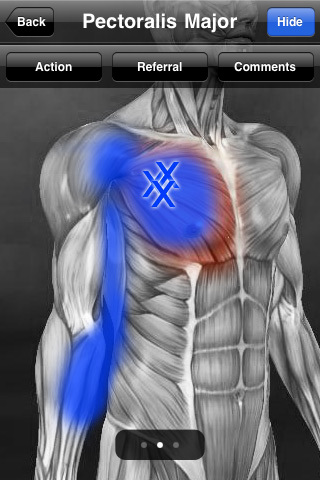
3) Muscle Trigger Points (iPod Touch / iPhone / iPad) (App store link here)

This App by Real Bodywork acts as a reference for common muscle trigger points. There is information on over 70 muscles and 100 different trigger point patterns, with information on the action of the relevant muscles and on the referral pain patterns. There is a 3D model which rotates in 2 animations to anterior and posterior images showing the different muscles, and muscles can be viewed individually from a list, or by choosing ‘zones.’ Real Bodywork provide a number of other anatomy Apps in addition to the Muscle Trigger Point App, including a ‘Learn Muscles’ App, a muscle and bone anatomy 3D for iPad, and skeletal anatomy 3D quiz and reference.

4) Instant Anatomy Lectures, Flash Cards, A/V Lectures and MCQ Apps (iPad / iPod Touch / iPhone / Android) (App store link here)

Robert Whitaker has been offering a number of excellent resources from his Instant Anatomy series for a number of years now. These originally started with books, going on to CD ROMs, and now a series of Apps. There are podcasts of anatomy lectures, video podcasts, and flash card Apps. This series of Apps offers some quite wonderful learning material, especially for the novice, and a great way to learn anatomy. The diagrams are easy to understand, although are more suited to learning than to explaining structures and pathology to patients. Some of the Apps are free on the App store, offered as ‘tasters’ with limited information, so you can try them out for yourself. Highly recommended for medical students and those re-engaging with anatomy after a while.

5) Aspects of Anatomy (iPad / iPod Touch / iPhone) (App store link here)

This App was developed by my one of my former anatomy teachers at University College, London, Professor Peter Abrahams, who is now Professor of Anatomy at Warwick University. He is also one author of the excellent ‘Essentials of Clinical Anatomy’ text. It consists of a series of 38 short (3-8 minute) lectures on a number of plastinated specimens, together with some related clinical information on related topics such as Colles fracture. In addition, imaging modalities are included, together with ‘spot’ quizzes (don’t I remember those during my Anatomy finals!) and clinically relevant MCQs. This is a wonderful resource for medical students and those revisiting anatomy.

CJSM would be interested to hear about your favourite Anatomy Apps, and how you use them in your clinical practice.

Cardiac screening of athletes with ECG – is it time to focus on the older athletic population?

Roy Shephard’s article in the May edition of CJSM , ‘Is Electrocardiogram Screening of North American Athletes Now Warranted?’ discusses the ongoing controversy of the appropriateness of the use of ECGs in screening College athletes for causes of sudden cardiac death. I’m wondering if it is now the time for us to focus our thoughts on ECG screening of the older athletic population.

My own awareness of the issues around ECG screening of athletes started some 20 years ago when I presented a session on ‘The Athlete’s Heart’ as part of my Physiology degree studies at University College, London. I remember being quizzed at the end of my presentation by the Course Tutor on the effects of detraining, and wishing that I had done a little more reading to back up my claims when I gave my answer stating that, as the adaptations to the normal heart were the result of normal physiological mechanisms, detraining should always result in changes to pre-training baseline on the ECG reflecting the anatomical and physiological detraining effects. His face at the time told me the story that he wasn’t entirely convinced, but I think I got away with it!

I have continued to revisit the issues and re-evaluate the evidence as my career in Sport and Exercise Medicine (SEM) has progressed. My first clinical experience of preparticipation screening came almost a decade ago whilst working in New Zealand when I was involved in providing care for New Zealand Academy of Sport athletes. Since then, another essay on the subject during my MSc SEM studies, teaching MSc and BSc students on an annual basis on ‘The Athlete’s Heart and Sudden Cardiac Death,’ and most recently conducting screening as part of the Football Association’s mandatory screening programme of young footballers, has kept me in touch with emerging research and clinical practice.

One thought has remained with me over the years – that of the importance of fundamental epidemiological principles such as Wilson’s criteria in screening, and linked to those, the need to consider what we are trying to achieve by screening . Essentially, the cardiac screening process seeks to identify individuals at an increased risk of sudden cardiac death. What we do not wish to do is to prevent healthy individuals from enjoying all of the benefits of sport and exercise. Sudden Cardiac Death in the young is still a rare event, mainly due to the underlying age-related population prevalence of associated conditions such as hypertrophic cardiomyopathy, but what about the older population?

The emerging importance of physical activity as an important, under-recognised independent risk factor for morbidity and mortality, often associated with lifestyle diseases such as type II diabetes mellitus, has led to an increasing global effort to engage the population in regular exercise as part of both primary and secondary disease prevention strategies. Whilst it is indisputable that the population benefits of exercise far outweigh the associated risks, it is nevertheless true that the risk of sudden cardiac death during exercise in the over 35’s is considerably higher than in the younger population due to the higher prevalence of associated conditions, mainly coronary heart disease.

ACSM guidelines and AHA risk stratification criteria for exercise testing and prescription offer clinicians guidance in the risk stratification of individuals who engage with healthcare professionals prior to becoming physically active, and point towards the appropriate use of ECG and Exercise Stress Testing as part of the preparticipation evaluation process. However, many individuals, including the older population who regularly exercise or those who may be about to commence regular exercise having been sedentary, will not come under the care of a healthcare professional. These individuals are therefore unlikely to participate in cardiac screening programmes.

Many questions about population cardiac screening prior to participation in sport and exercise come to mind, including :

1) What is the risk / benefit ratio and cost effectiveness of the adoption of ECG screening and exercise stress testing as per ACSM and AHA guidelines on a population basis for those wishing to engage in exercise?

2) How regularly should ECG screening and cardiac stress testing as part of preparticipation evaluation on an ongoing basis be conducted in the older athletic population?

3) What is the best and most appropriate way to engage older individuals involved in exercising, or about to become physically active, in order to conduct screening?

4) Should we be adopting targeted screening including ECG and cardiac stress testing in the older population who are involved in regular exercise?

My greatest concern is for the safety of the older, sedentary individual who decides to take up the sport they previously played perhaps 20 years ago at College, or perhaps who wishes to participate in a 10K run for a local charity, and who does not seek appropriate healthcare advice prior to increasing their physical activity levels.

Should we be focussing our efforts more at population level on screening these older individuals when attempting to prevent sudden cardiac death related to exercise?