Repeated heading of the ball in soccer – is there a link to brain injury?
December 11, 2011 2 Comments
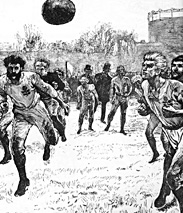 Another day, another article related to concussion and head injury in sport in the New York Times – this time, concerning a possible link between repeated heading of the ball in soccer and brain damage.
The article, ‘A new worry for soccer parents – heading the ball’ highlighted some new research recently presented at the Conference of the Radiological Society of North America.
Michael Lipton, associate director of the Gruss Magnetic Resonance Research Center at the Albert Einstein College of Medicine and medical director of MRI services at Montefiore Medical Center in New York, together with colleagues used diffusion tensor imaging (DTI) to study the effects of repeated heading of the ball in soccer, and found that players who repeatedly head the ball with a high frequency had brain abnormalities on scanning similar to patients with traumatic brain injury.
DTI was used to examine for areas of fractional anisotropy (FA) in the white matter of the subjects, which is thought to have a relation to healthy brain tissue – healthy white matter having a relatively high FA.
Dr Lipton and colleagues used DTI on 32 amateur soccer players who had played the sport since childhood, and estimated how often each player headed the ball on an annual basis based on a standardised questionnaire. They then ranked players based on estimated heading frequency.
The researchers went on to compare brain images of the players estimated to have executed the most frequent headers with those of the remaining players, and identified areas of the brain where FA values differed significantly in certain ‘regions of interest’ (ROI) in the brain responsible for attention, memory, executive functioning and higher-order visual functions.
Using statistical analysis, Lipton and colleagues found that greater heading frequency was associated with low FA. They concluded that exceeding a threshold for heading frequency (1000-1500) may result in brain abnormalities similar to those seen in TBI, and went on to suggest that ‘the exposure threshold we identify suggests public health interventions to minimize excess exposure and, thereby, the adverse outcomes.’
Critics of the study may wish to point out the possible issues of recall bias, plus possible errors in the estimates of frequency of heading and statistical analysis as weaknesses of the study.
For those who wish to read more, there is a great summary of the study on the Radiological Society of North America website. This includes links to video footage of Dr Lipton himself describing the study and related issues, together with the views of a participant in the study.
There have been other studies of heading in soccer related to brain injury, but most of these have been subject to methodological flaws making it difficult to draw conclusions. In addition, some studies have included subjects from the days before the modern soccer balls were used, when leather balls could weight considerably more and especially when wet.
Zetterberg and colleagues examined biomarkers for neuronal injury collected by lumbar puncture following repeated headings in a training session and found no significant changes in neurofilament light protein, total tau, glial fibrillary acidic protein, and albumin concentrations 7-10 days after the repeated headings, with only a mild elevation of CFS S-100B concentration. They concluded that repeated low-severity head impacts due to heading in soccer are not associated with neurochemical signs of brain injury.
Cognitive deficits have been associated with repeated headings in football by some authors such as Tysvaer, although others such as Janda and colleagues who studied a youth population found no abnormalities in cognitive function other than difficulty in learning new words.
The debate about heading in soccer and its correlation with brain injury seems set to rage on into the future.
In the meantime, what should we tell concerned parents requesting medical advice about the issue? Where do YOU stand on this? CJSM would like to know.
References :
(Image – England v Scotland 1872 at The Oval, London at Wikimedia commons)

Leave a Comment





 Clinical Journal of Sport Medicine Blog