July 22, 2012
by Chris Hughes
 Many of our blog readers will be familiar with the widely read text published by Lippincott Williams and Wilkins and produced in partnership with the American Medical Society for Sports Medicine (AMSSM), the 5-Minute Sports Medicine Consult, which is now in it’s second edition.
First published in 1991, the book consists of a wide range of topics relevant to Sports Medicine, arranged in alphabetical order for easy reference. The topics are presented in a structured fashion, with similar headings for each topic. These include the Basics which consist of descriptions, epidemiology, etiology, and commonly-associated conditions. Diagnosis follows on from Basics, with history, physical examination findings, diagnostic tests and differential diagnosis. Treatment and ongoing care are then presented, and finally there is a list of additional reading and references for each topic together with ICD9 and 10 codes where relevant, and clinical pearls, with the topic authors listed at the end.
Whilst the hard copy version is a great resource, it is a large text and not practical to take to locations outside of the consulting room. Recently, a kindle edition became available which is a straight copy of the text in the book. Now we have the launch of the electronic version of the text for iOS devices on the Apple App store, including the iPhone and iPad, this information is available to the Sports Physician on the go, and the app offers a whole deal more for users than either the hard copy or the kindle edition.
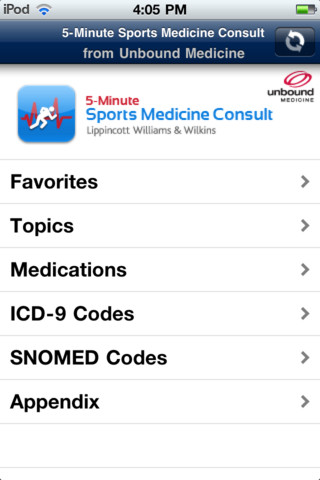
The startup interface includes links to favourite topics, with all of the topics arranged alphabetically as in the print version.  In addition, there are links to medications, ICD-9 codes, SNOMED codes, and 3 separate appendices including musculoskeletal radiography, office rehabilitation, and joint and soft tissue injection.
The entire text of the book is available offline. Individual topics are presented as in the book, with additional features including links to citations on Medline for each reference which makes it easy for the reader to go straight to the abstracts, although this features does require an active Wi-Fi or 3G connection to work.
Where radiological plates and illustrations are included in the source text, these can be seen in the text and figures can be selected and magnified for easy viewing which makes a great improvement on the viewing size of the graphics as seen in the textbook version. The x-rays in particular are very clear when magnified, and this feature is well implemented.
Over 280 separate topics are presented in the text, including over 20 new chapters since the publication of the first edition. Topics are varied, and range from athlete heart syndrome and several bone fractures through to medical disorders including menstrual disorders in the athlete, pericarditis and onychomycosis. Particularly useful are the clinical pearls offered at the end of many of the clinical topics which give useful hints and tips for clinical management of cases.
Each topic can be put into a personal list of favourites by highlighting a ‘star’ tab, for easy reference afterwards of those topics you might want to look at on a regular basis.
The topics are mostly up-to-date, although there are some notable omissions of some reference material that would have been useful to include such as the SCAT2 criteria for assessment of concussion, although these are clearly referenced in the text. in addition, there are a few personal bug-bears such as achilles tendinitis being presented as a topic where the use of the term ‘tendinopathy’ might have been more appropriate, omission of the importance of recognising enthesopathies as possible associations with rheumatological conditions as seen in the entry for plantar fasciitis, and no mention of MRI as a useful investigation for thigh adductor injuries. However, these are minor points and to some extent of personal preference.
The medications tab takes you straight to articles where the relevant medication is listed in the main text. Where a medication is mentioned in several articles, these are all listed with direct links to the relevant article, although one has to read the whole article to find out exactly where the medication is mentioned within the text. ICD-9 and SNOMED code tabs likewise take the reader to the start of the relevant articles where these codes are referenced in the main text.
The appendices of the main text are included in full, together with all their images. Appendix A, Musculoskeletal radiography, contains general tips on ordering x-ray investigations, and is arranged in a regional format with a wide range of different x-ray plates on show. Again, the selection and magnification feature works particularly well here. Unfortunately, there are no other imaging modalities included such as ultrasound, CT, or MRI.
Appendix B, Office Rehabilitation, contains 7 different topics including hamstring strain, patella femoral pain syndrome, ankle sprains, shin splints, plantar fasciitis, rotator cuff tendinitis, and epicondylitis. The articles are written for patients, and useful illustrations are included including exercises and stretches. A useful feature would be able to print out these topics for patients.
 The final Appendix focuses on Joint and Soft Tissue Injections, and includes detailed information for the use of soft tissue injections for a wide number of specific indications. Information includes indications for injection, detailed regional anatomy with illustrations, supplies and techniques of injection, and aftercare and is very comprehensive. CPT Codes are also included for reference.
Perhaps the crucial feature that gives a big advantage over the text is the updating tab – this imports regular updates of the text via the web, and ensures that the topic information should be kept up to date.
All in all, this is a well-implemented iOS version of a valued textbook, and I’m sure that many of you will be delighted to have it available to you on the go. It will be of use to clinicians studying for board exams in Sports Medicine who want a focused yet comprehensive summary of a particular topic, and to more senior clinicians who may wish to update themselves on particular topics. Future developments for the iOS version might include the incorporation of other radiological imaging modalities such as MRI, the use of colour images, and perhaps videos of joint injection techniques. The price on the App store compares well with the cost of the hard copy and kindle versions, and with the extra features and regular updates, this one looks a winner all the way.
The 5-Minute Sports Medicine Consult app is available now on the Apple App store for $94.99