Neuropsychological tests in sport-related concussion – are they worthwhile?

The article by Shrier in the current edition of CJSM revisits the issue of neuropsychological testing in the setting of sport-related concussion, and poses some searching questions in relation to the use of these tools in the diagnosis and management of sport-related concussion. In particular, he asks ‘…do the results of neuropsychological testing change patient management or provide other clinical benefit to the patient?’ and ‘Is there sufficient evidence to mandate it (neuropsychological testing) as standard of medical care?’ (Shrier, 2012).

Whilst it is clear that sport-related concussion is a hot topic in Sports Medicine, with an ever-increasing literature on the subject, and following three expert consensus panellist group meetings since 2001, controversy surrounding the diagnosis, management, and return to play protocols continues to rage amongst academics and clinicians alike.

In his article, Shrier concentrates on the application of neuropsychological tests to the sport-related concussion setting. Whilst it is accepted that neuropsychological tests alone are not adequate to confirm the diagnosis and dictate the ongoing management of concussion, they are currently widely used in the rehabilitation and return-to-play setting as a part of an overall neuropsychological assessment for players in elite sport suffering from a concussion – especially in hockey, and college football.

Shrier points out that neuropsychological tests are designed to give an objective assessment of brain function, but that ‘the objective in concussion management is to measure brain injury’ and points out that ‘brain injury is only one cause of decreased brain function,’ mentioning that there are several other factors that may affect brain function such as the presence or absence of other injuries or mood disorders (Shrier, 2012). The author does not point out exactly when he means by ‘brain function,’ however, nor discusses in detail any of the other multidimensional tools that may be used to assess this such as EEG and fMRI.

There are clearly limitations in using neuropsychological tests in the setting of sports-related concussion related to the issues Shrier points out in his article. However, it is important to remember that it is the application of these tests in the overall clinical context that perhaps assists the practitioner in making an informed and reasoned judgement as to whether impairment in brain function is likely to be secondary to concussion.

Further on in the article, Shrier goes on to argue that neuropsychological tests have ‘minimal value for an individual athlete and does not support mandating (their) use,’ (Shrier, 2012) and then examines the arguments for using the tests related to asymptomatic athletes at rest, athletes who are asymptomatic at rest but symptomatic on exertion, and athletes who are asymptomatic on exertion.

Whilst there is still academic debate surrounding the clinical usefulness of neuropsychological tests in the setting of sport-related concussions, doubt must also be levelled at their applicability and cost-effectiveness, a point also argued by Shrier in his conclusion. He also mentions that there are not enough neuropsychologists with appropriate expertise available to be able to warrant mandatory neuropsychological testing on a population level for them to be considered as standard of care, which is certainly true.

In his conclusion, Shrier argues that ‘NP testing provides only a small increase in prognostic information and does not change the management of athletes who are symptomatic at rest or with exercise,’ and points out that ‘There is no evidence that abnormal NP testing is associated with increased risk of further injury or delayed recovery in athletes who are asymptomatic at rest and exertion.’ (Shrier, 2012). 

The Concussion in Sport group, however,  in their last consensus statement mentioned that ‘the application of neuropsychological testing in concussion has been shown to be of clinical value and continues to contribute significant information in concussion evaluation.’ (McCrory et al, 2009).

No doubt Shrier’s article will fuel much continuing academic debate on the use of neuropsychological tests in the setting of sport-related concussion.

Are you using these tests as part of your overall concussion management programme?

CJSM would like to hear your thoughts on the debate.

References

1) Shrier i. 2012. Neuropsychological testing and Concussions: A Reasoned Approach. CJSM 22(3): 211-213

2) McCrory  P et al. 2009. Consensus Statement on Concussion in Sport 3rd International Conference on Concussion in Sport Held in Zurich, November 2008. CJSM 19(3): 185-200

Leave a Comment

Leave a Comment

Time for a break? Competition over the Christmas and New Year period

And so we have reached the Christmas and New Year break, with good-will on offer to one and all. For many of us, this is a time to get away from work – to spend quality time with our family and friends, and to take a breather from the every-day grind of the nine-’til-five. Perhaps some of us will be indulging a little more than usual by way of food, drink and merry-making.

This is, however, not the case for many of those involved in Sport including the athletes themselves and their numerous support staff. In fact, this is often one of the busiest times of the year for those involved in Professional sport, and the fixture calendar can be particularly crowded as the National sporting bodies and Leagues cram in the fixtures, perhaps in order to secure large crowds of seasonal fans and lucrative television rights.

Some sports participants enjoy a break at this time of year, whilst others are perhaps not so fortunate. For example, in the German Football Bundersliga, teams enjoy a four-week period during which the players can take a breather. It is true to say that some teams decide to fly overseas to train and compete in non-league tournaments during this period in order to maintain their in-season fitness, and some players also fly off to take part in National tournaments on other continents, but some teams certainly allow their players time off to spend with their friends and families citing the importance of rest and recouperation for both physical and psychological recovery.

There have been almost annual calls for a winter break for teams in the English Football League for the last few decades, with some managers and players stating that the demands of the football season, together with matches played during the summer period in competitions such as the World Cup and the European Championships, effectively mean that some players have very little time in which to recover and that this leads to adverse physical and psychological consequences for those players together with negative effects on the performance of National teams playing in the summer period and club sides.

Requests for winter breaks in football in the UK have been increasing over the last few seasons, and regional officials and organisations have tended to put the blame for the players’ busy schedules firmly at the door of FIFA and UEFA.

The latest calls for time off during the Christmas and New Year period here in the UK come from former England Manager Sven Goran-Eriksson, the new Sunderland Manager, Martin O’Neill, League One Football Manager Gus Poyet at Brighton, and Wolverhampton Wanderers midfielder Stephen Hunt. However, others are not in agreement with this strategy including Arsenal’s German defender Per Mertesacker who seems to prefer playing in the UK whilst his German footballing colleagues are enjoying some time off back in Germany at this time.

Arguments for the Christmas and New Year break include the following:

  • Allow for physical recovery
  • Allow for ‘psychological recovery’ and protect against adverse psychological effects of stress during the season / travel etc
  • Injury prevention (possibly linked to adverse weather conditions and hard grounds)
  • Improve overall performance over the season

There is a paucity of evidence on which to make these arguments, however.

Looking in greater detail at just one of these arguments, injury prevention, the evidence to support this has been somewhat conflicting. Although I could find nothing in the literature on the effect of a winter break on injury incidence, one might wish to extrapolate from research looking at the incidence of injuries occurring at different times of the season.

In a study published in the British Journal of Sports Medicine in 1998 on the effect of seasonal change in rugby league on the incidence of injury, an increased incidence of injury in summer was demonstrated, and in another prospective study published in the American Journal of Sport Medicine of injury incidence amongst players of one rugby league club over a nine season period, injury risk was found to have greatly increased as a result of changing the playing calendar from the winter months to the spring and summer period.

A study published in 2007 in the British Journal of Sports Medicine on the association of ground hardness with injuries in rugby union showed a seasonal change in ground hardness and an early season bias of injuries.

Orchard discussed the relationship between ground and climactic conditions and injuries in different codes of football, including soccer, rugby league rugby union, American football, Australian football and Gaelic football in 2002, and found an early-season bias for injuries to the lower limb. He concluded that variations in playing characteristics were likely to account for the patterns seen.

I could find nothing in the literature specifically relating to research on the proposed positive effects of a winter break on psychological factors such as mood profiles etc

Should we be offering our players and teams a mid-winter break, and if so, on the basis of which argument(s)?

CJSM would like to hear your thoughts.

In the meantime, all of us at CJSM would like to wish our blog readers a very happy Christmas and New Year, and we devote this blog post to all those who are working with teams over the Christmas and New Year period.

Leave a Comment

Leave a Comment

Injury risks of artificial turf in soccer

Ever since Astroturf was first installed at the Houston Astrodome back in the 1960’s, there has been much controversy about the use of artifical grass playing surfaces used in a number of different sports. The main issues relate both to ‘playability’ and the way that the surface properties affect playing dynamics, and to the risk of injuries occuring on artificial surfaces.

Despite this controversy, artificial surfaces have been used in a wide range of different sports and in some famous venues. In American Football, for example, the New England Patriots and the New England Revolution share an artificial playing surface at the Gillette stadium, whilst most field hockey games these days are played on an artificial surface.

In the UK, I vividly remember the early artificial surfaces used in football back in the 1980’s, when many teams dreaded the trip to Queens Park Rangers, Luton Town, Oldham Athletic and Preston North End on account of their ‘plastic pitches.’ At the time, most of the pitches were derided by football fans due a combination of their poor playability and recurrent carpet-burn injuries sustained by the players and they lost favour quickly.

I was therefore somewhat surprised to read on the BBC sport website that there are moves afoot for a return to the use of artificial turf in the Football League, headed by Wycombe Wanderers and Accrington Stanley. My interest was all the more galvanised by the fact that Wycombe play in the same league as the team that I look after, Leyton Orient. From the Clubs’ point of view, the argument for installing an artificial playing surface centres on economics, with artificial pitches being much easier to maintain than grass. In addition, it is easy to host other events at stadia with an artificial surface such as pop concerts and other social events. There are independent advocates both for the use of artificial surfaces in soccer, and against their use.

As a team physician, my immediate thoughts turned to the risks of injury when playing on artificial playing surfaces. There is no doubt that there has been an evolution of the quality of playing surfaces over the years. Astroturf, developed back in the 1960’s, was known for it’s somewhat abrasive properties, and the risk of ‘carpet burn’ injuries was all-too-apparent to anyone who dared to perform a slide tackle or similar manouvre on the surface. These were not the only injuries of concern on early artificial surfaces, and there were plenty of papers in the literature that reported an increased risk of other injuries on artificial playing surfaces (see Ekstrand & Nigg, 1989 ; Girard et al, 2007 ; & Steele & Milburn, 1988).

However, the modern third and fourth generation pitches are very different in construction and often promoted as possessing the same properties and injury-risk profiles as grass. For example, Dragoo and Braun reported that the overall injury rate on the new surfaces is comparable to that seen on natural pitches.

Therefore, it was with interest that I read a new review article by Williams and colleagues published in Sports Medicine in November 2011 of football injuries on third and fourth generation artificial turfs compared with natural turf.

The authors performed a literature search using Cochrane Collaboration review methodology to evaluate injury characteristics and risk factors for injury on artificial turfs compared with natural grass turf over a range of ‘football’ codes including Rugby Union, Soccer and American Football. The outcome measure used to assess each included study was the incidence rate ratio for injuries on natural and artificial turf, calculated using natural turf as the reference.

The authors found an increased incidence of ankle injury playing on artificial turf in 8 cohorts, although injury risk for knee injuries was inconsistent. There seemed to be a trend towards less muscle injuries playing on artificial turf compared with natural turf. There was, however, no data on head injuries and concussion.They concluded that their included studies showed a trivial difference in injury rates between third and fourth generation artificial turf when compared with natural turf. Limitations of the study were accepted, including the need for longitudinal prospective cohort studies including an adequate number of teams, and controlling for confounding factors such as weather and gender etc, and I think that there were indeed a number of important limitations of the study such that it is perhaps difficult to draw conclusions based on the evidence we have.

For me, the jury’s still out on the issue of injury risk with the newer artificial playing surfaces, but the traditionalist in me still thinks that soccer was meant to be played on a natural surface. Even if the risk of injury is, in time, proved to be no greater on an artificial surface, having watched soccer played on 3rd generation pitches and having played on them myself, I can say that from my point of view it never really looks or feels the same.

What do our readers think?

Should we entertain an expansion of artificial playing surfaces? If so, should that be just within specific sports? How do you think that we should assess injury risk on these surfaces and do you think that the effects seen would be different in different sports?

CJSM would like to hear your thoughts.

References :

Ekstrand J, Nigg BM. 1989. Surface-related injuries in soccer. Sport Med 8(1):56-62

Girard O et al. 2007. Effects of playing surface on plantar pressures and potential injuries in tennis. Br. J. Sp. Med. 41(11):733-8

Steele JR & Milburn PD. 1988. Effect of different synthetic sport surfaces on ground reaction forces at landing in netball. J. Sport. Biomech. 4(2):130-45

Dragoo JL & Braun HJ. 2010. The effect of playing surface on injury rate :a review of the current literature. Sport Med. 40(11):981-990

Williams S, Hume PA & Kara S. 2011. A Review of Football Injuries on Third and Fourth Generation Artificial Turfs Compared with Natural Turf. Sports Med. 41(11):903-923

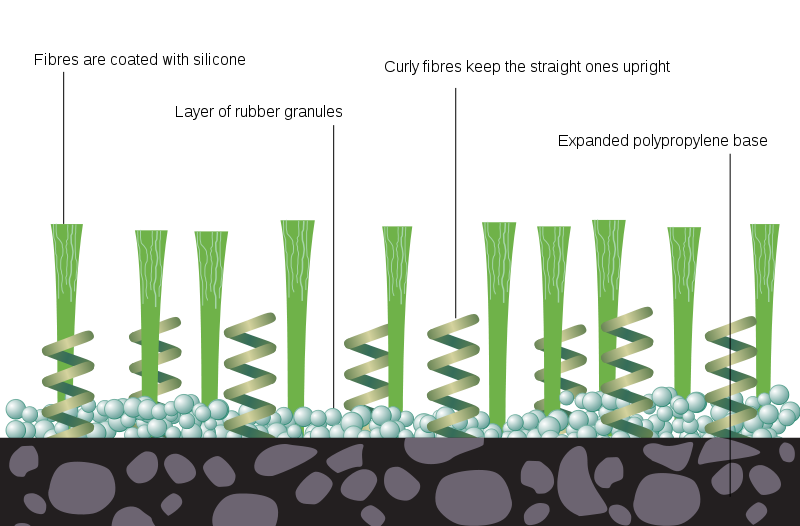
(Images of (1) modern artifical turf diagrammatic, (2) side view of artificial turf, and (3) Aspmyra, Norway taken from Wikimedia)