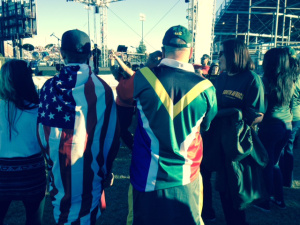
South Africa — here we come

FullSizeRender

The flags of the USA & RSA: South Africa, here we come!

It’s Monday, and in a busy American football season that means a clinic full of Friday’s injuries.  Some interesting stuff came my way today, including a jersey finger, an angulated 1st metacarpal fracture which needed a closed reduction, and an OCD lesion of the knee in a youth.

When not focused on those clinical encounters, I find my mind straying elsewhere, as 10 days from now I will join a couple of other folks from the American Medical Society for Sports Medicine (AMSSM) for a 2+ week tour of the sports medicine scene in South Africa. Dr. Doug McKeag, a former president of AMSSM,  Dr. Alison Brooks and I will be the AMSSM ‘travelling fellows’ heading out on this tour.  Our hosts there will include Jon Patricios, Phatho Zondi and Piere Viviers, among others, of the South African Sports Medicine Association (SASMA), and we’ll be culminating the trip with a visit to the 16th biennial congress of SASMA taking place 20 – 22 October in Johannesburg.

South Africa has a powerfully strong sports culture, which I’ve witnessed first hand when I last travelled to that beautiful country 20+ years ago.  I think of the great rugby and cricket teams the country has fielded [the former battling in the Rugby World Cup right now].   I think of the dominant golfers, Gary Player, Ernie Els, and a new generation headed by Louis Oosthuizen and others. And who could leave out mention of one of the premier ultramarathons on the planet, the Comrades Marathon, or the cause celebre of Caster Semenya.

The country has fielded an equally powerful team of sports medicine physicians and researchers over the years, many of whom have graced the journal pages and other media of CJSM.  I think of Tim Noakes & Jon Patricios.  I think of the research on hyponatremia and exercise-associated muscle cramping and more.

1200px-Cloud_and_Table_Mountain

Table Mountain & its table cloth– we’ll be there soon. Photo: courtesy of Shizhao

As we AMSSM fellows travel from Cape Town, to Pretoria and Johannesburg, we’ll be telling our stories on this blog and on social media.  If you’re on Twitter or Instagram, be sure to follow the hashtag #AMSSMTravellingFellows as Drs. Brooks, McKeag and I share our stories and our pictures.  SASMA2015 will have a bevy of the world’s ‘top dogs’ in the sports medicine world.  Folks like Drs. Lyle Micheli, Jonathan Drezner, Cindy Chang, and Karim Khan will be speaking at SASMA2015, and we’ll profile what they have to say on hot topics in the world of sports medicine.

I’m off to pack.  I can’t wait to get to the land of the Springboks and Proteas, of Table Mountain and the Witwatersrand.  More soon!

The Controversy Over Grass

madison plains

Where Pigskin Meets Grass

To be clear, my topic today is NOT a survey of what cannabis legalization has wrought in states like Washington or Colorado [as an aside, in our own little corner of the USA the question of legalization will be on the ballot in Ohio this fall].

The grasses we’re discussing are ‘Bermuda,’ ‘Fescue,’ ‘Bluegrass’ and the like.

And the question today is not whether ‘the Dude abides’ [he most certainly does], but is this: which is the safer surface on which to play sport, grass or turf?

The subject came to mind after reading about a recent kerfuffle in the NFL.  The Houston Texans have played on a specially designed grass surface over the years. This season, they are switching to turf in response to concerns voiced about the field quality by opponents such as the Kansas City Chiefs.  In the NFL, in this season for this stadium, there’s a push toward turf.

On the other hand, readers may remember the controversy that raged much of this year regarding the use of turf [as opposed to grass] for the FIFA Women’s World Cup. And that ‘other’ world cup, Rugby World Cup 2015, is taking place right now in England, with  Twickenham Stadium and its grass pitch as that event’s centerpiece.

Grass vs. turf?  The perennial question.  Looking at it solely from the perspective of injury prevention [as opposed to factors such as sports performance or maintenance costs], we have looked at this question from time to time in the blog and in the journal.

For instance, this summer, in the July 2015 CJSM, O’Kane et al. published their timely findings looking into shoe wear and surface type on injury rates in female youth soccer players.  They found that a grass surface and wearing cleats on grass raised rates of lower extremity injuries; they concluded: “When considering playing surfaces for training, communities and soccer organizations should consider the third-generation artificial turf a safe alternative to grass.” Something to consider in this population and this sport and a countervailing argument to the push for grass in future iterations of the Women’s World Cup? Perhaps.  Or might that be too great of a generalization, extrapolating from the youth to the elite sport level?  Very likely.

What about you: your thoughts on this matter?  Taken purely from the perspective of sporting safety and injury prevention, what are your thoughts, your read of the medical literature?  Grass vs. Turf:  which is safer?  Does the sport matter?  Does the level of play matter?

Tell us in the poll!


Rugby World Cup 2015: “All In”

Wallabies_vs_Springboks_lineout

Wallabies vs. Springboks: a potential fixture in #RWC2015 England Follow @CJSMOnLine during the World Cup to find out more.

The Rugby World Cup begins tomorrow in England, and I, like many others around the world, have been looking forward to this day for some time. It’s been on my mind at least since this blog post [‘Rugby’s Big Year(s)’], which I am republishing today.

Interest in the sport continues to grow here in the United States.  This interest is growing both in its own right–an awareness of the special excitement of rugby– and it is growing as there is increasing awareness of the sport’s impact on the broader world of football in general.  Rugby played midwife to American football, so to speak. The familial bond is still present: Jarryd Hayne, an Australian rugby player, just made his debut in an NFL regular season game; and the Wall Street Journal published an intriguing story today on the ‘thing or two’ that American football might learn from its mother sport.

I’ve written frequently on the sport in the pages of this blog, and the journal has published just as frequently on the subject.  And so we are ‘all in’ for the World Cup over the next six weeks.  Expect timely, topical posts on the sport medicine issues that arise as the games begin.

Among the other twitter feeds I’ll be following (and you should too):  @RugbyWorldCup (the official RWC2015 twitter feed); @WorldRugby (the official governing body of the sport, formerly known as the ‘IRB’); @Sharief_H (aka ‘Rugby Science); and @RugbySciNetwork (Rugby Science Network or ‘RSN’).  RSN is actually having an international conference on the sport and associated sport medicine, in Cape Town, and following the hashtag #RSN2015 will bring you a wealth of valuable information.

I’ll be travelling through South Africa and visiting Cape Town myself during the tournament, and so I’ll be sure to follow @Springboks as well.  Who knows, maybe I’ll be following a winner?  Or will it be the Pumas?  The All Blacks?  The Wallabies? Maybe the USA, ranked 15th in the world, will pull off the mother of all upsets?

We will find out at the end of October!

sportingjim's avatarClinical Journal of Sport Medicine Blog

IMG_1008 Sam Boyd Stadium, Las Vegas Nevada, site of the annual Rugby 7s tournament.

It’s amazing how time flies.  How is it already March?

It’s almost 7 p.m. and I’m writing by the light of a sun that is still above the horizon, thanks to one of my favorite inventions of the modern world: daylight savings time, which arrived last night.

This realization is a personal reminder, however, that I have been delinquent: meaning to write a blog post about an event that took place three weeks ago…..but, my oh my, business has just swamped me, I guess.

As the swallows return annually to San Juan Capistrano, so do the Rugby 7 squads of Kenya, South Africa, New Zealand and other countries come each February to the desert:  Las Vegas hosted the USA leg of the HSBC Sevens Series Feb 13 – 15.  It is the largest annual…

View original post 534 more words

CJSM Podcast 11: The Wilderness Medicine Issue

JSM-Podcast-BG (1)We’ve been working on the September 2015 CJSM issue for a long time–and by ‘we’ I mean a team of individuals, ranging from the CJSM editors to authors and thematic issue editors from the American Medical Society for Sports Medicine (AMSSM) and the Wilderness Medical Society.

chris madden

Dr. Chris Madden in his ‘office.’

Our guest for this, our 11th podcast, is Dr. Christopher Madden, a past president of the AMSSM and one of this issue’s editors (and an author too).  Dr. Madden is a hard-working clinician at Longs Peak Family Medicine, and practices the full range of family and sports medicine.

In between circumcisions, vasectomies, concussions, and mountain bike rides, he was able to find that ‘sweet spot’ to sit and talk with us for a little bit about the newly published Wilderness Medicine thematic issue.

We covered an array of topics–from diagnosing acute mountain sickness in pre-verbal children to the top 3 most memorable parts of his year as AMSSM president.

We enjoyed the chat, and we hope you do too.  Check it out here.