ACSM Annual Meeting in Indianapolis

Dan_Gurney_&_Crosthwaite

Vintage Indy 500: Dan Gurney

Indianapolis:  home of the Indy 500, that just took place last Sunday, and this week home of the 60th Annual Meeting of the American College of Sports Medicine (ACSM).

I’ve already enjoyed a couple of great days here, and I wanted to share some of the high points.

First, I attended a session on exercise therapy and youth, cleverly entitled, “Linking Health Care with Fitness Care in Youth to Prevent Generation XXL.”  The session was organized as a series of talks given as part of ACSM 2013 and the concurrently run 4th World Congress on Exercise is Medicine.  Among the speakers was Avery Faigenbaum, EdD, a professor of pediatric exercise science whom I have heard speak on several occasions over the years.

He is always a scintillating speaker.  Much of his work over the years has involved demonstrating the safety and effectiveness of resistance training in youth.  His talk here  as part of this session took on a different subject:   “Exercise Deficit Disorder in Youth:  Challenging Traditional Dogma.”  If you have not heard of “Exercise Deficit Disorder” (EDD) before, you will be hearing more about it in the future.

Read more of this post

Consensus Statement on Concussion in Sport – the 4th International Conference on Concussion in Sport. Video introduction by Dr Willem Meeuwisse

Following on from the AMSSM Position Statement on Concussion in Sport published in the last edition of CJSM, this month sees the publication of the latest Consensus Statement on Concussion in Sport from the 4th International Conference on Concussion in Sport held in Zurich in November 2012.

The 4th Statement takes into account the most up-to-date research on the topic of concussion in sport, and is accompanied by the new Sports Concussion Assessment Tool (SCAT3), Child SCAT, and the Concussion Recognition Tool (CRT) for patients and parents. Printable copies of the new tools can be downloaded via the links provided on the CJSM website.

In this video, Concussion in Sport Group Member Dr Willem Meeuwisse, former Editor-in-Chief of the Clinical Journal of Sport Medicine, presents an introduction to the new statement and discusses the main new features therein including the new SCAT3, child SCAT3 and Concussion Recognition tools.

Leave a Comment

Leave a Comment

Neuropsychological tests in sport-related concussion – are they worthwhile?

The article by Shrier in the current edition of CJSM revisits the issue of neuropsychological testing in the setting of sport-related concussion, and poses some searching questions in relation to the use of these tools in the diagnosis and management of sport-related concussion. In particular, he asks ‘…do the results of neuropsychological testing change patient management or provide other clinical benefit to the patient?’ and ‘Is there sufficient evidence to mandate it (neuropsychological testing) as standard of medical care?’ (Shrier, 2012).

Whilst it is clear that sport-related concussion is a hot topic in Sports Medicine, with an ever-increasing literature on the subject, and following three expert consensus panellist group meetings since 2001, controversy surrounding the diagnosis, management, and return to play protocols continues to rage amongst academics and clinicians alike.

In his article, Shrier concentrates on the application of neuropsychological tests to the sport-related concussion setting. Whilst it is accepted that neuropsychological tests alone are not adequate to confirm the diagnosis and dictate the ongoing management of concussion, they are currently widely used in the rehabilitation and return-to-play setting as a part of an overall neuropsychological assessment for players in elite sport suffering from a concussion – especially in hockey, and college football.

Shrier points out that neuropsychological tests are designed to give an objective assessment of brain function, but that ‘the objective in concussion management is to measure brain injury’ and points out that ‘brain injury is only one cause of decreased brain function,’ mentioning that there are several other factors that may affect brain function such as the presence or absence of other injuries or mood disorders (Shrier, 2012). The author does not point out exactly when he means by ‘brain function,’ however, nor discusses in detail any of the other multidimensional tools that may be used to assess this such as EEG and fMRI.

There are clearly limitations in using neuropsychological tests in the setting of sports-related concussion related to the issues Shrier points out in his article. However, it is important to remember that it is the application of these tests in the overall clinical context that perhaps assists the practitioner in making an informed and reasoned judgement as to whether impairment in brain function is likely to be secondary to concussion.

Further on in the article, Shrier goes on to argue that neuropsychological tests have ‘minimal value for an individual athlete and does not support mandating (their) use,’ (Shrier, 2012) and then examines the arguments for using the tests related to asymptomatic athletes at rest, athletes who are asymptomatic at rest but symptomatic on exertion, and athletes who are asymptomatic on exertion.

Whilst there is still academic debate surrounding the clinical usefulness of neuropsychological tests in the setting of sport-related concussions, doubt must also be levelled at their applicability and cost-effectiveness, a point also argued by Shrier in his conclusion. He also mentions that there are not enough neuropsychologists with appropriate expertise available to be able to warrant mandatory neuropsychological testing on a population level for them to be considered as standard of care, which is certainly true.

In his conclusion, Shrier argues that ‘NP testing provides only a small increase in prognostic information and does not change the management of athletes who are symptomatic at rest or with exercise,’ and points out that ‘There is no evidence that abnormal NP testing is associated with increased risk of further injury or delayed recovery in athletes who are asymptomatic at rest and exertion.’ (Shrier, 2012). 

The Concussion in Sport group, however,  in their last consensus statement mentioned that ‘the application of neuropsychological testing in concussion has been shown to be of clinical value and continues to contribute significant information in concussion evaluation.’ (McCrory et al, 2009).

No doubt Shrier’s article will fuel much continuing academic debate on the use of neuropsychological tests in the setting of sport-related concussion.

Are you using these tests as part of your overall concussion management programme?

CJSM would like to hear your thoughts on the debate.

References

1) Shrier i. 2012. Neuropsychological testing and Concussions: A Reasoned Approach. CJSM 22(3): 211-213

2) McCrory  P et al. 2009. Consensus Statement on Concussion in Sport 3rd International Conference on Concussion in Sport Held in Zurich, November 2008. CJSM 19(3): 185-200

Leave a Comment

Leave a Comment

Repeated heading of the ball in soccer – is there a link to brain injury?

Another day, another article related to concussion and head injury in sport in the New York Times – this time, concerning a possible link between repeated heading of the ball in soccer and brain damage.

The article, ‘A new worry for soccer parents – heading the ball’ highlighted some new research recently presented at the Conference of the Radiological Society of North America.

Michael Lipton, associate director of the Gruss Magnetic Resonance Research Center at the Albert Einstein College of Medicine and medical director of MRI services at Montefiore Medical Center in New York, together with colleagues used diffusion tensor imaging (DTI) to study the effects of repeated heading of the ball in soccer, and found that players who repeatedly head the ball with a high frequency had brain abnormalities on scanning similar to patients with traumatic brain injury.

DTI was used to examine for areas of fractional anisotropy (FA) in the white matter of the subjects, which is thought to have a relation to healthy brain tissue – healthy white matter having a relatively high FA.

Dr Lipton and colleagues used DTI on 32 amateur soccer players who had played the sport since childhood, and estimated how often each player headed the ball on an annual basis based on a standardised questionnaire. They then ranked players based on estimated heading frequency.

The researchers went on to compare brain images of the players estimated to have executed the most frequent headers with those of the remaining players, and identified areas of the brain where FA values differed significantly in certain ‘regions of interest’ (ROI) in the brain responsible for attention, memory, executive functioning and higher-order visual functions.

Using statistical analysis, Lipton and colleagues found that greater heading frequency was associated with low FA. They concluded that exceeding a threshold for heading frequency (1000-1500) may result in brain abnormalities similar to those seen in TBI, and went on to suggest that ‘the exposure threshold we identify suggests public health interventions to minimize excess exposure and, thereby, the adverse outcomes.’

Critics of the study may wish to point out the possible issues of recall bias, plus possible errors in the estimates of frequency of heading and statistical analysis as weaknesses of the study.

For those who wish to read more, there is a great summary of the study on the Radiological Society of North America website. This includes links to video footage of Dr Lipton himself describing the study and related issues, together with the views of a participant in the study.

There have been other studies of heading in soccer related to brain injury, but most of these have been subject to methodological flaws making it difficult to draw conclusions. In addition, some studies have included subjects from the days before the modern soccer balls were used, when leather balls could weight considerably more and especially when wet.

Zetterberg and colleagues examined biomarkers for neuronal injury collected by lumbar puncture following repeated headings in a training session and found no significant changes in neurofilament light protein, total tau, glial fibrillary acidic protein, and albumin concentrations 7-10 days after the repeated headings, with only a mild elevation of CFS S-100B concentration. They concluded that repeated low-severity head impacts due to heading in soccer are not associated with neurochemical signs of brain injury.

Cognitive deficits have been associated with repeated headings in football by some authors such as Tysvaer, although others such as Janda and colleagues who studied a youth population found no abnormalities in cognitive function other than difficulty in learning new words.

The debate about heading in soccer and its correlation with brain injury seems set to rage on into the future.

In the meantime, what should we tell concerned parents requesting medical advice about the issue? Where do YOU stand on this? CJSM would like to know.

References :

Zimmerman M et al. 2011. Making Soccer safer for the Brain : DTI-defined Exposure Thresholds for White Matter Injury Due to Soccer Heading

Zetterberg H et al. 2007. No neurochemical evidence for brain injury caused by heading in soccer. Br.J.Sp.Med. 41:574-577

Tysvaer A & Lochen E. 1991. Soccer injuries to the brain. A neuropsychological study of former soccer players. Am.J.Sp.Med. 19:56-60

Janda D et al. 2002. An evaluation of the cumulative effect of soccer heading in the youth population. Inj. Control Saf.Promot.9:25-31

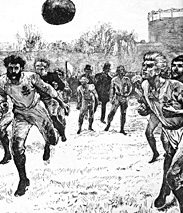
(Image – England v Scotland 1872 at The Oval, London at Wikimedia commons)

Leave a Comment

Leave a Comment