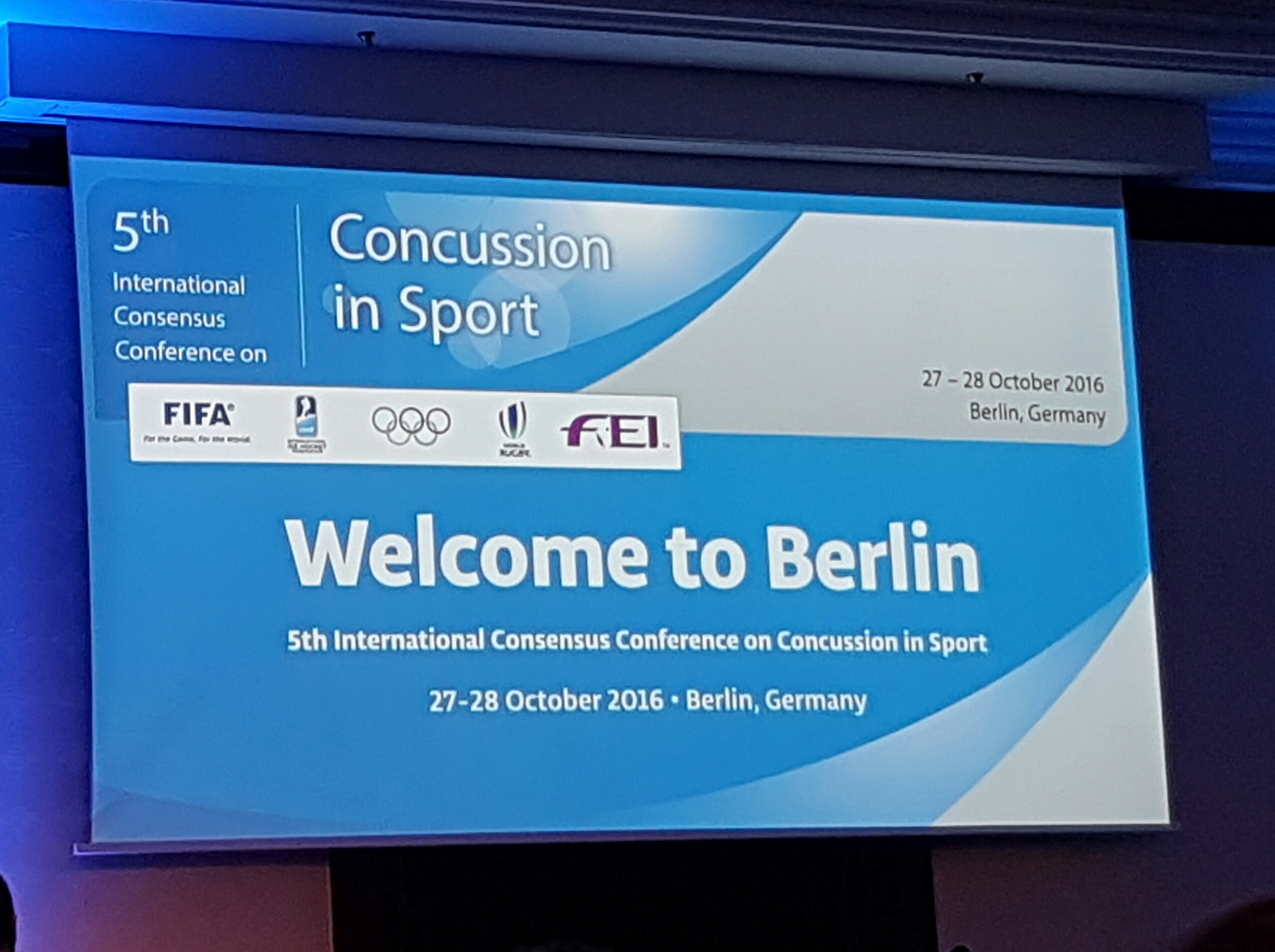
Berlin 2016: The 5th International Consensus Conference on Concussion in Sport

20161027_120311The 4th International Consensus Conference on Concussion in Sport is one of CJSM’s published pieces that gets referenced frequently. Reflecting work that took place at a conference in Zurich in 2012, it was time to have an update on the issue of sports-related concussions.  As many of you know, the 5th consensus conference just took place in Berlin.  I was sorry I could not attend, and I look forward to the publications that will emerge from this meeting.

Today’s blog post is both about the Berlin conference and the power of social media.  I have written about social media and its import in the world of contemporary sports medicine.  I have celebrated the ability of media such as Twitter to bring people from different parts of the globe together, essentially obliterating barriers of distance and time.  I have lectured frequently on the ability of social media to translate findings from research into clinical practice.

Today’s blog post is proof of that power.

CJSM is delighted to have today guest author Osman Ahmed, a lecturer in physiotherapy at Bournemouth University in the UK, a practicing sports physiotherapist for the Football Association, and a leader in the use of social media in our profession. He attended and presented a poster at the Berlin conference. I first ‘met’ Dr. Ahmed on Twitter, and we’ve begun a deepening collaboration drawing on our mutual research interests.  We continue to interact on Twitter and Google Drive, but I have yet to shake his hand! [there are some issues social media can’t resolve on its own…..yet]

Some day, I look forward to meeting Osman in person.  In the mean time, I hit him up to share with the CJSM readership his impressions from the consensus conference.   Thanks so much for taking the time, Osman.

_____________________________________________________________________________________

Impressions of a concussion consensus conference from a newbie: Berlin 2016  — Osman Ahmed

the-ritz

The largest chandelier in the whole of Germany is present in the lobby of the Ritz-Carlton Hotel

Few in the sports medicine community would argue that a consensus meeting has been as eagerly anticipated as the 5th International Consensus Conference on Concussion in Sport in Berlin this October. Since the last consensus meeting in Zurich in 2012, there has been an ever-increasing focus on sports concussion in the mainstream press [1], the scientific literature [2], and also in popular culture [3]. Given the magnitude of this conference, the impressive Ritz-Carlton Hotel in Potzdamer Platz was a fitting setting.

With so much attention on concussion in sport, there was plenty for the organising committee to work towards ahead of the conference. Read more of this post

Concussions — looked at from multiple perspectives

img_2348

With one of the great ones — Dr. Greg Myer, leading concussion and ACL prevention researcher

It should come as no surprise that there has been a lot of ‘discussion’ recently about the topic of concussions in our world of sports medicine. That subject has been a ‘hot button’ issue for a decade.

Whether the issue is one of Cam Newton playing on through an injury that may have warranted immediate evaluation or whether it’s the topic of concussion reporting at the youth level, there is an on-going conversation in the media, social media, medical literature and conferences on sports-related concussions (SRCs) in all their many facets.

I was given an entirely new view on SRCs today. I had the great pleasure of attending a lecture on concussion prevention given by my friend (and frequent CJSM contributor) Greg Myer, PhD, who was visiting my home institution of Nationwide Children’s Hospital.  He delivered a talk entitled, “Concussion Prevention:  Has Nature Already Provided the Solution?”

It was a fascinating exploration of biomimetics influencing primary sports medicine research.  Dr. Myer and his team saw in nature a paradox:  species of woodpeckers knock their heads against hard objects thousands of times,  generating up to 1500 g-force units with each hit, all the while avoiding getting concussed. They then looked at the biology of how the bird manages this  and developed a device that players can wear in their sport to, potentially, reduce their own risk of SRCs.

The lecture was compelling, both for the details of the device and the research, and for the overall brilliance of the concept.  Talk about thinking ‘outside the box’:  looking at a woodpecker, and seeing a way of making athletes safer on the playing field.  Fascinating stuff.

I finished off the day with more of Dr. Myer and more of concussions, by picking up the September CJSM. In this issue, we have four original research studies focused on sport-related concussions (SRCs). Three come from Boston, a ‘hub’ of research on SRCs, and one comes from South Africa, which I was able to review  in the last CJSM blog post.  One of the Boston studies includes Dr. Myer as a contributing author:  Young Athletes’ Concerns About Sports-Related Concussions:  The Patient’s Perspective.  Another reports results of a survey of American Medical Society for Sports Medicine (AMSSM) Physicians on concussion management practices.  And the third looks at SRCs from the perspective of another set of stakeholders, coaches: Content, Delivery, and Effectiveness of Concussion Education for US College Coaches.

In this issue, therefore, we look at SRCs from the perspective of the patient, the doctor, and the coach.  We look at SRCs ‘spanning the globe,’ from Boston to Cape Town.

And though Dr. Myer’s work on concussion injury prevention is not published in our pages, please use the links I have provided above to read (and see) more of what’s behind the idea that woodpeckers may help provide part of the solution to SRCs.

The animal perspective, so to speak.

Enjoy all the different views of this common injury, and, as ever, let us know what you think in the comments section of this blog.


To Tackle or Not: That is the Question

CcrbuLCUkAABq_7

Rugby Sports Med panel (L to R): Drs. Kerr, Gerber, Viljoen, Cantu, Akhavan, Mjaanes, Landry

There is an ever-increasing debate on both sides of the Atlantic regarding contact and collision sports for youth.  In particular, the issue of tackling (whether in rugby or American football) is in the cross-hairs of many.  I’ve written about this recently after Dr. Bennet Omalu, the subject of the movie ‘Concussion’ and the pathologist who first described CTE in an American professional football player, wrote an op-ed piece in the New York Times arguing that contact football should be banned in those under age 18 [‘Don’t Let Kids Play Football’].

My impetus for this blog post is two-fold: 1) I am currently attending a rugby sports medicine conference, where the issue of tackling and brain injury is a ‘hot topic’ for discussion; 2) the issue of tackling in youth rugby has exploded after recent events in the UK.

USA Rugby sports medicine hosts a conference each year around this time, and this year there was a panel of experts who entertained the question: when should youth athletes take up contact/collision sports?  There was a variance of opinion and a recognition that more research needs to be done to give an informed answer to this question.

In the background, occurring in the ‘real world,’ this same question was being debated in the media and social media after a group approached the UK government asking for a ban on tackling in youth rugby. The Sport Collision Injury Collective (@sportcic on Twitter) circulated a petition signed by 70 academics asking that touch rugby only be taught to schoolboys in the UK [“Our message is simple: Prevent injury, remove contact.  Replace contact with touch in school rugby.”]

The media response has been vigorous:  check out these stories from the BBC and the Guardian.  Opinions have come from players, parents and coaches as well as physicians  [the Royal College of Paediatrics and Child Health wrote a response to this proposal ] and sports scientists.

This is an important and healthy debate, one where I find most if not all stakeholders have the health and welfare of our youth foremost in mind as we try to gather more information and make decisions now, the ramifications of which may not be seen for years to come.

And so, I thought I would use this blog as one more platform where concerned folks could weigh in on their opinion of this question. Take the poll below,* ** follow the links above, and engage in the discussion which is taking place in the media.

*There have been many ages proposed for initiation of contact in youth sports, ranging from age 10 to 18.  For the purposes of the poll, I have tried to give a variety of options, though I recognize the choices are not exhaustive.

**I have intentionally given poll takers the option for a limited number of answers, recognizing that there is room for many more (e.g. ‘we need more information’, ‘yes, allow contact, but we need to reduce the amount kids get’, ‘football and rugby are different, and my answers would be different for each sport’ etc.)

Shedding light on the dark

It’s January and winter has at last arrived in North America. It officially started several weeks ago, but it took a while to really get going.  After a balmy December (for most of the country, anyway), the first month of 2016 has given us, as expected, single digit temperatures and snow:  the Minnesota vs. Seattle playoff game earlier this month was the third coldest NFL game in history. This month is also giving us the shortest days of our year north of the equator.

ACSP 2016

ACSP meeting coming up — Come to Surfers’ Paradise if you can!

[sidebar and shout out to our colleagues in the Australasian College of Sports Physicians (ACSP)–I am so looking forward to the warmth and long, sunny days of Surfers’ Paradise, in a mere 4 weeks!!!]

But the days are lengthening, and the sun will get stronger each day, of course. And metaphorically, at least, I can find light in this darkness by sitting down with this month’s edition of CJSM.  You can, too.

Yes, ‘shedding light in the dark,’ that’s the image I hold as I enjoy this privilege of being one of a group of editors managing one of sports medicine’s premier journals.  The on-going process of scientific investigation continues to expose the dark corners of our knowledge base, and journals like ours–disseminating this knowledge via print, internet, and other media vehicles–help practicing sports medicine clinicians bring the latest evidence-based research to the sidelines, training rooms and clinics.

In truth, I recently wrote about being ‘in the dark’ (literally and figuratively) as I watched the movie ‘Concussion’ and reflected on how much we still lack in our understanding of this clinical entity, in almost all aspects:  diagnosis, management, treatment, prognosis.  I am reading now with pleasure three pieces of original research about concussion just in our January issue, bringing their light to bear on the issue:

And as I have begun to prepare my talk for the upcoming ACSP conference (“School sports and youth injury: the promise and the peril”), I find myself leaning heavily on research published in CJSM. To wit: Read more of this post