Ramadan and the World Cup

The Islamic holy month of Ramadan begins today and will affect athletes and sporting fans around the globe until the fast is broken with the feast of Eid al-Fitr on July 28.

The World Cup may be like a religion, and is currently affecting the lives of many…..but throughout the next month Ramadan will have possibly the bigger impact on over a billion people on the planet.
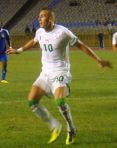
640px-Yebda2

Hassan Yabda, one of the players on the Algerian national team.

How, for instance, will the fast affect Algerian athletes who play their World Cup knock out match against Germany in two days?  How will it affect, for that matter, the millions of the faithful, Algerian fans who will be watching?

We revisit a blog post from last year, and an excellent study published in our pages on this very issue:  Does Ramadan Affect the Risk of Injury in Professional Football?

How topical:  The World Cup, the very pinnacle of professional soccer–it’s happening!  Ramadan–it has begun!

Good luck to the teams playing in the knock-out stages of the World Cup, and Ramadan Mubarak!

sportingjim's avatarClinical Journal of Sport Medicine Blog

Crescent_Moon_(2558144570) The Crescent Moon rising at sunset, marking the start of the month of Ramadan

The month of Ramadan begins tomorrow, July 9, and lasts until August 7.  As many of this blog’s readers will know, observant Muslims will fast from dawn until sunset:  no food, no liquids…..no sports drinks or power bars.  The questions of ‘carb loading’ or ‘gluten free’, (‘should i drink some chocolate milk after my workout?‘) can all be put on the table until the evening.  The diet is one of pure abstinence, morning until night.

Muslim athletes are not unique in observing a fast: Catholic Christians will consume much less than usual if observing the prescribed tenets of Lent on Ash Wednesday and Good Friday, and Jewish athletes will go a full 25 hours consuming nothing on Yom Kippur:  friends have told me they will be loath to brush their teeth or even shower, lest…

View original post 936 more words
Sideline assessment of concussion and return to play – are we practising what we preach?

Rugbyball2

A different shaped ball, a different World Cup….. Similar challenges

The more things change the more they stay the same…..this post by CJSM Executive Editor Chris Hughes was written in 2011 about the RUGBY World Cup incident involving a guy named Parra. Could have been written about the recent brouhaha over the 2014 FOOTBALL World Cup incident involving the guy named Pereira. In both cases, a player was inappropriately put back on to the field.

Be sure to take a look as well at the Zurich Consensus Statement on Concussion in Sport, found in the CJSM.  The section on the sideline evaluation of the player suspected of having a concussion is especially well written.

Chris Hughes's avatarClinical Journal of Sport Medicine Blog

The seventh Rugby Union World Cup competition ended last saturday in a tense final between strong favourites, the famous New Zealand All Blacks, and France, the former holding out for a one-point win 8-7 over Les Bleues.

The game featured a number of injuries, but one caused more of a stir than most – the injury to the French number 10 Morgan Parra.

Parra took what appeared to be an accidental blow to the side of his head from the knee of All Blacks’ Captain Richie McCaw in a ruck, and appeared to be visibly concussed, looking shaky on getting up after receiving lengthy on-field medical attention. The incident can be seen in this video.

He was taken from the field of play and replaced by Trinh-Duc. Surprisingly, however, he re-appeared on the field after around 5 minutes and continued to play on for another 5 minutes until he experienced another…

View original post 620 more words

What’s a World Cup without controversy?

Uruguay 4 - Chile 0

Uruguay’s Alvaro Pereira

Followers of this blog will know I have just returned from Quebec City, where I spent a fabulous four days catching up with professional colleagues from around the world at the 2014 FIMS sports medicine conference.  The event was hosted by the Canadian Academy of Sports and Exercise Medicine (CASEM), who conjointly held their annual meeting with FIMS.

Followers of the vastly bigger event known as the World Cup will know during this same period, there was the medical (mis)decision seen around the world involving Uruguay’s Alvaro Pereira:  knocked unconscious, and subsequently allowed to return to the pitch.

In truth, I got to see the event live, along with hundreds of millions of other people on the planet.  On a break in between conference sessions, I was in my hotel room. I had the television on while working on the laptop, when I noticed the downed Pereira.  My initial glimpse of his limp body was first out of context, which is to say I didn’t see the hit live, and I had yet to see the replay; my initial reaction was to fear the worst, as Pereira’s entirely limp body had me concerned he had suffered a cardiac event.

Quickly, though, I got to see the replay–the knee to the head–and it all made sense to me.

What followed, in some ways, made no sense.

Like the others in the viewing universe, I saw Pereira attended to by his medical staff.   As he got to the sideline he started to vigorously protest the intended substitution; and, of course as you all know, Pereira eventually made his way back to the pitch……

And at that moment I saw the twitter universe explode.

At the very least, the 2012 Zurich Consensus Statement on Concussion in Sport was being honored in the breach rather than the observance.

Just a smattering of the tweets: Read more of this post

Sochi and Quebec City: Memory and Desire

The first days of summer are almost here, the longest days of the year in the Northern Hemisphere.  I have been looking forward to this since the dark days of December and January.

opening ceremonies connie lebrun

Dr. Connie LeBrun, at opening ceremonies, Sochi 2014 Winter Olympics

Summer carries its intrinsic sweetness with it every year, but this year my anticipation of these days has been wrapped up with dreams of Quebec City, where the 2014 Canadian Academy of Sport and Exercise Medicine (CASEM) will have its annual meeting concurrently with the XXIII FIMS World Congress of Sports Medicine.

There is much to look forward to, including catching up with old friends.  Connie Lebrun–who will be familiar to several readers of this blog–will be among the folks I see.  Aside from communiques via email, I will typically only get the chance to see Connie at such conferences (I saw her last in Orlando, at the ACSM meeting). Among the many hats she wears, she is on this journal’s editorial board, and I enjoy her frequent contributions to the CJSM journal club feature.

Connie was the head physician for the Canadian Olympic team that traveled to Sochi earlier this year. I asked her to give a quick run down of her experiences in sports medicine at the 2014 Winter Olympics, and she has graciously obliged.

What did T.S. Eliot say about mixing memory and desire?  I’m no poet, but I think it’s a natural combination to combine the two; and so here’s to the memories of Sochi, and the anticipation of what is to come in Quebec.

___________________________________________

Memories of Sochi – Dr. Connie Lebrun


photo (9)

Alexey Pleskov and Connie LeBrun, 2014 ACSM Orlando

Just back last week from the American College of Sports Medicine Annual Meeting in Orlando Florida. The last session that I attended was a Special Event entitled “SOCHI 2014:  Sports Medicine Challenges, Strategies and Solutions. It was submitted by the ACSM Olympic and Paralympic Issues Committee, of which I am a member, and Chaired by Dr. Margo Mountjoy, member of the IOC Medical Commission. She later spoke about the International Olympic Committee (IOC) and the Injury and Illness Surveillance system that they have been using at Olympic Games since 2008. A highlight for me, though, was hearing Dr. Alexey Pleskov, the Chief Medical Officer (CMO) for the Sochi 2014 Olympics and Paralympics – discussing Medical Services at the Games. Then Dr. Paul Piccinnini (DDS), also from the IOC Medical Commission, enlightened us about Management of Dental Disease and Oro-Facial Trauma during the 2014 Winter Olympics, which apparently accounts for ~ 40% of all athlete-treatments in the Polyclinic(s) at the Olympics. This was followed by a “tag-team” of Dr. Randy Wilber (PhD, USOC Training Center, Colorado Springs) and Dr. Nanna Meyer (PhD, RD) discussing the preparation of the US Speed Skating team, in terms of physiology and training, as well as outlining some of the sports nutrition challenges and strategies.

The presentations and photos brought back many memories for me, as I was honored to have been the Chief Doctor for the Health and Science Team (HST) for the Canadian Olympic Team. Read more of this post