The Effectiveness of Ankle Taping

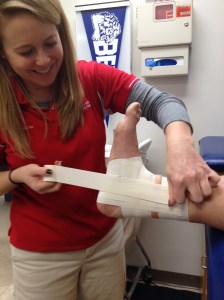
gail taping ankle

ATC Gail Swisher, Bexley High School
and Nationwide Children’s Hospital,
demonstrating her art

To tape or not to tape, that is the question.

And the answer is of interest to a lot of folks out there.

“Residual Mechanical Effectiveness of External Ankle Tape Before and After Competitive Professional Soccer Performance,” published in our January issue, has been our most emailed study so far this year.  On our twitter feed, @csjmonline, I can also tell you that the posts I’ve been making have been getting a lot of traffic.

There is a great deal of interest in this most utilitarian of subjects. It’s original research coming from a group out of Germany:  Best, Mauch, Böhle et al., and currently on the CJSM website it’s FREE!  It’s time to check it out!

All of us in clinical sports medicine can attest to the ubiquity of ankle injuries.  The authors of this study note, for instance, that aside from muscle strains, ankle ‘distortions” are the most frequent injuries seen in professional soccer, accounting for about 20% of all injuries.  They further note that bracing and adhesive taping of the ankle are commonly used to prevent and treat these injuries, though “….the effect of adhesive ankle tape remains inconclusive, in comparison to semirigid orthoses and braces….”

There is considerable debate over the residual effectiveness of taping over the course of a prolonged sporting session.  The issue is of practical significance, as the author’s note that during soccer matches, a disproportionately high number of injuries occur during the last third of each halftime.  To date, there have been few studies that have evaluated the mechanical, protective properties of tape beyond 30 minutes of exercise.

It is in this context, then, that the authors’ developed what amounts to their research hypothesis:  “…during realistic competitive soccer performance reflecting a halftime of 45 minutes–ankle tape might lose most of its assumed initial mechanical effectiveness to reliably prevent ankle distortions.”  They set out to test just that. Read more of this post

The Sports Gene: How Olympians are made (or born)

450px-Erika_Coimbra_2013

Erika Coimbra,
Brazilian Summer Olympian,
and one of the subjects of
“The Sports Gene”

The venues at Sochi are still, it seems, a work in progress.  Nevertheless, before the week’s end, we will (should?) see the Winter Olympic games start up.  Soon, we’ll get to watch some of the finest athletes in the world compete at their sport.

There has been a lot of talk about the on-going construction at the most expensive games in Olympic history, as well as the issue of gay rights and cultural sensibilities in Russia;  and there have been worries about the potential for terrorism.  But soon, when the competitions begin, I hope the focus will justifiably be on the athletes on the snow and ice.

Or in Tweet speak: #LetGamesBegin

I’ve not been consciously preparing for this elite sporting event, but rather coincidentally recently picked up a book that highlights elite athletes and has received a great deal of positive ‘buzz’:  The Sports Gene, by David Epstein.

You likely have heard of the book.  It has been receiving excellent reviews and is generating a lot of chatter in print, visual and social media.  On Monday, for instance, The Guardian hosted a live chat online with the author.  Subtitled, “Inside the Science of Extraordinary Athletic Performance,” the book delves into one of the ‘ultimate’ questions in sport:  nature or nurture, which is more important?  And, specifically, which is more important in the realm of elite sport?

Like many ‘ultimate’ questions, the real answer is not a clean, binary one.  That said, I walk away from reading this book thinking the bulk of the evidence is in favor of nature:  genetic endowments favor the production of elite athletes. Read more of this post

#SuperBowlXLVIII

800px-NYC_Empire_State_Building

The iconic Empire State Building:
Super Bowl in view.
Photo: Daniel Schwen

After all the talk about Manning’s comeback, Sherman’s rant, the NYC vs. NJ rivalry, and the weather….we have come at last to Super Bowl Sunday. The high holiday of American football.

The collision, not just of two football teams but also of a vast sporting event and the NYC/NJ media megalopolis, has created predictable fireworks.  For example, you can tweet a prediction of who will win the game, with the hashtag #WhosGonnaWin, and determine the lighting color of the  Empire State building itself.

The power of the pen?  No, it’s the power of the tweet!

Getting back to the weather.  It has been frightful, both in North America and Down Under.  The Australian Open almost had player defections over the intense environmental conditions they faced from an uprecedented heat wave.  At the same, a polar vortex swept down over most of Canada and the USA bringing fears of hypothermia, frostbite and other assorted ills to outdoor exercise enthusiasts, sportsmen, and, possibly, spectators.  When all is said and done, however, it appears that Sunday’s Super Bowl game will be played under cold, but tolerable and dry conditions:  the most recent prediction I have seen suggests game time temperature should be just around freezing, and the skies should be clear.

I suspect the NFL commissioner Roger Goodell may have sought some help from Timothy Cardinal Dolan in supplicating the higher powers to ensure the Super Bowl would avoid becoming an Ice Bowl…..like the last time the NFL championship occurred in the NYC area, in 1962. Read more of this post

Overuse Injuries and Burnout in Youth Sports

Pawsox_17937_2013-06-30

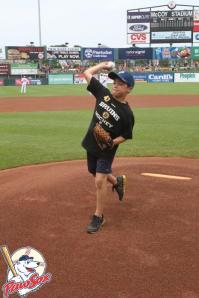
10,000 hours of practice, and
he might make the Red Sox?*

We’re very pleased at CJSM to open the New Year with a shout:  a fantastic systematic review and position statement on the subject of youth sport, from the American Medical Society for Sports Medicine (AMSSM).

The focus of the paper–in the January 2014 issue, which has just published–is on overuse injuries, which are thought to represent roughly half of all the injuries youth athletes sustain.

All readers of the journal, and of this blog, will find this a worthwhile read.  I have a selfish interest in the subject, as I am currently practicing pediatric sports medicine, and in my professional life I live and breathe the issues discussed in the paper. Moreover, I know several of the authors of this paper, and I think highly of them all.

But this is not about ’eminence based’ medicine.  No, it’s evidence-based all the way.  The paper is both a systematic review and the AMSSM position statement on the subject of “Overuse Injuries and Burnout in Youth Sports”.  The authors conducted a thorough review of the literature, identifying 953 papers and citing 208 unique references in their comprehensive analysis of this broad subject.  They go on to review what is known, and then make recommendations, classified using the Strength of Recommendation Taxonomy (SORT) grading system.

The paper is broadly organized into the following subsections:  epidemiology; risk factors (intrinsic and extrinsic); discussion of high-risk overuse injuries;  discussion of several concepts mentioned frequently in the literature of youth sports (readiness for sport; sport specialization; burnout); and prevention.

The study is so very comprehensive, I cannot do better justice to it than encourage you to read it yourself.  I thought I might here mention some of what stood out for me. Read more of this post