5 Questions with Jim Borchers: Team Doc of the National Champion Buckeyes!

jim borchers

A VERY happy crew: Jim Borchers (center), Bob Sweeney (L) & Doug Calland (R) in Arlington, TX after the National Championship game.

Followers of this blog know that I live in Columbus, Ohio.

And most of you know what that would mean for life here the last two weeks.

Unless you are overseas and/or pay no attention to American college football–which is true for some of our readers–I don’t need to tell you that Columbus is home to the reigning, undisputed National Champions of NCAA Division 1 football:  the Ohio State University beat Oregon decisively in the game on January 12 at AT&T Stadium in Arlington, TX, 42 – 20.

The medical staff of that team is a group of clinicians whom I know well.  I have great admiration for the clinical and scholarly work they do.

In the aftermath of the game, I reached out to my friend, Jim Borchers, M.D., M.P.H. and asked him if would have time to share some of his thoughts on the game, the season, and a variety of other topics.  I am happy to say he said yes.

Jim is an example of that clinical and scholarly excellence I just wrote of. He is the Director of the Division of Sports Medicine in the Department of Family Medicine at OSU. He is an Associate Professor and the Director of the Primary Care Sports Medicine Fellowship there, as well.  And besides being the team physician for the football team, he takes care of men’s and women’s basketball, soccer, and lacrosse as well.

I’m happy to say he still, somehow, finds time to help out with the journal.

Now, without further adieu, here is our conversation with Dr. Borchers.

______________________________________________________

1) CJSM: I understand you were both a player for the Buckeyes when you were in college and now are one of the team physicians for the new, National Champs. Can you describe what different thoughts and emotions you have as a player for an elite team vs. those you have as a team physician.

JB: I was very fortunate to play football at Ohio State from 1989-1993.  As a player during that period, we were working very hard to try to get Ohio State back to the top of the Big 10 conference.  During my playing days, I was like my other teammates – focused on winning and performing to the best of our abilities.  During those years I experienced some great wins and some tough losses and certainly appreciated how important football was to all of the fans and alumni of Ohio State.  As a player, I always wanted to be on a championship team – one that would be remembered at Ohio State.  My senior year we were Co-champions of the Big 10 conference and finished 10-1-1 and in the top 10 in the country.  At a recent 20 year reunion honoring that team, I was reminded of how fortunate we were as a team to compete at Ohio State. Read more of this post
Genetic Testing for Sports Injuries

The recent NFC championship game proved, I think, this truth: a true champion is not dead until the final whistle blows. The Seahawks  won in dramatic fashion over the Packers, my favorite team.  As many commentators noted, Seattle played horribly for 58 minutes, but were stellar for the last two; and that was all that mattered in the end.

As a fan, my initial reaction is to think “we gave it away.”  But that is a disservice to the champions.  The Seahawks never lay down, and they seized the moment when it presented itself.

Still…..as a fan, I wonder–if Aaron Rodgers’ calf were 100%, would we have pulled away more decisively earlier in the game?  The field goals in the red zone: would they have been touchdowns instead if our quarterback had his usual mobility?

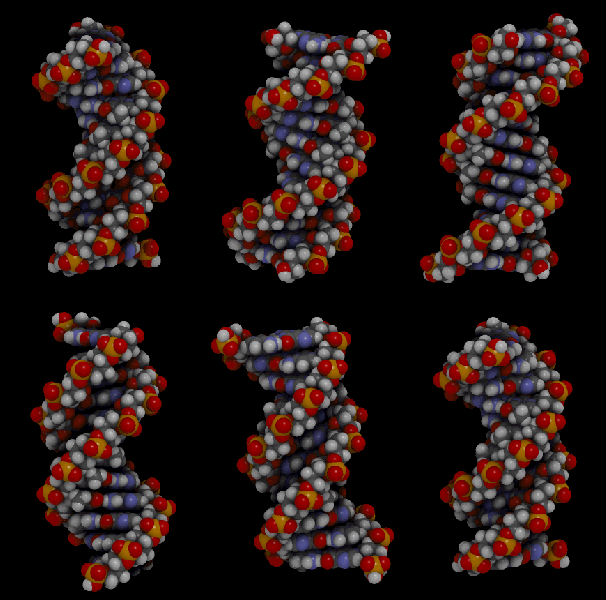
Bdna_cropped

Does Rodgers carry a valuable SNP in the genes of his gastrocnemius? I hope so!

Well, we Packer fans have an offseason to think about ‘what ifs,’ and the Packers medical staff has an offseason to rehab Rodgers’ injury and think about secondary prevention.  Perhaps the Packers will want to think about doing some genetic testing as part of their assessment. Management and the medical staff may want, at least, to take a look at our lead editorial for the January 2015 issue:  “The Dawning Age of Genetic Testing for Sports Injuries.”

We have written about ‘genes’ and sports in the pages of this blog:  a very popular post last year was “The Sports Gene:  how Olympians are made (or born),” a review of David Epstein’s excellent book, The Sports Gene:  Inside the Science of Extraordinary Athletic Performance. As those titles would indicate, the focus on the sports/gene intersection in those pieces was more on sports performance than sports injury.

The ‘intersection’ of sports injury and genes has come up in the pages of the CJSM journal itself:  Genetics:  Does it Play a Role in Tendinopathy? and an investigation into genotypes and the risk for concussion in college athletes  are among the offerings we’ve had on this subject in recent years.

In the January lead editorial, Gabrielle Goodlin and her co-authors from Stanford do an excellent job in a short space of reviewing a great deal of what evidence already exists in this world, as well as pointing out directions where this work may be headed. Read more of this post

Sudden Cardiac Death: The Israeli Experience

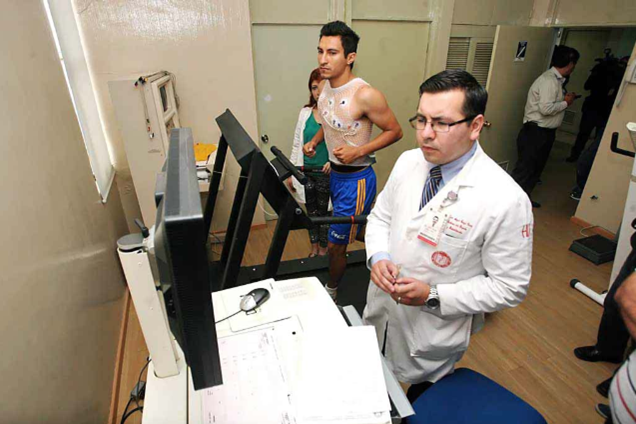
dr jose garza

Dr. Jose Garza, conducting a stress test on an athlete, Monterrey, Mexico

Screening for sudden cardiac death (SCD) remains one of the more contentious debates in the world of sports medicine.  As a matter of public policy, consensus medical opinion in the United States still argues against universal, mandatory  screening with electrocardiograms (ECGs); whereas in Europe, specifically in Italy, ECG screening is more of a routine practice.

The debate over this screening is carried on at many conferences and in many medical journals, including ours.  We’ve previously looked at the question of whether it makes sense to screen North American athletes with ECGs, for instance.  Earlier this year, we published a review of the different approaches American universities are currently using regarding the issue of athletic cardiovascular screening.  Recently, the topic came up in the podcast discussion I had with Dr. William Roberts on new directions for the pre-participation evaluation (PPE).  American and European sport medicine bodies can find a lot of common ground in where the PPE can be improved, according to Dr. Roberts, with the principal exception of this one issue.

Recently, Dr. Sami Viskin, from the Department of Cardiology, Tel Aviv Medical Center, spoke at my home institution about how athletes are screened for SCD in Israel.  He has written extensively on the issue of screening athletes for SCD, including a study arguing that it is not a cost-effective strategy in the United States.  The title of his recent talk: “Mandatory ECG screening of athletes saves lives: proven fact or wishful thinking?”

Our Division of Sports Medicine has been hosting another international guest this past month: Dr. Jose Angel Garza, a sports medicine physician from the University Hospital of the Universidad Autonoma de Nuevo Leon (UANL) in Monterrey, Mexico. He was also present at Dr. Viskin’s talk, and I asked him for his reflections on the subject of mandatory ECG screening in athletes.

Thanks Joe!

________________________________________________

Among the sports medical community, there is an ongoing and often heated debate on whether mandatory ECG screening should be performed on athletes. Several countries such as Italy and Israel have implemented such measures. The European Society of Cardiology has issued recommendations about mandatory screening of athletes with ECG. So this begs the question: Does ECG screening save lives in athletes? Read more of this post

Ebola and the Athlete

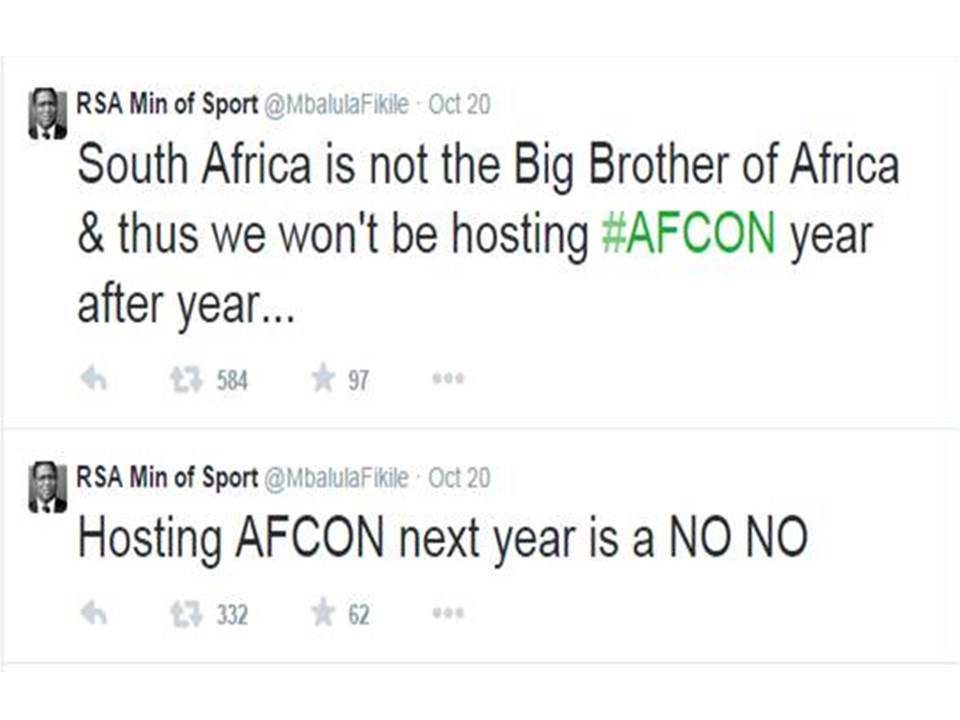
twitter rsa pic

The South African Minister of Sport has tweeted a ‘no, thank you’ to being host.

The biennial Africa Cup of Nations (AFCON) is set to begin in January 2015. Organizers are still looking for a host.

Morocco was set to host the tournament but has pulled out because of the fears over Ebola contagion. The Republic of South Africa has already served notice that they will not volunteer to be alternative hosts:  the country’s Minister of Sport has tweeted that the RSA is “…not the Big Brother of Africa….” and will not be standing in as host for the Cup. As I understand it, the Confederation of African Football organizers are meeting November 2 to discuss solutions for what seems to be an impasse.

If sports is indeed a mirror of the culture, then it stands to reason that concerns regarding the Ebola virus would show up in sporting venues, training rooms, sport talk shows, and athletes’ twitter feeds.  The current outbreak of the virus is still largely confined to certain nations in W. Africa, but it  is the largest and most deadly one in history.  Sport, like society at large, is concerned.  How might teams handle potential exposures?  Must consideration be given to quarantining? Is it reasonable to target only those countries at the epicenter in W. Africa?  Is ‘quarantine-lite’ the way to go? Is it wise to consider having large numbers of people travel to and from one country, as in the case of hosting AFCON?

Carrier_of_diphtheria_keep_out_of_this_house_by_order_of_board_of_health.

A sign of things to come?

A generation or two ago–most especially in the pre-vaccine and pre-antibiotic era–the quarantine was a standard measure for handling outbreaks of contagious diseases in communities.  My mother describes how she and her whole family were quarantined after she developed strep throat as a young girl in the 1930’s.   In the modern world, however, the quarantine as a response to controlling Ebola has already come under heavy fire, at least here in the United States.

The intersection of public health, international sporting events, and an infectious virus is not unique to this moment in time, of course.  In 2010 CJSM published a thematic issue on “Emerging Issues in Sport Medicine,” and included among the many offerings an article on International Travel and the Elite Athlete as well as an article on Public Health Recommendations for Athletes Attending Sporting Events.The 2009 CJSM published original research on a novel, web-based approach to more carefully monitor illnesses in professional rugby union players.  These documents are potentially useful resources to help teams and sporting federations formulate responses to this newest challenge.

But I want to acknowledge that the Ebola virus raises issues which require a great deal more work to determine appropriate, evidence-based interventions.  Winter is coming in the Northern Hemisphere, and we know we should be offering our athletes influenza vaccinations. We have a ‘system’ to handle the flu.  What to do with a disease like Ebola for which there is no current vaccine let alone an established treatment?  Likewise, what to do in the case of a virus which does not pose an airborne exposure risk like the flu, but has a much higher case fatality rate when the virus is contracted?

Already, popular sentiment has begun ‘making’ decisions of a sort.   Read more of this post