Exertional Rhabdomyolysis

I hope the blog readership has had a chance to take a look at the most recent issue of CJSM.  The September 2013 edition of the Journal has studies looking at conditions from concussion to osteoporosis and at sports from football to ballet.  It is a varied mix, and a testament to the wide range of conditions primary care sports clinicians treat and study.

Nile_Kinnick

The great Nile Kinnick,
University of Iowa
1939 Heisman trophy winner,
World War II hero

I spent a good amount of time in August talking about concussions, and I could easily continue this thread throughout September.  I started off the month, in fact, with a look at my friend Bill Meehan’s recent work on the “The Presence of Undiagnosed Concussions in Athletes.”  I thought I’d take a break from that topic, and look at a less common but also potentially dangerous condition:  exertional rhabdomyolysis.  It’s a particularly relevant topic at this moment, as exertional rhabdo often times strikes untrained athletes working out in hot and humid environmental conditions, and it’s an unseasonable 95 in Columbus Ohio today, where I am writing this post.

A Cluster of Rhabdomyolysis Affecting a Division I Football Team,” a study by Smoot, MK, Amendola, A, Cramer, E et al., looks at an ‘outbreak’ of the condition in January 2011 at the University of Iowa’s football (american) team after some intense off-season lifting workouts.  Ironically, we had a cluster of our own in Columbus, Ohio, home to Iowa’s Big Ten rival Ohio State, just this spring, in the women’s sport of lacrosse.  The LAX players were hospitalized after team members performed a new 20 minute workout involving repetitive pushups, situps and chin ups, without break.  Six female athletes were hospitalized for as much as a week.  The local newspaper reported,  “Five returned to play last season, all except sophomore Kelly Becker of Dublin…..who has since transferred to Michigan.”
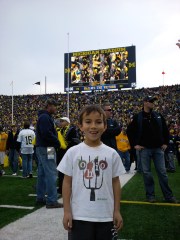
mo squared at michigan

The author’s son,
letting it all hang out
in the ‘Big House’
Ann Arbor, MI

Ok, stop!!  If that doesn’t suggest to you the gravity of the situation, nothing will.  As a consequence of her experience as an athlete who developed exertional rhabdo, a young woman traded in being a Buckeye for a Wolverine.  The ultimate protest!!!!

Returning to the study…..The authors set out to look for what might be risk factors for exertional rhabdo (ER) in collegiate football players.  They begin by doing a brief and excellent overview of the signs and symptoms, defining characteristics, and known risk factors for ER.  They proceed then to describe the workout the 16 football players did (e.g. 100 back squats at 50% of one rep maximum) and how the young men presented with ER.  Thirteen players were hospitalized for ER after this workout.

The authors were given permission to look at the medical records of 10 of the 13 cases. Nine of the 10 had urine screens negative for drugs (one had a positive opiate screen, but his urine had been collected after being administered narcotic analgesics); one of the 10 had sickle cell trait; and two of the 10 had consumed creatine before the workout.

Read more of this post

Exercise Deficit Disorder in Youth: Thinking Outside The Sandbox

avery

Avery Faigenbaum, Ed.D, FACSM: Jersey boy energizes the crowd

As a pediatric sports medicine specialist, I typically spend my days ministering to the maladies of the active child or adolescent; but as a public health advocate, I worry more about the other end of the spectrum:  the growing (pun intended), global pandemic of childhood underactivity and obesity.

The global problem of underactivity in youth is being investigated by many people.  One of the leaders in this field is a Jersey boy; no, not Jon Bon Jovi…… I have been a big fan of Dr. Avery Faigenbaum, from the College of New Jersey, for some time.  From his work investigating the safety of resistance training in children to his new focus on “Exercise Deficit Disorder” (EDD), his work has been an inspiration to me.

Last summer, I had the pleasure of working with him here in Columbus, Ohio, and we even got to record a session of Nationwide Children’s Hospital’s “Pediacast” where we discussed the problem of EDD.  This summer, I got to catch up with Dr. Faigenbaum at the American College of Sports Medicine meeting in Indianapolis.   Though he could probably bench press three of me, I successfully arm-wrestled him into doing a guest blog.  Just in time:  Dr. Faigenbaum is heading to Argentina in July as a guest professor.

And so before he can run away, it is with great pleasure that I present to the readership Dr. Faigenbaum’s blog post:  “Exercise Deficit Disorder in Youth:  Thinking Outside the Sandbox.”

___________________________________________________________________________________________

The pervasive reach of physical inactivity has now spread worldwide and some authors have appropriately described this issue as a “pandemic” (4). Levels of physical activity among modern-day youth are down while time spent watching television and surfing the Internet are up. Researchers from Canada recently assigned a letter grade of D- to physical activity levels in 5- to 17-year olds (1) and findings from the Youth Risk Behavior Surveillance survey indicate that one-third of high school students in the United States played video or computer games for 3 or more hours on an average school day (5). The decline and disinterest in physical activity appears to emerge early in life, and by the time students enter high school their sedentary habits are difficult to break. As a professor of pediatric exercise science, I am deeply concerned that regular physical activity has become a neglected dimension of health that has yet to garner the medical power and political clout of other pediatric and adolescent health issues such as cigarette smoking or super-sized beverages.

Read more of this post

ACSM Annual Meeting in Indianapolis

Dan_Gurney_&_Crosthwaite

Vintage Indy 500: Dan Gurney

Indianapolis:  home of the Indy 500, that just took place last Sunday, and this week home of the 60th Annual Meeting of the American College of Sports Medicine (ACSM).

I’ve already enjoyed a couple of great days here, and I wanted to share some of the high points.

First, I attended a session on exercise therapy and youth, cleverly entitled, “Linking Health Care with Fitness Care in Youth to Prevent Generation XXL.”  The session was organized as a series of talks given as part of ACSM 2013 and the concurrently run 4th World Congress on Exercise is Medicine.  Among the speakers was Avery Faigenbaum, EdD, a professor of pediatric exercise science whom I have heard speak on several occasions over the years.

He is always a scintillating speaker.  Much of his work over the years has involved demonstrating the safety and effectiveness of resistance training in youth.  His talk here  as part of this session took on a different subject:   “Exercise Deficit Disorder in Youth:  Challenging Traditional Dogma.”  If you have not heard of “Exercise Deficit Disorder” (EDD) before, you will be hearing more about it in the future.

Read more of this post

Sport and Exercise Medicine – A Fresh Approach. Guest blog by Dr Richard Weiler

Sport and Exercise Medicine (SEM) has been evolving rapidly around the globe and is gaining mainstream recognition. In the United Kingdom it formally began life in 2005, when the Chief Medical Officer at the time, Liam Donaldson, pledged to develop the specialty as a commitment to the London 2012 Olympics. 2012 has arrived and the specialty of Sport & Exercise Medicine is slowly gaining a foothold in the publicly funded UK National Health Service (NHS).

In the UK, we now have an established Faculty of Sport & Exercise Medicine and a fairly comprehensive and evolving 4-year specialist training programme . There are currently about 50 specialist trainees in training across the country and about 10 doctors have become specialists in SEM in the last couple of years.

Challenging economic climates have resulted in new measures being implemented by the Government. ‘Market forces’ have been suggested as a means to ensure that funds are targeted locally and efficiently for patient needs. This has resulted in an urgent need for the fledgling SEM specialty to justify its existence and demonstrate patient benefit and cost effectiveness in order to establish new SEM services and maintain existing services. This is not easy for a specialty that has existed for only a few years. A major obstacle when speaking to those holding the funds is the lack of understanding about what SEM specialists can offer the NHS. Is it about elite sport, athletes and the Olympics or is it about exercise, gyms and running?

The truth is mostly ‘none of the above’ for the general population, so late in 2011 we published an NHS Information Document explaining what an SEM specialist offers the NHS and NHS patients. This is broadly based on education, research, musculoskeletal, sports medicine, physical activity for prevention of chronic disease and physical activity prescribed in the treatment of chronic disease (exercise medicine).

We hope that this peer reviewed NHS Information Document, endorsed by all the key UK organisations in the SEM field, will be helpful to our colleagues and fellow multidisciplinary team members both in the UK and around the world.

The rest as they say is history, or in the wise words of Master Yoda “Always in motion is the future.”

The publication involved the collaboration of too many people to thank individually, but the co-authors, whom were all SEM trainees at the time of writing, all deserve individual mention (in no particular order). Natasha Jones, Kate Hutchings, Matt Stride, Ademola Adejuwon, Polly Baker, Jo Larkin and Stephen Chew.

Dr Richard Weiler is an Honorary Consultant in Sport and Exercise Medicine based at  University College London Hospitals Foundation Trust, London, UK

Leave a Comment

Leave a Comment