May Day! May Day!

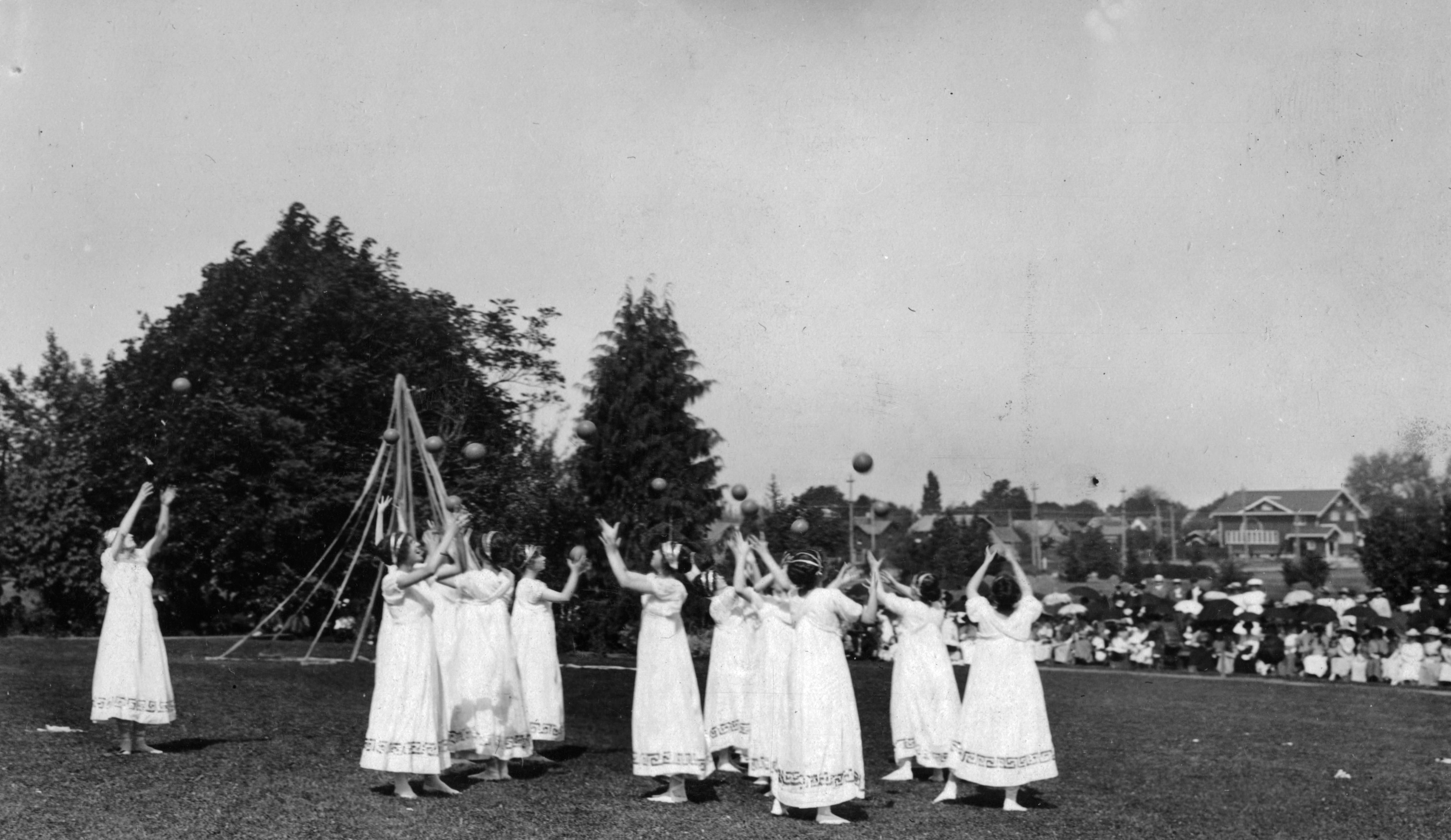
May_Day_Pageant_Greek_maidens_playing_ball_(4203990870)

Net Ball? Cirque de Soleil? No– it’s a group of ‘Greek maidens’ celebrating May Day around the Maypole!

It’s May–time for dancing around the Maypole….and time for the third issue of CJSM for 2015.

We have quite a lot in store for you in this issue.  We have made the Practical Management article on Concussion Management in Collegiate Student-Athletes : Return to Academics Recommendation the main Editor’s pick and set it free.  There is a growing body of evidence on “Return to Play” from a concussion–but what should a student-athlete do about “Return to Learn”?  Read the article and find out!

Our second “Editor’s Pick” is an article on injury prevention in Aussie Rules Football: Bridging the Gap Between Content and Context:  Establishing Expert Consensus on the Content of an Exercise Training Program to Prevent Lower-Limb Injuries.  If it’s from Australia, and the subject is injury prevention, it is no surprise that one of the authors on this important contribution is Caroline Finch, the doyenne of Antipodean sport safety!  This “Editor’s Pick” is free too.

There is more, much more, including other familiar names from the world of sports medicine research.  We’ve chatted up Chris Nowinski in the past on one of our podcasts–he is one of the authors in another offering on concussions:  Concussion Reporting Intention:  A Valuable Metric. Jim Borchers–whom we last caught up with shortly after his OSU Buckeyes had won the NCAA DI College Football Championship–has co-authored an interesting case report on a serious skin infection in a football player.

One of the new aspects of CJSM in 2015 is our ‘Case Report’ section: now to be found  on-line,  a move which enhances the potential for multiple media (video, audio) to be posted as part of the descriptions of some of these cases.  If you’re a subscriber but have historically loved the print version of the journal, don’t despair; but to get the case reports do go to the website or download the CJSM app on your iPad.

Finally, and this blog post is by no means an exhaustive list of all May’s offerings, there is another interesting case report on a traction apophysitis in an adolescent athlete–found in a rather uncommon place.  As a pediatric sports medicine physician  I read this case  from Stanford with great interest.

We hope you enjoy this issue of the journal, and we hope spring has come your way in the Northern Hemisphere…or that you may be enjoying a mild Fall if you are Down Under.

5 Questions with Christian Baumgart

Baumgart, Christian

Christian Baumgart, lead author of new study, Pubished Ahead of Print

It’s been a while since I’ve had the chance to ask a guest ‘5 questions,’ a recurring feature of this blog.  Our May issue is still a few days from being published…..too soon for guests!  And so I thought it was time to give readers a taste of our ‘Published Online First’ feature.

Once a manuscript has passed CJSM’s rigorous peer review process, ‘made the grade’ and been accepted, it is still a few months away from being published in print.  Like many journals, we have a healthy backlog of manuscripts which have been accepted but await publication.

But it’s not too soon for the authors to break out the champagne, because the article can be fully formatted and made available electronically prior to print–fully searchable in PubMed, prime time for the C.V.

One such study came to us from researchers in the Department of Movement Science at the University of Wuppertal in Germany: Effects of Static Stretching and Playing Soccer on Knee Laxity.  This is a randomized clinical trial looking at the effects of static stretching and playing soccer on anterior tibial translation.  I emailed the lead author, Christian Baumgart, and he was more than happy to join us on funf fragen…er, five questions!

Danke Christian!  I hope to meet you some day in Germany.

__________________________________________________

1) CJSM: What would you say was the most notable finding in your study?

CB: Previous studies have shown that different exercises lead to an increase in the sagittal knee laxity. The surprising finding of our study was that static stretching also increases the sagittal knee laxity and even to a greater extent than playing soccer. From a biomechanical point of view this fact seems to be logical, because in healthy athletes the joint mobility during stretching is limited primarily by ligaments and capsules. Subsequently, these connective tissues were short-termed plastic deformed. It is unclear whether the connective tissues adapts structurally, if the external load is applied long-term.

2) CJSM: Do you think the statistically significant increases in anterior tibial translation (ATT) you found both in static stretching and playing football (soccer) are clinically significant? Read more of this post

‘Think so vs. Know so’: Dr. Jonathan Finnoff on Sports Ultrasound

IMG_0622

Dr. Jonathan Finnoff delivering Grand Rounds in Columbus, Ohio

Earlier this week I was injecting an ankle:  was I in the joint or not?  I ‘think so’–but with an ultrasound I would ‘know so.’ Perhaps that is all I really need to say in this blog post on sports ultrasound!

Readers of the journal and this blog will be familiar with the Mayo Clinic’s Jonathan Finnoff.  Dr. Finnoff has made substantial contributions to the field of sports ultrasound and most recently was the lead author on a highly cited review of this modality.  I had the chance to interview him and profile this work, an American Medical Society for Sports Medicine position statement, in our December 2014 podcast featuring him.

Dr. Finnoff headed a highly regarded sports ultrasound program at the recent 2015 AMSSM conference in Florida.  I arrived a day late for that, and so could not attend.  Not only did I want to go to that program for its educational value, I wanted to meet the man himself!  As I have written, it is both a wondrous and strange attribute of the modern world to become so engaged with someone on Twitter, or Skype, and yet never meet them in person.

I am happy to say my disappointment was short-lived as the busy doctor was able to come visit Columbus, Ohio yesterday.  I was able to catch the sports medicine grand rounds he delivered at Ohio State and get to shake, at last, the hand that holds the transducer.

Jonathan:  it was good to finally meet you!

If you have never had the chance to hear him speak, make sure you avail yourself of the next opportunity [or listen to the podcast :)]  In the mean time, I wanted to share some of what I came away with from the talk. Read more of this post

#AMSSM15: Winding down in sunny Florida

IMG_1119

Drs. Bill Meehan of Boston Children’s and Frank Wang, Team Doc of Harvard: bringing a little Boston to Florida at #AMSSM15 (We approve of the ‘Stanley Cup’ beard Dr. Meehan)

As I wrap up my stay in Hollywood, Florida for the 24th meeting of the American Medical Society for Sports Medicine (AMSSM), it’s a strange realization I come to now sitting down to write a blog post:  how can four days pass so quickly?

One answer to that question:  if the days are packed full of interesting activities.

I can only attempt in this post to survey in brief just what the agenda has been.  That is my self-appointed task, in any case, as I indulge in the last few minutes of the sultry, southern Florida life before I jump a plane home.

I was struck  by just how strong the AMSSM leadership is as I sat through the organization’s ‘State of the Union’ address, delivered co-jointly by outgoing president Chris Madden and incoming president Jon Divine.  I am a member of AMSSM as well as the Emerging Media Editor of CJSM, and so I had a doubly strong interest in the talk.

I was struck, as well, by how strong the organization’s staff is–those folks have done a fabulous job organizing this meeting for what is now approaching almost 2o00 physicians!

The AMSSM is the largest primary care sports physician organization in the world.  It is one we are proud to represent as its official journal; one we are proud to include among our group of partner societies which span the globe (which include CASEM, ACSP, and the AOASM).  Both Drs. Madden and Divine delivered inspiring speeches, ones devoted at heart to a recognition that an organization represents the sum of its parts:  we imperfect human beings who, in this organization’s case, are working hard to define the best practices of primary care sports medicine.

I will hold close for some time, I hope, the words of the parting president of AMSSM, Dr. Madden, who used a quotation attributed to Gandhi:  “Be the change you want to see in the world.” Read more of this post