Sports Medicine in Oz

coffs harbour

Coffs Harbour, Australia, site of the 2015 ACSP meeting.

While many of us in the Northern Hemisphere are shivering and shoveling our way through winter, members of the Australasian College of Sports Physicians (ACSP) are holding their annual meeting under a summer’s sun at the Pacific Bay Resort, Coffs Harbour, New South Wales, Australia.  “Exercise is Medicine” is the theme for the five-day conference.

The ACSP is one of our partner societies and this year, I regret to say, I’ll not be able to make it Down Under to catch the proceedings myself.  I do, however, have a friend who is at the conference right now and has volunteered to write a post or two about what is happening in the lecture halls and on the beaches.

Dr Hamish Osborne, MBChB, MMedSci, FACSP is a Sport and Exercise Physician, a Senior Lecturer in Sport and Exercise Medicine, and Academic Co-ordinator for the Post Graduate Diploma in Sport and Exercise Medicine, Department of Medicine, University of Otago, Dunedin, New Zealand.   I know him best as one of this journal’s Associate Editors–I saw him last at our 2014 Editorial Board meeting in Canada, and we stay in touch via conference calls and Twitter the rest of the year.

Here is his first post from the meeting:

____________________________________________

The Australasian College of Sports Physicians Conference kicks off here in Coffs Harbour on Tuesday. Coffs Harbour is on the Australian east coast approximately half way between Brisbane and Sydney and enjoys a beautiful coastal location with temperatures in the high 20’s predicted. I got here safely last night driving the near 400km from Brisbane and managed to avoid any Kangaroos hopping across the road around dusk.

The conference is preceded by a mini conference for our trainees and is underway as I write. All trainees present their research to date from the various stages of the four years of their training. The variety of the work presented today has been fantastic. For example, while  plenty of work has been published on the accuracy of ultrasound vs MRI for identifying rotator cuff tears in those having operations for their rotator cuff pain, it’s important as a clinician to know how this translates to the undifferentiated painful shoulder that walks through the clinic door:  i.e. how good or bad is ultrasound vs MRI at looking at the rotator cuff if clinically I’m suspicious of the labrum being the problem? This recognizes that the history and to a greater extent examination has poor sensitivity and specificity in the undifferentiated patient and we do need to rely somewhat on the imaging.

__________________________________________________

Hamish, thanks for taking the time from both the conference and the lovely beachfront of Coffs Harbour to write this post.  I hope you will have the time to write another post as the proceedings wind down.

And to all of you reading this, make sure to follow Dr. Osborne and the Division of SEM at Univ. of Otago on Twitter @Hamish_Osborne and @OtagoUniSEM respectively; and make sure to follow #ACSP_conf and @ACSP_SportsDocs this week!
Super Bowl Aftermath

Julian_Edelman_2014

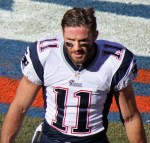
Julian Edelman, New England Patriots pic: Jeffrey Beall

It’s a Tuesday as I write, so literally (and figuratively) I do not propose to do any “Monday Morning Quarterbacking.”  I’ll leave it to others to deconstruct Pete Carroll’s decision at the end of the game (though I don’t think it was that crazy of a call, and was in keeping with other contrarian decisions he has made that actually got the Seahawks into the Super Bowl–like the fake field goal call against Green Bay in the NFC Championships).

The Russell Wilson interception obviously turned out badly for Seattle, and sent all of New England into a frenzied state of joy (though a snowstorm in the region is causing the fans there to hold off one more day from a celebratory parade through Boston).

No, I’m here to focus on sports medicine–specifically the management of Julian Edelman’s apparent concussion in the big game–and encourage you, the reader, to take a poll to stimulate conversation about the issue.

I’m sure a lot of us in the sports medicine world had a sense of deja vu when we saw Edelman stay in the game after what many viewers thought was a concussion:  in the 2014 FIFA World Cup there were several similar incidents, when several players had suspicious head injuries whose management was questionable.  In the aftermath of that tournament, we had a podcast with guests Matthew Gammons and Cindy Chang , physicians of the American Medical Society of Sports Medicine (AMSSM), exploring the issues involved with management of possible concussions in real time, in the setting of a highly visible sporting event…like the Super Bowl.

The NFL has, in the wake of much criticism, introduced new concussion protocols.  It is my understanding that “….. the NFL assigns an independent physician to each team to monitor head injuries, and there is another independent ‘spotter’ who watches players on both teams from a booth above the field and can radio to the sidelines if there is evidence of an on-field concussion.” [1] Additionally, each team has its own medical personnel to monitor the situation as well as do any necessary evaluations.

It is not clear to me, however, that there is an independent physician who is empowered to remove a player from the field of play; to mandate removal if necessary, and not just ‘monitor.’  Should there be a clinician who i) has no conflict of interest [as exists intrinsically in any dynamic that involves medical personnel employed by a team:  player safety comes first, but there are, inarguably, biases that can creep into our decisions when player performance, especially in the setting of the World Cup or the Super Bowl, is at a premium]; and ii) who has the power, and the backing from the league, to disregard the player’s opinion, the coaches’ opinions, etc. and can mandate even the removal of a key player like, say, Tom Brady, for suspicion of a concussion, on the biggest stage of their sport.

And so, today’s poll:


References

[1] The Super Bowl’s Concussion Calculation, The New Yorker, Ian Crouch.

http://www.newyorker.com/news/sporting-scene/super-bowls-concussion-calculation, accessed 2/3/15


Super Sunday

rachel nichols

Some of the media absurdity, and social media fun, in the run up to the Super Bowl

Why is Marshawn Lynch not talking?

Will #DeflateGate show up in the next edition of Webster’s dictionary?

Might Richard Sherman be in a hospital labor and delivery room rather than the stadium on Super Bowl Sunday?

The two week period between the NFL conference championships and the Super Bowl is at last, blessedly, over and it’s time for the real deal, the big kahuna, the game itself:  #PatriotsVsSeahawks.

There is so much room to fill in this fortnight that the media gets a little loopy, and many of the questions being asked with bated breath are, as the above sampling would indicate, fairly ridiculous.

One redeeming dimension to this tempest is that some clever folk get the opportunity to emphasize the absurdity of it all: I especially enjoyed the Jimmy Kimmel spoof of the DeflateGate controversy, “I am the locker room guy,” for which I owe Rachel Nichols a big thank you:  her tweet first made me aware of this hilarious video.

There has been the opportunity, as well, for what I think are intelligent analyses of the current state of the NFL, and of American football itself.  Mother Jones–a magazine not typically paired with, say, Sports Illustrated–recently ran an article entitled “The NFL’s Terrible, Horrible, No Good, Very Bad Year” and which began with a statement which sounds like the NFL apocalypse is nigh:  “From domestic violence and concussions to racist team names and angry cheerleaders, 2014 was a rotten year for pro football.”  Katy Perry–the singer who will perform at halftime this Sunday and the person with the largest twitter following on the planet–made what I think was a particularly concise evaluation of the multiple domestic violence issues occurring this season:  “It wasn’t an image problem–it was a problem.”

Many of the articles I’ve been reading in various periodicals have direct relevance to those of us in the universe of sports medicine.  The New York Times has done a great job in the past several days profiling the increasing awareness of injury risks associated with football; examples include an article on NFL outreach to mothers to assure them of football’s relative safety (and ensure for the league a pipeline of young talent coming their way) and an article profiling the recent study in Neurology purporting to demonstrate the long-term cognitive effects of initiating contact before the age of 12.

The Guardian even stepped into the fray with a very interesting piece on the potential for a measles outbreak in Arizona:  the massing of large populations; the recent outbreak of the disease in nearby California; and the relative lack of herd immunity (thanks to historically low rates of vaccination), contribute to a ‘perfect storm’ of contagion. The most deadly of childhood febrile exanthems–according to the CDC–may make for a post-Super Bowl hangover that won’t go away.

Like many of us who go into sports medicine, though, I do love sports, warts and all.  I am looking forward to a good game between New England and Seattle…..and a respite from the silly stories.

I am looking forward, too, to the research that will eventually come out of the NFL Player’s Association $100 million dollar grant to Harvard looking at player safety.  That’s a 10 year project, and so much of what will be found is still years away.  I am confident, as the evidence comes in, that some of the manuscripts to be published will be found in the pages of CJSM.  I am eager to discuss that research with you along the way.  Super Bowl L (actually Super Bowl 50–the NFL is dispensing with the Roman numerals for a year) will surely have more medically relevant stories seen in a new, evidence-based context…..and, of course, more inanity.

For now:  good luck to both teams.  May the players stay safe on Super Bowl Sunday. And….one last question:

Will Marshawn Lynch grab his crotch in celebration?

See you all next week.

5 Questions with Jim Borchers: Team Doc of the National Champion Buckeyes!

jim borchers

A VERY happy crew: Jim Borchers (center), Bob Sweeney (L) & Doug Calland (R) in Arlington, TX after the National Championship game.

Followers of this blog know that I live in Columbus, Ohio.

And most of you know what that would mean for life here the last two weeks.

Unless you are overseas and/or pay no attention to American college football–which is true for some of our readers–I don’t need to tell you that Columbus is home to the reigning, undisputed National Champions of NCAA Division 1 football:  the Ohio State University beat Oregon decisively in the game on January 12 at AT&T Stadium in Arlington, TX, 42 – 20.

The medical staff of that team is a group of clinicians whom I know well.  I have great admiration for the clinical and scholarly work they do.

In the aftermath of the game, I reached out to my friend, Jim Borchers, M.D., M.P.H. and asked him if would have time to share some of his thoughts on the game, the season, and a variety of other topics.  I am happy to say he said yes.

Jim is an example of that clinical and scholarly excellence I just wrote of. He is the Director of the Division of Sports Medicine in the Department of Family Medicine at OSU. He is an Associate Professor and the Director of the Primary Care Sports Medicine Fellowship there, as well.  And besides being the team physician for the football team, he takes care of men’s and women’s basketball, soccer, and lacrosse as well.

I’m happy to say he still, somehow, finds time to help out with the journal.

Now, without further adieu, here is our conversation with Dr. Borchers.

______________________________________________________

1) CJSM: I understand you were both a player for the Buckeyes when you were in college and now are one of the team physicians for the new, National Champs. Can you describe what different thoughts and emotions you have as a player for an elite team vs. those you have as a team physician.

JB: I was very fortunate to play football at Ohio State from 1989-1993.  As a player during that period, we were working very hard to try to get Ohio State back to the top of the Big 10 conference.  During my playing days, I was like my other teammates – focused on winning and performing to the best of our abilities.  During those years I experienced some great wins and some tough losses and certainly appreciated how important football was to all of the fans and alumni of Ohio State.  As a player, I always wanted to be on a championship team – one that would be remembered at Ohio State.  My senior year we were Co-champions of the Big 10 conference and finished 10-1-1 and in the top 10 in the country.  At a recent 20 year reunion honoring that team, I was reminded of how fortunate we were as a team to compete at Ohio State. Read more of this post