The November CJSM and the PPE

Halloween, El Dia de los Muertos….Guy Fawkes Day!  We end October and roll into November in an exciting way in North America and across the Atlantic…..all the more so here at CJSM, where November 1 marks the publication of our sixth and last issue of the calendar year.  Our crew–ranging from the Editor in Chief in London to our Managing Editor in Canada–can, perhaps, take a few days break and indulge in the candies, dulces, or bonfires, as the case may be.  And the rest of us can enjoy the treat of the new journal.   We have a great issue in store, and I plan on profiling over the next month several of the published studies here in the blog.  The headliner has to be the in-depth view on the athletic preparticipation physical evaluation (PPE):

Advancing the Preparticipation Physical Evaluation:  An ACSM and FIMS Joint Consensus Statement.

Check it out:  it’s free even without a subscription to the journal, for the time being.

I am working on the podcast production phase of an interview I had with the lead author, William Roberts, M.D.;  the final product promises to be a lot of fun and will be broadcast soon. One of the subjects Dr. Roberts and I touched on in that talk was the potential value of the electronic evaluation, or ‘e-PPE.’  To whet your appetite for what is to come, why don’t you take the poll at the top of this post, and let us know if you use an e-PPE in your practice (in Ohio, where I practice, we just started using them with high school athletes this spring).  Then, click on the link above to the study itself.

Stay tuned for the podcast, and be sure to check out the entire new issue.  November is here, and with it the promise of good things in the journal and on the blog.

ACL Injury Prevention

photo (30)

Dr. Timothy Hewett, in action

I had the good fortune (and space in my clinic schedule) to attend a lecture given earlier this month by Tim Hewett, PhD, FACSM.  Dr. Hewett is a man of many titles.  I know him best as the Director of Research and Director of the Sports Health & Performance Institute at Ohio State University Sports Medicine, and his talk was on “Understanding and Preventing First and Second ACL Injuries.”

If you have never heard Tim speak, you are missing out on a treat.  I learn so much from his talks: ranging from the ones I catch at the annual American College of Sports Medicine (ACSM) gatherings to the ones I occasionally can attend here in Columbus, Ohio, the city we both call home.

It stands to reason: the man has authored over 248 peer reviewed articles and has been awarded millions of dollars of grant money.  We have had the fortune here at CJSM to have published a number of his manuscripts, including one in the most recent September 2014 journal (on gender differences in hip abduction/adduction) and one in 2012 on  the incidence of ACL re-injury after primary reconstruction.

acl rupture post reconstruction deidentified

Oh, my reconstructed ACL: Where have you gone?

The issue of primary- and secondary-prevention of ACL injury is huge. We’ve lived, for instance,  through a virtual epidemic of ACL ruptures in the NBA over the past couple years.  Derrick Rose is returning (yet again) to the hardcourt after his terrible injury in the 2012 playoffs, and that’s great news for the Bulls and fans of great basketball in general.   In his talk Dr. Hewett suggested that at least part of this statistical uptick  in ACL injuries was likely due to the NBA lockout, resulting in an abbreviated 2011 – 2012 season preceded by an ‘abnormal’ preseason.  “These teams have a very structured offseason training program where they do a lot of injury prevention-type neuromuscular training”  (NMT), Hewett has been quoted in interviews.  The absence of such pre-season NMT work, he thinks, is associated with the litany of ACL injuries seen that season, capped off by Derrick Rose’s.

ACL injury prevention is both needed and achievable.  In his lecture, Dr. Hewett stated that there is evidence to suggest that anywhere from 50% to 100% of patients who sustain an ACL rupture go on to develop osteoarthritis (OA) of the knee, even in those who go on to have an ACL reconstruction (ACLR) Read more of this post

Tip-off: The NBA Season is Set to Begin!

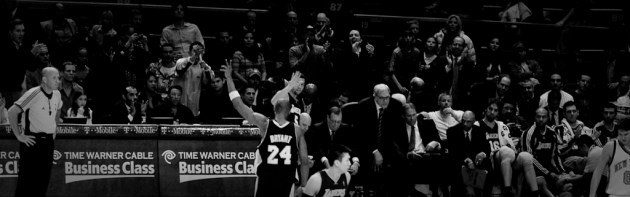
Kobe_Bryant_61_NYK3

“Kobe Bryant 61 NYK3,” by C.J. Iuzer.

The NBA regular season begins in a week, but there has been a lot happening already on the sports medicine front in the league.

From Paul George’s tib/fib fracture  to Kevin Durant’s ‘Jones fracture’  to Anthony Davis’ ‘wrist sprain,’  the athletic trainers, sideline physicians, and orthopaedic surgeons have had a busy ‘off season.’

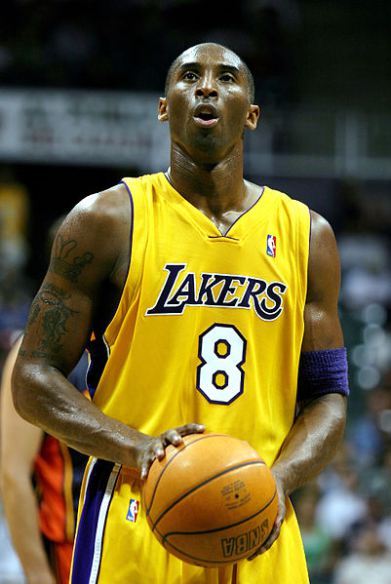
And then, there is the question of Kobe.  He has been in the press a lot!

The NY Times recently had an interesting chat with the Kobe and Arianna Huffington, a unique friendship to say the least.  It seems Kobe is indeed looking at his future, however many seasons he may have in front of him.  And before he has even taken a shot in the regular season, pundits aplenty have shared their skepticism about his ability to perform on the court:  seems like a lot of folks are betting Kobe will be an albatross around the neck of the Lakers.

As most readers would know, Kobe Bryant ruptured his Achilles tendon at the end of the 2013 season. We blogged about it at the time (I’m reblogging the original post below) and discussed the pros/cons of operative vs. non-operative treatment of such injuries.  The issues of managing Achilles tendon pathology find their way frequently into the pages of CJSM.  Two such articles I would especially commend to the readers as being particularly relevant to the question of Kobe’s ability to recover:   “Complications after surgery or non-operative treatment for acute Achilles tendon rupture,”  and “Does accelerated functional rehabilitation after surgery improve outcomes in patients with acute Achilles tendon ruptures?”

Kobe, of course, went through operative treatment and an accelerated rehab.  His 2014 season was cut short because of a knee injury.  For the brief time he played, it would seem his Achilles held up quite well.  I suspect his knee injury was of the sort we saw after the NBA lockout, where a prolonged layoff from the sport can lead to higher rates of injury; that is, I think his knee injury was more linked to a prolonged absence from high-level running and jumping related to his prolonged recovery from Achilles tendon surgery.  A similar process was involved in Derek Jeter’s case, where a quick return from one injury (ankle fracture) led to a season-ending issue in another body part (quad strain).

I wouldn’t bet against Kobe, no sir.  He is as tough as they come, and throughout his career he has been at the forefront of athletes employing cutting-edge concepts in training and recovery.   I don’t know about the Lakers as a unit.  But I think Kobe can make some headlines that are not related to injury this season.  Draining 61 points at Madison Square Garden one more time in his career?  I think the Black Mamba may just have it in him.

sportingjim's avatarClinical Journal of Sport Medicine Blog

Image Kobe Bryant

I woke up this morning to hear very sad news that occurred in the NBA last night:  Kobe Bryant has ruptured his Achilles tendon.

Kobe, who turns 35 this year, is one of the most recognized athletes in the world (maybe one of the few things that China and the USA can agree on). He had been leading his team to crucial victories as they were making a playoff run when he succumbed to this not uncommon injury in the middle aged athlete. 

As he is quoted saying, he made a move he had executed a ‘million times’ when he felt like someone had kicked him in the leg, and he subsequently crumpled to the ground.  This is the classic history one might obtain when caring for an athlete with such an injury.  If you watch the video, you’ll see Kobe perform a classic…

View original post 380 more words

The Black Cyclone

Jrobinson

#42, Jackie Robinson Photo by Bob Sandberg, Look

The intersection of art and sport, that’s the subject of my brief post today.  And who can get away from the subject of concussion in sport medicine these days?  So that’s in the mix too……

First, a quiz:  who is the first African-American to play professional football in the United States?

We all know Jackie Robinson broke the ‘color barrier’ in Major League Baseball.  April 15, the anniversary of that day in 1947, is now celebrated as a holiday in MLB, and his #42 is retired across the league.

But what of football?  I had thought the answer was Marion Motley of the Cleveland Browns, but it turns out I had the wrong man, and the wrong era.

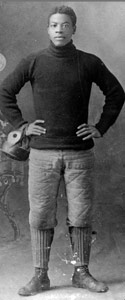
Charles Follis, a native Ohioan, played for the Shelby Athletic Club from 1902 – 06, and has the distinction of being the first black professional American football player.  He lived and played before the NFL even existed, and he is a subject of a play which I just watched, “The Black Cyclone.”

It’s a fascinating story and a wonderful play.  Malabar Farms, the venue where I watched the show, is equally enchanting, a true gem of central Ohio:  the working farm and former home of Louis Bromfield, an author and screenwriter as well as a man truly devoted to sustainable agriculture.  Malabar Farms is simply beautiful, and is perhaps best known as the place where Humphrey Bogart and Lauren Bacall (who died earlier this year) were married.
6531961_122590335060

Charles Follis, ‘The Black Cyclone’

The play was held in a barn on the farm, and was well attended.  The story of Charles Follis’ life has dramatic power and should deservedly be better known.  I felt somewhat chastened that I had never known his name prior to watching the play.  There is even a direct connection between Charles Follis and Jackie Robinson:  Branch Rickey*, the general manager of the Brooklyn Dodgers and the man who brought Jackie Robinson on to the team, was a friend and football teammate of Charles Follis.

One of the more fascinating moments of the evening was what I saw as the intersection of my sports medicine life and this story.

Charles’ younger brother Curtis died when they were both young men playing football. The scene is recreated on stage. Curtis is playing football and gets tackled roughly by players who are none to happy to be playing against a black man. The actor demonstrates symptoms of a concussion; he returns to the playing field and is hit again, at which point–in dramatic fashion–he succumbs to ‘diffuse cerebral swelling.’

Head injury fatalities in youth football remain, unfortunately, a contemporary subject.  Only a week before watching this play, the national news was running the story of a New York high school player who died on the field after an on-field collision.

In Curtis Follis’ case, one might hope that should these injuries occur on the field in 2014, an athletic trainer or team physician would identify the first injury and hold the player from a return to the game.  It certainly is incumbent upon those of us caring for athletes to monitor the situation on the field, as underreporting of significant head injuries remains distressingly all too common:  in high school football more than 50% of such injuries are not reported by the players, according to a well-known 2004 CJSM study by McCrea et al. 

Better concussion management is also the subject of one of our podcasts:  take a listen when you have the chance. 

I do not know what plans the producers of the play have for taking ‘The Black Cyclone’ on the road, but I do hope it comes your way.  The Charles Follis story is most definitely one that should be better known.  The same can be said for Malabar Farms:  if you’re ever in central Ohio, it’s well worth the visit.

_______________________________________________________________

*Branch Rickey is deservedly famous for his instrumental role in integration of American sports.  As he put it, “Ethnic prejudice has no place in sports, and baseball must recognize that truth if it is to maintain stature as a national game.”

He should also be known as being instrumental in the introduction of batting helmets, a major step toward improving baseball player safety…..but that’s a subject for another post!