The Sports Gene: How Olympians are made (or born)

450px-Erika_Coimbra_2013

Erika Coimbra,
Brazilian Summer Olympian,
and one of the subjects of
“The Sports Gene”

The venues at Sochi are still, it seems, a work in progress.  Nevertheless, before the week’s end, we will (should?) see the Winter Olympic games start up.  Soon, we’ll get to watch some of the finest athletes in the world compete at their sport.

There has been a lot of talk about the on-going construction at the most expensive games in Olympic history, as well as the issue of gay rights and cultural sensibilities in Russia;  and there have been worries about the potential for terrorism.  But soon, when the competitions begin, I hope the focus will justifiably be on the athletes on the snow and ice.

Or in Tweet speak: #LetGamesBegin

I’ve not been consciously preparing for this elite sporting event, but rather coincidentally recently picked up a book that highlights elite athletes and has received a great deal of positive ‘buzz’:  The Sports Gene, by David Epstein.

You likely have heard of the book.  It has been receiving excellent reviews and is generating a lot of chatter in print, visual and social media.  On Monday, for instance, The Guardian hosted a live chat online with the author.  Subtitled, “Inside the Science of Extraordinary Athletic Performance,” the book delves into one of the ‘ultimate’ questions in sport:  nature or nurture, which is more important?  And, specifically, which is more important in the realm of elite sport?

Like many ‘ultimate’ questions, the real answer is not a clean, binary one.  That said, I walk away from reading this book thinking the bulk of the evidence is in favor of nature:  genetic endowments favor the production of elite athletes. Read more of this post

#SuperBowlXLVIII

800px-NYC_Empire_State_Building

The iconic Empire State Building:
Super Bowl in view.
Photo: Daniel Schwen

After all the talk about Manning’s comeback, Sherman’s rant, the NYC vs. NJ rivalry, and the weather….we have come at last to Super Bowl Sunday. The high holiday of American football.

The collision, not just of two football teams but also of a vast sporting event and the NYC/NJ media megalopolis, has created predictable fireworks.  For example, you can tweet a prediction of who will win the game, with the hashtag #WhosGonnaWin, and determine the lighting color of the  Empire State building itself.

The power of the pen?  No, it’s the power of the tweet!

Getting back to the weather.  It has been frightful, both in North America and Down Under.  The Australian Open almost had player defections over the intense environmental conditions they faced from an uprecedented heat wave.  At the same, a polar vortex swept down over most of Canada and the USA bringing fears of hypothermia, frostbite and other assorted ills to outdoor exercise enthusiasts, sportsmen, and, possibly, spectators.  When all is said and done, however, it appears that Sunday’s Super Bowl game will be played under cold, but tolerable and dry conditions:  the most recent prediction I have seen suggests game time temperature should be just around freezing, and the skies should be clear.

I suspect the NFL commissioner Roger Goodell may have sought some help from Timothy Cardinal Dolan in supplicating the higher powers to ensure the Super Bowl would avoid becoming an Ice Bowl…..like the last time the NFL championship occurred in the NYC area, in 1962. Read more of this post

Pre-game intravenous hyperhydration, anyone?

The #NFL #SuperBowlXLVIII takes place this weekend, and we revisit one of our most talked about studies in the last few years.  Thanks to our Executive Editor Chris Hughes, @SportsDoc_Chris, for this 2011 post.

Chris Hughes's avatarClinical Journal of Sport Medicine Blog

The editorial in this month’s CJSM by Coombes and colleagues on Intravenous Rehydration in the National Football League highlights the widespread prevalence of the practice of pre-game hyperhydration as reported in the study by Fitzsimmons and colleagues, also in this month’s Journal here .

Fitzsimmons and colleagues surveyed the head athletic trainers of 32 NFL teams using an online survey tool and managed to achieve an impressive 100% response rate. They found that 75% of all teams had used pre-game hyperhydration with iv fluids, with an average of 5 to 7 players per team per game receiving intravenous fluids prior to play. The most common reasons for this strategy cited by trainers were to prevent muscle cramps (23 out of 24), prevent dehydration (19), at the request of the player (17), to prevent heat illness (14), and to improve player exercise tolerance (8).

It is somewhat alarming to find out that this practice…

View original post 177 more words

Rugby and #VegasBaby

The Sands

The vintage casino,
“The Sands,” no longer
with us, but there’s still a
lot of fun to be had in Vegas!

Vegas!  Rugby!  What a pair!

I just got back from the USA Rugby Sports Medicine conference, associated with the International Rugby 7s tournament stop in Las Vegas.  What a great weekend it was!  Ranging from the clinical sessions, to the sport, to the weather….to all that Vegas has to offer, it was brilliant.  I would heartily recommend this conference to any one in clinical medicine with an interest in the sports of rugby union, rugby league and rugby sevens.

Every year at this time, in Las Vegas:  it’s worth the trip.
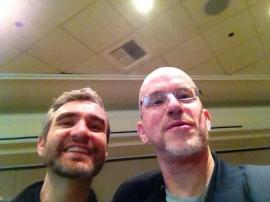
kerr macdoald

Drs. Hamish Kerr and Jim MacDonald:
‘selfie’ in between sessions.
Smiles = rugby matches about to commence


The conference proceedings began on Thursday night and wrapped up by late afternoon on Friday.  I had the chance to moderate some sessions.  I was so impressed with several of the speakers, recruited by my friend Michael Keating, Director of Medical Services, USA Rugby and the driving force behind this conference.

As the headline speaker on Thursday night Bob Cantu, MD. spoke about the 4th Consensus Statement on Concussion in Sport and Chronic Traumatic Encephalopathy (CTE).   Among the several other wonderful speakers on the two days, Hamish Kerr, M.D., Chair of the USA Rugby Medical and Safety Committee, spoke on several occasions, as did Jonathan Hanson, M.D. ( @SportsDocSkye ), coming all the way from the Isle of Skye in Scotland.  Dr. Hanson has worked with the Scottish Rugby Union for over a decade.  Between the two of them, the conference participants got a great domestic and international perspective on the state of the sport and the associated medical management.

One of the most important lessons I gleaned from the proceedings is the existence of the excellent resource developed by the International Rugby Board (IRB) known as ‘rugby ready‘. This is an on-line resource that can be used by clinicians, parents, players, coaches, referees.  Subjects range from those which introduce the sport and its rules to best practices on injury prevention and management.  It’s fabulous, and I think represents a ‘best practices’ model:  I yearn for something similar for American Football, a one-stop site I could share with parents of youth who question me about the medical issues of getting their kids involved in that sport.

American football has a lot to learn from rugby, indeed.

FIJI fan

Fijian fan celebrating his team’s try.
Flags of all nations flew this weekend
over Sam Boyd Stadium, Las Vegas

So, after the conference proceedings, what was the natural next step?  Heading to Sam Boyd stadium, outside of the city, to take in the sport and pageantry of the Rugby7s tournament that took place this weekend.  Under sunny, dry, 70 degree blue skies, the teams played several competitive matches, culminating with a South African victory over New Zealand in the championship cup draw.  It was such fun to soak in the culture as well–yes culture and rugby do not represent an oxymoronic pairing of words!!!  Such fun to see the Samoan fans, the Kenyan and Uruguayan fans, the French, Fijian…..the flags, the chants, the celebrations, the dancing to the beat of Bob Marley.   It was a great scene.  To my mind, it was everything sport should be.

As I wrote in my last post, we feature rugby fairly frequently in the pages of CJSM (you can check this link to see some of the offerings under keyword ‘rugby’).   As ever, check the journal out for its rich offerings of a variety of sports and clinical medical topics, follow us @cjsmonline, and keep tabs on this blog.  It may be cold in the Northern Hemisphere, but we have some topics as hot as an Australian Open match coming up soon in the journal and blog.

the macarena

Fans doing ‘the macarena.’
EVERYONE, players and spectators,
exercising at Rugby7s!