Ovid Concussion to consequence Webinar – Managing Sport-related Concussion On & Off the Field – Tuesday 18th October 2011 12:00pm EST

 Many of our readers will be involved on a regular basis with the management of sports participants with concussion, whether that is at the pitch side, at the training ground, or in a secondary or tertiary care environment.

As part of the Ovid webcast series, there is a forthcoming event on the Management of Sport-related Concussion both on and off the field on  Tuesday, October 18, 2011 at 12:00PM Eastern / 9:00AM Pacific time.


Margot Putukian, Director of Athletic Medicine at Princeton University, Past President of the American Medical Society for Sports Medicine, and member of the NFL’s Head, Neck and Spine Committee will be joining John D. Corrigan, Professor in the Department of Physical Medicine and Rehabilitation at Ohio State University and Editor-in-Chief of the Journal of Head Trauma Rehabilitation for a 60 minute discussion on what is known, and what is not known about managing concussion as an acute event – particularly in the context of sports, and as a marker within a person’s lifetime history of effects on brain functioning.

You can register for the Concussion to Consequence Ovid Webcast here.

For those of you who are not familiar with the Ovid Webinars and podcasts, these resources highlight a wide range of current issues in the health sciences and medicine and are well worth checking out. Archived Webinars can be found here, and the iTunes series of Ovid podcasts has free podcast downloads here.

Most of you will be familiar with the Consensus statement on Concussion in Sport from the 3rd International Conference on Concussion in Sport held in Zurich, 2008 which is available in full text online from CJSM, together with appendices including the second full Sports Concussion Assessment Tool (SCAT2) and Pocket SCAT2.

Some questions I have for our blog readers include :

1) How useful do you find the Pocket SCAT2 in practice? What are it’s pros and cons?

2) Are you using SCAT2 as part of preparticipation evaluation baseline screening and, if so, how useful do you find it?

3) What improvements do you think could be made to SCAT2 and the Pocket SCAT2?

CJSM would like to hear your views.

Leave a Comment

Leave a Comment

Abuse, Harassment and Bullying in Sport

 This month marks the publication of an important article in CJSM, the Canadian Academy of Sport and Exercise Medicine Position Paper on Abuse, Harassment and Bullying in Sport, and highlights the issue of safeguarding within the sporting environment.

I am sure that if we reflect on our own experiences whilst working within sport, most of us will be able to recollect incidents highlighting the important issue of safeguarding within the sporting environment. The problem of unacceptable behaviours is probably more widespread than we realise due to the likely under-reporting of events, longstanding cultural precedents, and the fine line that exists between acceptable strategies aimed at getting the best out of sports participants and unacceptable behaviours.

There have been some recent important claims and disclosures of unacceptable behaviours from prominent sporting personalities, including the legendary American boxer Sugar Ray Leonard,  UK Olympic diving hopeful Tom Daly, and Australian umpire Daryl Harper amongst others.

The CASEM paper highlights the definitions of the terms abuse, harrasment and bullying, citing the paper by Stirling published in the BJSM in 2009 ‘Definition and constituents of maltreatment in sport: establishing a conceptual framework for research practitioners.’  Risk factors and signs and symptoms of unacceptable behaviours are discussed together with recommendations for healthcare professionals working in sport, and practical advice on what to do in the event of disclosure and suspicion is given. In addition, there is advice on primary prevention, and on protecting oneself from spurious allegations of unacceptable behaviours.

There are a wide range of resources available for those working in sport on safeguarding issues including the following :

1) Respect in Sport

Sheldon Kennedy, former NHL player with Detroit Red Wings, Calgary Flames and Boston Bruins, is perhaps as famous for his disclosure of sexual abuse by his former coach and his work as a spokesperson for the prevention of unacceptable behaviours as he is for his fame as an NHL star. Sheldon founded Respect in Sport in 2004 together with Wayne McNeil, and their website provides an online certification program, together with links to other resources.

2) The UK-based National Society for the Prevention of Cruelty to Children website has a section devoted to safeguarding children and young people in sport, although the general principles and issues highlighted are equally applicable to adults. The NSPCC child protection in Sport Unit (CSPU) was founded in 2001 to work with UK Sports Councils, governing bodies and others to reduce risk to children of abusive behaviours during sporting activities. The website has a number of excellent resources including a series of videos of scenarios highlighting unacceptable behaviours to raise awareness.

3) The Bullying UK website, has a section devoted to the issue of bullying in sport and discusses amongst other things, important issues to consider when introducing a sports club anti-bullying policy.

4) The youth sports psychology website blog has a section devoted to bullying in sports, and offers an opportunity for parents and others to share their experiences of unacceptable behaviours within the sporting environment and for mutual support.

5) Women Sport International’s sexual harrasment task force discuss sexual harassment and signpost to resources on their website. They also offer support for victims and for those who require further information.

6) The UK Government charter for action against homophobia and transphobia in sport, with signatories including the UK Football Association, Rugby Football League, Rugby Football Union and Law Tennis Association have their own facebook page which seeks to raise awareness of issues particularly relevant to these forms of unacceptable behaviours within sport.

The responsibility for safeguarding individuals within the sporting environment rests on the shoulders of all of those who are involved in sport, and this month’s CASEM position paper in CJSM acts as an significant resource and a reminder of this important issue. It’s free, so please signpost your colleagues to it as raising awareness is one of the most important steps we can all take. Awareness, planning, vigilance and effective action when necessary are key when it comes to preventing and dealing with unacceptable behaviours within the sporting environment.

CJSM would like to hear your views on safeguarding, and your experiences.

Keep safe.

Leave a Comment

Leave a Comment

France, Le Tour, cycling injuries and cycle helmets

Welcome back following a short break in France, during which I spent a week in the Languedoc admiring the scenery and enjoying the French hospitality. Not everyone was as lucky as I was to be taking things easy, however, and Le Tour was in full swing during my time there, this being the 98th edition of the race since it was first held in 1903. The gruelling 21 stages run over 23 days covers a distance of 3430 km, and the race is a real test with a chequered and interesting history.

This year’s Tour was won by an Australian for the first time, Cadel Evans, who gained the lead on the penultimate day.

As usual, there were a number of casualties, mostly from crashes involving some high profile riders. These included Britain’s Bradley Wiggins who crashed out on stage 7 of Le Tour with a fractured clavicle during a pile-up which can be seen in this Guardian UK video footage . Others injured during the race included Andreas Klöden, Alexandre Vinokourov, Janez Brajcovic, Jurgen Van Den Broeck and Chris Horner who were all unable to continue the race due to their injuries.

Again this year, a large proportion of serious  injuries were caused by collisions with vehicles, including an incident with a car involved with TV coverage which resulted in injuries to Juan Antonia Flecha and Johnny Hoogerland and led to Christian Prudhomme, Tour organiser, to say ‘It’s a scandal.’ Hoogerland’s dramatic lacerations following his collision with barbed wire can be seen in this image. In addition, Nikki Sorensen was struck by a photographer on his motorbike.

For a useful review of injuries associated with cycling, see this 2001 article by Thompson and Rivara published in American Family Physician.

Those of us who are perhaps more used to keeping safe whilst cycling in the streets might be more interested in this article published earlier this year in Injury Prevention by Lusk and colleagues, based on regional data from Montreal, which highlights the differences in injury rates between cycling on cycle tracks compared with comparable reference streets. The study found that the relative risk of injury on cycle tracks was 0.72 (95% CI 0.60 to 0.85) compared with cycling in reference streets, suggesting that the risk of injury from cycling on tracks is less than cycling in the streets.

A key element of road cycle safety surely has to be legislation for the mandatory use of helmets which still hasn’t found it’s way here in the UK. This is perhaps regretful – especially following the introduction of the London Cycle Hire Scheme which merely advises riders to consider wearing a cycle helmet . The British Medical Association currently supports the introduction of legislation, but this is opposed by the Transport and Health Study Group. Whether or not the position on mandatory laws for cycle helmets in the UK will change in the future may well depend on reaction following  the recent publication of the ‘Health on the Move 2’ report .

Historically, Australia has taken the lead Internationally on compulsory cycle helmet laws which have been enforced there since 1990, with New Zealand following suit in 1994. Read more about issues related to cycle helmets in Australia and Internationally on this interesting Australian website.

A recent bmj.com poll on the compulsory wearing of helmets by adult cyclists resulted in 68% of respondents (n=1439) voting no to the idea of mandatory wearing of helmets. The BMJ blog led to a lively debate on the topic. Despite the controversy, I for one will continue to wear my cycle helmet whilst cycling on the roads.

Do you think that there should be world-wide mandatory legislation for cycle helmet wear for road cyclists? CJSM would like to hear your thoughts on this – feel free to post your comments on the blog.

Vote on our quick poll on the issue on our website front page here.

(Pictures from mIKL194FV and AFP) 

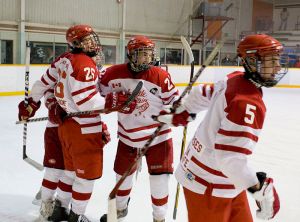
Atoms and Pee Wees – age classification nomenclature in Ice Hockey

Raaii and colleagues’ article in this month’s CJSM concerning patterns of mouthguard utilisation in minor hockey players introduced me to the terms ‘Atom’ and ‘Pee Wee’ as applied to Ice Hockey.

I had heard of ‘Pee-Wee Herman’ before, Paul Rubens’ fictional comedic character, and ‘The Mighty Atom,’ Sydney Charles Wooderson MBE who was one of Britain’s greatest middle-distance runners in the 1930s and 40s,  but had not heard of the terms ‘Atom’ and ‘Pee Wee’ as applied to Ice Hockey. After a little research, I was able to find out that they refer to specific age categories.

The relevant age categories in Canada are as follows – Mini-mite (1-2 years old), Mite (3-4), Tyke (5-6), Novice (7-8), Atom (9-10), Pee Wee (11-12), Bantam (13-14), Midget (15-17), and Juvenile (18-20).

Interestingly, the nomenclature is quite different between Countries. In the United States, for example, the Mini-mites category of players are aged 5-6 years old, with Mites from 7-8, Squirts 9-10, Pee-Wees 11-12, Bantams 13-14, Midget-minors 15-16, Midget-majors 15-18, and Juniors of ages 16 and over.

In France, there are moustiques aged 9 and under, Poussins 10-11, Benjamins 12-13, Minimes 14-15, and cadets 16-18. The relevant age categories as defined by the German Ice Hockey Federation in Germany consist of Kleinstschüler (bambini) aged 8 and younger, Kleinschüler 9-10 years old, Knaben 11-12, Schüler 13-14, Jugend 15-16, and Junioren 17-18.

In Switzerland, the Schweizerischer Eishockeyverband (Swiss Ice Hockey Federation) defines ages categories for Bambini (9 years old and younger), piccolo (10-11), Moskito (12-13), Mini (14-15), Novizen (16-18), and Junioren (19-20).

The Swedish Ice Hockey Federation defines perhaps more conventional nominal age categories of U11 (11 and younger) and above for each age from U12-U16, with U18 and U20s categories.

A few issues come to mind here. One relates to the differences in the age categories for the same named categories in different Countries which could be confusing to some. For example, the Mite category in Canada describes those aged 3-4, but in the US the term would refer to the 7-8 year old category.

Another issue concerns the names for the age categories themselves. Whilst some of them might be considered as quaint by some, and might indeed possess a certain National and cultural heritage, to others the age category names might appear to be strange or at worst, even insulting. For example, the term ‘squirt’ is defined in the Oxford English Dictionary as a ‘puny or insignificant person,’ or in the US Oxford English Dictionary as an ‘insignificant, impudent or presumptious’ person, and as such would be seen as an insult to many people.

Should we be moving towards using an accepted International standard nomenclature for age categories in Ice Hockey based perhaps on the Swedish system, or do you think that we should continue to encourage the use of regional nomenclature? Let us know your thoughts. In the meantime, it would seem that it pays to know your Pee Wees from your Midget-majors !

(Original photographs by Thund3rh3art and Jason Bain)