National Collegiate Athletic Association targeted for legal action on the issue of concussions amongst student athletes

There was an interesting article in the New York Times this week highlighting a recent class action lawsuit aimed at the NCAA over alleged negligence in relation to prevention and treatment of brain injuries in athletes.

The action represents the first attempt to target the NCAA rather than individual colleges or schools, as pointed out by Nikki Wilson on the Collegiate and Professional Sports Law Blog. Four plaintiffs, three with a history of participation in College football and one who played soccer, have filed lawsuits alleging a ‘long-established pattern of negligence and inaction with respect to concussions and concussion-related maladies sustained by (the NCAA’s) student athletes.’

There are a wide range of claims made, including allegations that the NCAA has failed to implement :

– A support system for players unable to continue to play or lead a normal life after sustaining concussions

– Legislation addressing treatment and eligibility of players who have sustained multiple concussions

– Guidelines for screening and detection of head injuries

– Return-to-play guidelines for players who have sustained concussions

– Effective ways of addressing or correcting coaching of tackling methods that cause head injuries

One plaintiff, Adrian Arrington, claims to have suffered ‘numerous and repeated concussions’ during his playing time at Eastern Illinois and now is alleged to suffer from memory loss, depression, and near-daily migraines as a result. The lawsuit claims that the NCAA ‘..has failed its student-athletes choosing instead to sacrifice them on an altar of money and profits.’

Perhaps unsurprisingly, Donald Remy, the NCAA General Counsel and Vice President for legal affairs, has called the lawsuit ‘wholly without merit.’

The organisation responded by stating that ‘..the NCAA has been concerned about the safety of all of its student-athletes, including those playing football, throughout its history,’ and claimed that ‘..we have specifically addressed the issue of head injuries through a combination of playing rules, equipment requirements, and medical best practices.’

The NCAA and the CDC have collaborated to create educational resources for coaches, student-athletes, medical staff and college sports supporters. The NCAA Sports Medicine Handbook has 4 pages on concussions including information on symptoms, and has a revised management plan for all athletes with concussion.

The outcome of the legal actions will no doubt be watched closely by all former college athletes who believe that they may be suffering from ongoing symptoms as a result of repeated concussions during play.

For a further discussion on the lawsuit issues, readers can listen to the EDUsports podcast on the subject.

In the meantime, CJSM would like to hear your thoughts.

Leave a Comment

Leave a Comment

France, Le Tour, cycling injuries and cycle helmets

Welcome back following a short break in France, during which I spent a week in the Languedoc admiring the scenery and enjoying the French hospitality. Not everyone was as lucky as I was to be taking things easy, however, and Le Tour was in full swing during my time there, this being the 98th edition of the race since it was first held in 1903. The gruelling 21 stages run over 23 days covers a distance of 3430 km, and the race is a real test with a chequered and interesting history.

This year’s Tour was won by an Australian for the first time, Cadel Evans, who gained the lead on the penultimate day.

As usual, there were a number of casualties, mostly from crashes involving some high profile riders. These included Britain’s Bradley Wiggins who crashed out on stage 7 of Le Tour with a fractured clavicle during a pile-up which can be seen in this Guardian UK video footage . Others injured during the race included Andreas Klöden, Alexandre Vinokourov, Janez Brajcovic, Jurgen Van Den Broeck and Chris Horner who were all unable to continue the race due to their injuries.

Again this year, a large proportion of serious  injuries were caused by collisions with vehicles, including an incident with a car involved with TV coverage which resulted in injuries to Juan Antonia Flecha and Johnny Hoogerland and led to Christian Prudhomme, Tour organiser, to say ‘It’s a scandal.’ Hoogerland’s dramatic lacerations following his collision with barbed wire can be seen in this image. In addition, Nikki Sorensen was struck by a photographer on his motorbike.

For a useful review of injuries associated with cycling, see this 2001 article by Thompson and Rivara published in American Family Physician.

Those of us who are perhaps more used to keeping safe whilst cycling in the streets might be more interested in this article published earlier this year in Injury Prevention by Lusk and colleagues, based on regional data from Montreal, which highlights the differences in injury rates between cycling on cycle tracks compared with comparable reference streets. The study found that the relative risk of injury on cycle tracks was 0.72 (95% CI 0.60 to 0.85) compared with cycling in reference streets, suggesting that the risk of injury from cycling on tracks is less than cycling in the streets.

A key element of road cycle safety surely has to be legislation for the mandatory use of helmets which still hasn’t found it’s way here in the UK. This is perhaps regretful – especially following the introduction of the London Cycle Hire Scheme which merely advises riders to consider wearing a cycle helmet . The British Medical Association currently supports the introduction of legislation, but this is opposed by the Transport and Health Study Group. Whether or not the position on mandatory laws for cycle helmets in the UK will change in the future may well depend on reaction following  the recent publication of the ‘Health on the Move 2’ report .

Historically, Australia has taken the lead Internationally on compulsory cycle helmet laws which have been enforced there since 1990, with New Zealand following suit in 1994. Read more about issues related to cycle helmets in Australia and Internationally on this interesting Australian website.

A recent bmj.com poll on the compulsory wearing of helmets by adult cyclists resulted in 68% of respondents (n=1439) voting no to the idea of mandatory wearing of helmets. The BMJ blog led to a lively debate on the topic. Despite the controversy, I for one will continue to wear my cycle helmet whilst cycling on the roads.

Do you think that there should be world-wide mandatory legislation for cycle helmet wear for road cyclists? CJSM would like to hear your thoughts on this – feel free to post your comments on the blog.

Vote on our quick poll on the issue on our website front page here.

(Pictures from mIKL194FV and AFP) 

World Cup time in Germany for the International Women’s Football Teams

It’s an exciting time in Germany right now as the Women’s Football World Cup kicked off today with the hosts off to a winning start against Canada, and with France beating Nigeria.

Since 1991, the tournament has been held every 4 years, this being only the second time that the tournament has been staged in Europe since it was last hosted by Sweden in 1995. Germany will be looking to win the Cup for the third time running, and as hosts are the current favourites and the team to beat according to most commentators. There are 16 teams competing for the title, with the final taking place on the 17th of July in Frankfurt.

Having had the privilege of working with the England Women’s under 23’s team for a few years prior to taking on my current role with Leyton Orient FC, I am taking a particular interest in the England Women’s team and hoping that they will go at least one step further than the quarter final stages which is the furthest they have gone so far in the tournament last time out in China in 2007 and in Sweden in 1995. Another fan is my 12-year old niece Anna, who plays for a local team in Sheffield. They had a great season and managed to win their local Cup tournament this year making this uncle particularly proud!

I have nothing but the greatest of respect for top-level Women Footballers who are incredibly dedicated athletes, often competing in a world far removed from that of their male International counterparts and receiving only a fraction of the financial rewards of the men. They commonly work in other occupations or are to be found studying for qualifications in their spare time, all the while pursuing their careers as top-level International athletes. Their level of dedication and training matches that of the men for the most part, and I have found them an absolute pleasure to work with and have been humbled by their dedication to their Sport.

I had the pleasure of watching the England Women’s measured performance during their 2-1 win against the USA earlier this year in preparation for their World Cup bid. The game was held at our very own Brisbane Road stadium, my team Leyton Orient’s home ground, and I had the fortune to sit back, relax, and watch the game as crowd doctor on that occasion. England got off to a great start with 2 early goals and managed to keep in front until the end, despite a goal from the visitors and a USA-dominated second half.

Women’s Football is not without its particular problems when it comes to injuries, with most of us being aware of a well-documented significantly increased risk of ACL injuries in women when compared to their male counterparts. Hartmut and colleagues’s 1 year prospective study of the Women’s Bundesliga published last year in CJSM followed up 254 players from all 12 Women’s Premier League teams in Germany and reported an injury rate of 3.3 per 1000 hours (games 18.5 per 1000 hours ; practice 1.4 per 1000 hours). Most of these (31%) were ankle injuries, with 22.1% knee, 12.9% thigh, and 7.1% head injuries, with a seasonal peak towards the start of the season and with injury rates doubling in the last half an hour of play. The authors noted that most of the severe injuries were non-contact injuries, and speculated that these may well be prevented by ‘certain coordinative training methods’ (Hartmut G et al, 2010). 

This FIFA health and fitness guide for players and coaches, written by Katharina Grimm and Donald Kirkendall and based on original articles published as a supplement on Women’s Football in the British Journal of Sports Medicine in 2007  ,explains some injury prevention strategies for women footballers, and includes the ‘PEP’ programme (Prevent injury and Enhance Performance) with specific exercises focussed on the prevention of the more common injuries including ACL injuries, ankle and head injuries. It also provides additional useful information about nutrition, bone health and some more general topics in a format friendly to coaches and players. Well worth a read.

(picture by WOGERCAN10)

When Anatomy meets Technology – Learning and Educating with Anatomy Apps

With over 108 million iPhone sales since 2007 and rising, together with 60 million iPod touch sales and 25 million iPads, there is a now a huge global userbase for applications (Apps) on these devices with over 425,000 Apps in total available in the App store.  Android-capable mobile phones are also growing in popularity, and these have their own applications for use on these devices.

An App store search using ‘anatomy’ reveals 372 iPhone and iPod touch compatible anatomy Apps, together with 170 dedicated iPad anatomy Apps. Some of these show images of anatomy, some are ‘flash cards’ and some have integrated quizzes.

Anatomy apps can be useful for both learning anatomy and for using as an educational tool in  a patient consultation. Given the portability of the iPhone, iPod touch and iPad, it is easy to use these Apps in the clinic, at the training ground, or whilst on tour with teams, and most of the Apps do not require internet access to function once they have been downloaded.

Some of the better Apps have the ability to add notes and annotations to diagrams, and to view structures from multiple angles with magnification. Whilst the detail is sometimes limited, there is often more than enough to be able to use an App to help to explain the relevant structures to patients in order to improve their understanding of their injuries, and indeed to learn some of the anatomy that a Sports Physician might need. However, the extensive detail is often lacking, so there is room for improvement.

Here are my ‘Top 5’ Anatomy Apps currently available in the App store :

1) Pocket Body – The Interactive Human Body (iPad / iPod Touch / iPhone) (App store link here)

This App by eMedia Interactive LTD has a 9-layer graphic of the human body, with 4 views (anterior, left lateral, posterior and right lateral), and the images magnify up nicely without significant pixellation. Muscles, bones, tendons, vessels and nerves are all shown. Pins are attached to most of the muscles, and a quick press reveals the origin, insertion, key relations, functions, and innervation and vascular supply. In addition, some clinical notes are shown although these are somewhat limited in scope and not always accurate. It is possible to add your own notes, and to edit these. Many of the pins attached to nerves are red, and indicate the structures but give no additional detail although you can add your own notes and indeed can add your own pins on the model.

There are 3 different quizzes available – a ‘locate pins’ quiz, an MCQ, and a flash card type quiz and these can be set to examine any particular region. In addition, there is the ability to take a screenshot of an image and to share the image by email, post on your Facebook page or link to Twitter, or save to your device. This is a great App for learning the basics of musculoskeletal anatomy, and for showing relevant structures to patients.

2) Muscle System Pro II (Nova Series) and Skeletal System Pro II (Nova Series) (iPad / iPod Touch / iPhone) (App store links here – muscle & skeletal)

These are 2 separate Apps by 3D4 Medical, and show some really quite beautiful images, with the ability to view from many different angles. The image pins link to information boxes. The information on muscles shows origin, insertion, action, innervation and vascular supply. There is also the ability to add your own notes. Individual structures can be shown such as different bones, with excellent quality images when fully magnified, and with much anatomical detail. There are quizzes, although these are somewhat easy for anyone except novices. The images are probably the best available on these devices and are particularly impressive on the iPad, and these can be shared by email or social networking applications.
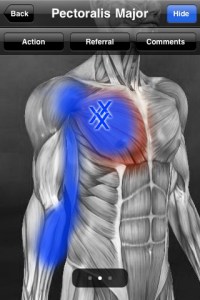
3) Muscle Trigger Points (iPod Touch / iPhone / iPad) (App store link here)

This App by Real Bodywork acts as a reference for common muscle trigger points. There is information on over 70 muscles and 100 different trigger point patterns, with information on the action of the relevant muscles and on the referral pain patterns. There is a 3D model which rotates in 2 animations to anterior and posterior images showing the different muscles, and muscles can be viewed individually from a list, or by choosing ‘zones.’ Real Bodywork provide a number of other anatomy Apps in addition to the Muscle Trigger Point App, including a ‘Learn Muscles’ App, a muscle and bone anatomy 3D for iPad, and skeletal anatomy 3D quiz and reference.

4) Instant Anatomy Lectures, Flash Cards, A/V Lectures and MCQ Apps (iPad / iPod Touch / iPhone / Android) (App store link here)

Robert Whitaker has been offering a number of excellent resources from his Instant Anatomy series for a number of years now. These originally started with books, going on to CD ROMs, and now a series of Apps. There are podcasts of anatomy lectures, video podcasts, and flash card Apps. This series of Apps offers some quite wonderful learning material, especially for the novice, and a great way to learn anatomy. The diagrams are easy to understand, although are more suited to learning than to explaining structures and pathology to patients. Some of the Apps are free on the App store, offered as ‘tasters’ with limited information, so you can try them out for yourself. Highly recommended for medical students and those re-engaging with anatomy after a while.

5) Aspects of Anatomy (iPad / iPod Touch / iPhone) (App store link here)

This App was developed by my one of my former anatomy teachers at University College, London, Professor Peter Abrahams, who is now Professor of Anatomy at Warwick University. He is also one author of the excellent ‘Essentials of Clinical Anatomy’ text. It consists of a series of 38 short (3-8 minute) lectures on a number of plastinated specimens, together with some related clinical information on related topics such as Colles fracture. In addition, imaging modalities are included, together with ‘spot’ quizzes (don’t I remember those during my Anatomy finals!) and clinically relevant MCQs. This is a wonderful resource for medical students and those revisiting anatomy.

CJSM would be interested to hear about your favourite Anatomy Apps, and how you use them in your clinical practice.