Wild at Heart

Mt_Adams

Mt. Adams, in the Cascades. Photo by Pugetopolis, Wikimedia

September is here, and the first of the month is when we would normally be publishing the fifth edition of CJSM for 2015.  But ‘things’ are a little special this time around.

We’re publishing on 9/9/15 this year, after the Labor Day weekend in the USA has passed.  And we’re not just ‘publishing,’ we are ‘co-publishing’:  along with Wilderness and Environmental Medicine (WEM), the official journal of the Wilderness Medical Society (WMS), we are producing a themed issue on the pre-participation evaluation of adventure and wilderness athletes.

And so, while President Obama is making his own mountain news with the change of a name, we’ll be looking to make a mark in the media and social media with this special wilderness issue (perhaps not as big — @POTUS has almost 4 million followers on Twitter).

We publish research relevant to this world of adventure/wilderness medicine frequently.  In the blog, in the last year, I have written about ‘High Altitude Medicine,’ risk factors for Acute Mountain Sickness (AMS) , and the Badwater 135, the ultra-marathon run through Death Valley in the summer time. In the journal, we have recently published the Canadian Academy of Sport and Exercise Medicine (CASEM) Position Statement on High Altitude Medicine; original research on the renal function of runners participating in an Ultra-Distance Mountain run; and multiple case studies involving adventure athletes, including this interesting one on the ‘heel-hook’ rock climbing maneuver, creating a specific pattern of knee injury.

What is so special about the September 2015 issue is that members of the American Medical Society for Sports Medicine (AMSSM) and the WMS collaborated on the project–the editors and individual authors were members of either or both AMSSM and WMS.  And the final product–a series of articles focused on primary injury prevention and pre-participation evaluation of this special type of athlete–is being co-published by WEM and CJSM.  It’s the culmination of a process nearly two years old, and took the effort of a great many people to put into production.

We have planned several posts and a podcast to highlight various aspects of the new issue.  You’ll be hearing a lot about it, here on the blog and on our social media feeds. You’ll here about it in this podcast too!   And, most importantly, we hope you visit cjsportmed.com to read the issue itself.

Let the adventure begin……

Rugby’s Big Year(s)

IMG_1008

Sam Boyd Stadium, Las Vegas Nevada, site of the annual Rugby 7s tournament.

It’s amazing how time flies.  How is it already March?

It’s almost 7 p.m. and I’m writing by the light of a sun that is still above the horizon, thanks to one of my favorite inventions of the modern world: daylight savings time, which arrived last night.

This realization is a personal reminder, however, that I have been delinquent: meaning to write a blog post about an event that took place three weeks ago…..but, my oh my, business has just swamped me, I guess.

As the swallows return annually to San Juan Capistrano, so do the Rugby 7 squads of Kenya, South Africa, New Zealand and other countries come each February to the desert:  Las Vegas hosted the USA leg of the HSBC Sevens Series Feb 13 – 15.  It is the largest annual rugby tournament held in North America. and Las Vegas has been its host since 2010.

As followers of the blog will know, USA Rugby conducts an outstanding medical symposium every year just prior to the tournament, and I was out for some education as well as sport.  It was a fabulous conference, and I do hope you all get a chance to attend some day.

Tim Hewett, who is well known to readers of this blog, gave a great talk on original research of the difference in injury rates between collegiate rugby and American football players.  We are most definitely looking forward to seeing that research published.  Hey, Tim, if you’re looking for a place to send that manuscript for peer review, send it our way.

His colleague from Ohio State, the orthopaedic surgeon and OSU Team Doc Chris Kaeding, gave a great talk as well, regarding data on knee outcomes coming out of the ‘Multicenter Othopaedic Outcomes Network,’ or MOON group, some of whose research we have published in CJSM.

With the George North story on everyone’s mind, we were all eager to hear what concussion experts such as Chris Nowinski of the Sports Legacy Institute had to say about minimizing injury risk in rugby.  Nowinski presented one of the best and most nuanced talks I have heard on the ‘concussion crisis’ in sports. I enjoyed it so much I caught up with him after the conference, and the interview I had with him is now available as a podcast. Read more of this post

In honour of the Grey Cup

Series 975 - Primary photographs of Gilbert A. Milne & Co. Ltd.

Celebrating with the Grey Cup

The Grey Cup, the ‘Super Bowl’ of the Canadian Football League, is being contested this evening in Vancouver. The Hamilton Tiger-Cats face off against the Calgary Stampeders, and it promises to be an exciting contest.

We are proud of the diverse background of our many contributors to this peer-reviewed journal, who range from academics to clinicians who are ‘in the trenches.’ One of those on the front-lines is David Levy, M.D., the Medical Director for those Hamilton Tiger-Cats.

His piece from the 2012 CJSM, on a ‘risk-tolerance approach’ to assessing athletes undergoing a pre-participation evaluation (PPE), is always worth a read; perhaps never more so than in light of our most recent CJSM piece on advancing the PPE.  While you’re at it, catch our podcast conversation with William Roberts, lead author of that new PPE statement.

And then sit down to enjoy the Canadian football action.  Good luck to Dr. Levy’s Tiger-Cats, and good luck to their opponents, the Stampeders, as well.

Chris Hughes's avatarClinical Journal of Sport Medicine Blog

This month’s Editorial in CJSM by Levy and Delaney highlights the issue of the role of the Team Physician in the process of the Preparticipation evaluation.

Team Doctors are often called upon to make a decision about the suitability of an individual for return to play. In this role, the burden of responsibility for the decision making process is likely to lie with the clinician, at least in the first instance, whether or not the team manager and the player decide to follow their advice.

Few would argue that the clinician is best placed to make a definitive ‘medical’ decision on return to play decisions since they are likely to have the most educated opinion about decisions related to the health of the player within the team environment. However, the question of where the responsibility should lie with the ultimate decision made is a contentious one.

In the context of…

View original post 676 more words

Sudden Cardiac Death: The Israeli Experience

dr jose garza

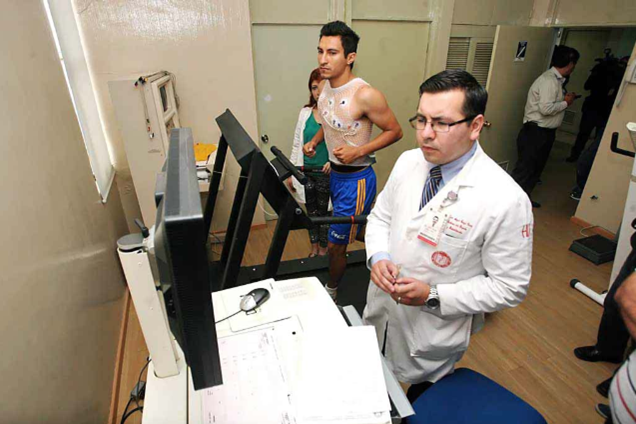
Dr. Jose Garza, conducting a stress test on an athlete, Monterrey, Mexico

Screening for sudden cardiac death (SCD) remains one of the more contentious debates in the world of sports medicine.  As a matter of public policy, consensus medical opinion in the United States still argues against universal, mandatory  screening with electrocardiograms (ECGs); whereas in Europe, specifically in Italy, ECG screening is more of a routine practice.

The debate over this screening is carried on at many conferences and in many medical journals, including ours.  We’ve previously looked at the question of whether it makes sense to screen North American athletes with ECGs, for instance.  Earlier this year, we published a review of the different approaches American universities are currently using regarding the issue of athletic cardiovascular screening.  Recently, the topic came up in the podcast discussion I had with Dr. William Roberts on new directions for the pre-participation evaluation (PPE).  American and European sport medicine bodies can find a lot of common ground in where the PPE can be improved, according to Dr. Roberts, with the principal exception of this one issue.

Recently, Dr. Sami Viskin, from the Department of Cardiology, Tel Aviv Medical Center, spoke at my home institution about how athletes are screened for SCD in Israel.  He has written extensively on the issue of screening athletes for SCD, including a study arguing that it is not a cost-effective strategy in the United States.  The title of his recent talk: “Mandatory ECG screening of athletes saves lives: proven fact or wishful thinking?”

Our Division of Sports Medicine has been hosting another international guest this past month: Dr. Jose Angel Garza, a sports medicine physician from the University Hospital of the Universidad Autonoma de Nuevo Leon (UANL) in Monterrey, Mexico. He was also present at Dr. Viskin’s talk, and I asked him for his reflections on the subject of mandatory ECG screening in athletes.

Thanks Joe!

________________________________________________

Among the sports medical community, there is an ongoing and often heated debate on whether mandatory ECG screening should be performed on athletes. Several countries such as Italy and Israel have implemented such measures. The European Society of Cardiology has issued recommendations about mandatory screening of athletes with ECG. So this begs the question: Does ECG screening save lives in athletes? Read more of this post