Like Turkey & Gravy: Thanksgiving and the NFL

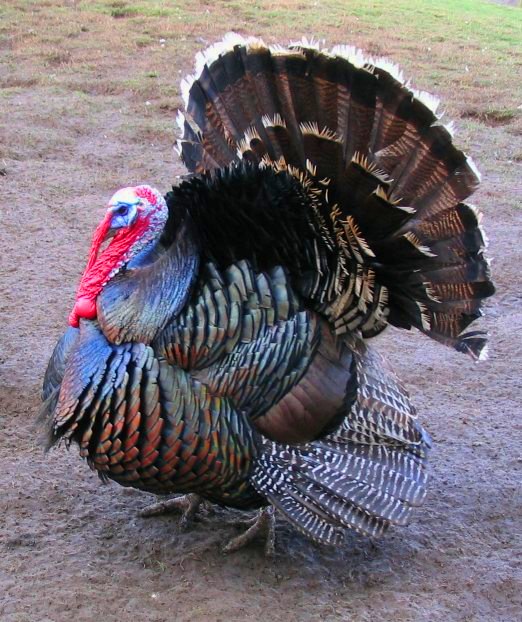
Male_north_american_turkey_supersaturated

Male turkey, photo courtesy of Nordelch.

Yep, they ‘go together’ …..well, maybe not like “….rama lama lama ka dinga da dinga dong,” but the fit is surely as tight and traditional as turkey and gravy.

Today is Thanksgiving; I have the day off; and I’ll be sitting down for a feast, both of food and of football.

The day is loaded with gridiron football:  Lions v. Bears, Cowboys v. Eagles, and Seahawks v. 49ers. The colleges, too, have some intriguing games:  can TCU win and perhaps leap into the top 4 of the college football playoff standings?

Whether or not you are a fan of their respective teams, who can’t get interested in the rivalry between Pete Carroll and Jim Harbaugh, which extends back to their days at USC and Stanford.

“We bow to no man, we bow to no program at Stanford football,” said Harbaugh.  And the two men–and programs they run–continue to go after each other at the professional level. The Seahawks/Niners game should be a good one.

Yes, it will be a great day to enjoy football.

It sure has been a difficult season to do the same.

The New York Times ran a very interesting piece in their Sunday magazine earlier this month:  “Is Football the Next Tobacco?” speculating on whether NFL quarterback will go the way of, well, the Marlboro Man.  America, the magazine of the U.S. Jesuits, also ran a thoughtful piece on ‘what will become of football.‘  And going from the angels to the devils, so to speak, the journalists at Vice sports wrote what I think is a very insightful analysis of what they term the ‘concussion-industrial complex.’  The author echoes many of my concerns over the nexus of sport/injury/fear/business that sports-related concussion has come to represent in modern sport.

Even Saturday Night Live has riffed on the subject, with a very funny segment that aired last week and lampooned several aspects of the ‘concussion crisis.’

On the evidence-based, sports medicine side, we continue to contribute to the conversation over how best to diagnose and manage concussions in our athletes.  In our most recent, November journal, we have a Letter to the Editor from the former President of CASEM Pierre Fremont which addresses concerns over an earlier editorial in CJSM on whether it is time to re-think the Zurich consensus statement and guidelines on concussion.  We were able to interview the authors of that statement in our first podcast; that would make an enjoyable listen for this holiday weekend.  And don’t forget to check our “Published On-Line First” section of the journal’s website, which includes a queue of original research articles that are lined up to be published in print in 2015….but can be viewed right now on-line.  The offerings include a study with important findings on what is special about pediatric concussions by Johna Register-Mihalik et al.

The topic of concussion comes up frequently in the blog as well, of course.  Our review of the television documentary, “League of Denial,” is just one of the many posts we have written on sports-related concussions over the last few years.

Football and feast:  whether you are enjoying this Thursday as the Thanksgiving holiday in the United States, or getting closer to your weekend elsewhere…..I hope you all have a restful and safe few days ahead of you.  For all of us here at CJSM, I can tell you this Thanksgiving how thankful we are to have you engaged with this journal in advancing the research into the health and safety of the athletes we al care for.

All the best.
Sudden Cardiac Death: The Israeli Experience

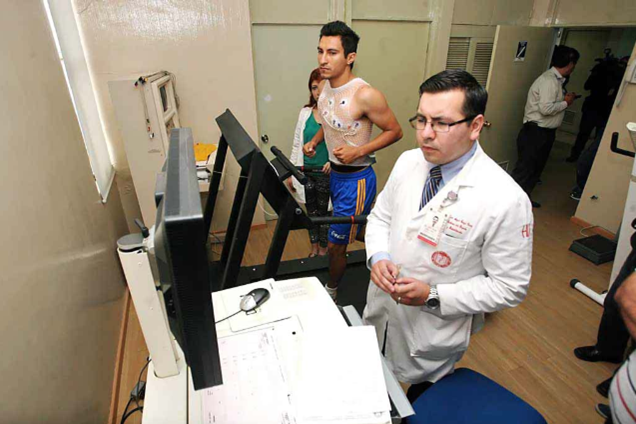
dr jose garza

Dr. Jose Garza, conducting a stress test on an athlete, Monterrey, Mexico

Screening for sudden cardiac death (SCD) remains one of the more contentious debates in the world of sports medicine.  As a matter of public policy, consensus medical opinion in the United States still argues against universal, mandatory  screening with electrocardiograms (ECGs); whereas in Europe, specifically in Italy, ECG screening is more of a routine practice.

The debate over this screening is carried on at many conferences and in many medical journals, including ours.  We’ve previously looked at the question of whether it makes sense to screen North American athletes with ECGs, for instance.  Earlier this year, we published a review of the different approaches American universities are currently using regarding the issue of athletic cardiovascular screening.  Recently, the topic came up in the podcast discussion I had with Dr. William Roberts on new directions for the pre-participation evaluation (PPE).  American and European sport medicine bodies can find a lot of common ground in where the PPE can be improved, according to Dr. Roberts, with the principal exception of this one issue.

Recently, Dr. Sami Viskin, from the Department of Cardiology, Tel Aviv Medical Center, spoke at my home institution about how athletes are screened for SCD in Israel.  He has written extensively on the issue of screening athletes for SCD, including a study arguing that it is not a cost-effective strategy in the United States.  The title of his recent talk: “Mandatory ECG screening of athletes saves lives: proven fact or wishful thinking?”

Our Division of Sports Medicine has been hosting another international guest this past month: Dr. Jose Angel Garza, a sports medicine physician from the University Hospital of the Universidad Autonoma de Nuevo Leon (UANL) in Monterrey, Mexico. He was also present at Dr. Viskin’s talk, and I asked him for his reflections on the subject of mandatory ECG screening in athletes.

Thanks Joe!

________________________________________________

Among the sports medical community, there is an ongoing and often heated debate on whether mandatory ECG screening should be performed on athletes. Several countries such as Italy and Israel have implemented such measures. The European Society of Cardiology has issued recommendations about mandatory screening of athletes with ECG. So this begs the question: Does ECG screening save lives in athletes? Read more of this post

Revisiting Bicycle Helmets: Injury Prevention for Kids and More

A year ago I wrote the blog post below, which I am re-posting today.  I wrote the post to coincide with the publication in the November 2013 CJSM of the Canadian Academy of Sports and Exercise Medicine (CASEM) position statement on mandated bicycle helmet use in Canada.

I was reminded of the statement–and the blog post–today as I came across an article posted on the Facebook page of CASEM related to a recent study published in the New England Journal of Medicine looking at the the causes of head injuries in children.  For those under high school age, falls–including those from bicycles–are an exceedingly common cause of head injury.  One striking statistic from the study, quoted in the article:  for children presenting to the ED with a head injury resulting from a bicycle accident, only 18% were wearing a helmet.

The post I wrote last year generated more responses I think than any other post I have written on this blog, and it warranted several follow up posts .  I was struck by the passion–and quite often, vitriol–of many people writing in.  It wasn’t my first introduction to troll-like behavior on social media, but it was possibly the loudest and most ‘international’ I have experienced to date.

I hope you have a chance to look at the articles contained in the links on this post and the ‘reblog’ below.  I think the approach to injury prevention, specifically relating to bikes and most specifically relating to ‘kids on bikes,’ should be multifactorial:  yes to improved road safety, yes to a different relationship between cars and bikes, yes to a built environment that is more accommodating to bikes and pedestrians–but yes as well to personal protective equipment, like helmets.

As ever, we are interested in your thoughts.  But I say with the utmost politeness:  please note that any post that I find does not contribute to a civilized discussion will not be posted on the discussion board.

All the best.

sportingjim's avatarClinical Journal of Sport Medicine Blog

The November issue of CJSM has been out for a week, and I hope you’ve had a chance to look at our latest offering.  It is also our last offering for 2013 (CJSM is a bimonthly, publishing 6 times a year).  The next time the journal will hit your mailboxes and inboxes will be January 2014.

FIMS 2014 Quebec City, site of the XXXIII FIMS
World Congress of Sports Medicine
CJSM will be there: will you?

2014 promises to be a big year in sports and sports medicine.  The Winter Olympics take place in Sochi, Russia; the FIFA World Cup is in Brazil; and the Commonwealth Games are in Glasgow, Scotland.   On the sports medicine front, the Canadian Academy of Sports and Exercise Medicine (CASEM) hosts the FIMS 2014 World Congress of Sports Medicine in Quebec City, and earlier in the spring the AMSSM annual meeting takes place in…

View original post 1,260 more words

Ebola and the Athlete

twitter rsa pic

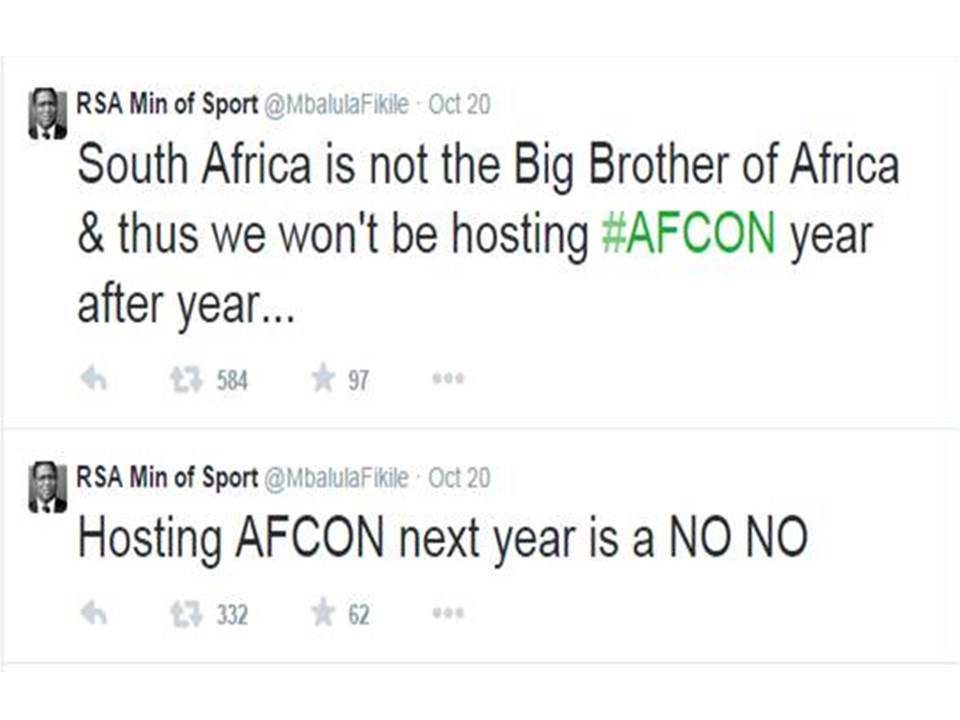
The South African Minister of Sport has tweeted a ‘no, thank you’ to being host.

The biennial Africa Cup of Nations (AFCON) is set to begin in January 2015. Organizers are still looking for a host.

Morocco was set to host the tournament but has pulled out because of the fears over Ebola contagion. The Republic of South Africa has already served notice that they will not volunteer to be alternative hosts:  the country’s Minister of Sport has tweeted that the RSA is “…not the Big Brother of Africa….” and will not be standing in as host for the Cup. As I understand it, the Confederation of African Football organizers are meeting November 2 to discuss solutions for what seems to be an impasse.

If sports is indeed a mirror of the culture, then it stands to reason that concerns regarding the Ebola virus would show up in sporting venues, training rooms, sport talk shows, and athletes’ twitter feeds.  The current outbreak of the virus is still largely confined to certain nations in W. Africa, but it  is the largest and most deadly one in history.  Sport, like society at large, is concerned.  How might teams handle potential exposures?  Must consideration be given to quarantining? Is it reasonable to target only those countries at the epicenter in W. Africa?  Is ‘quarantine-lite’ the way to go? Is it wise to consider having large numbers of people travel to and from one country, as in the case of hosting AFCON?

Carrier_of_diphtheria_keep_out_of_this_house_by_order_of_board_of_health.

A sign of things to come?

A generation or two ago–most especially in the pre-vaccine and pre-antibiotic era–the quarantine was a standard measure for handling outbreaks of contagious diseases in communities.  My mother describes how she and her whole family were quarantined after she developed strep throat as a young girl in the 1930’s.   In the modern world, however, the quarantine as a response to controlling Ebola has already come under heavy fire, at least here in the United States.

The intersection of public health, international sporting events, and an infectious virus is not unique to this moment in time, of course.  In 2010 CJSM published a thematic issue on “Emerging Issues in Sport Medicine,” and included among the many offerings an article on International Travel and the Elite Athlete as well as an article on Public Health Recommendations for Athletes Attending Sporting Events.The 2009 CJSM published original research on a novel, web-based approach to more carefully monitor illnesses in professional rugby union players.  These documents are potentially useful resources to help teams and sporting federations formulate responses to this newest challenge.

But I want to acknowledge that the Ebola virus raises issues which require a great deal more work to determine appropriate, evidence-based interventions.  Winter is coming in the Northern Hemisphere, and we know we should be offering our athletes influenza vaccinations. We have a ‘system’ to handle the flu.  What to do with a disease like Ebola for which there is no current vaccine let alone an established treatment?  Likewise, what to do in the case of a virus which does not pose an airborne exposure risk like the flu, but has a much higher case fatality rate when the virus is contracted?

Already, popular sentiment has begun ‘making’ decisions of a sort.   Read more of this post