Motor Vehicle Accidents: The Leading Cause of Death in Collegiate Athletes

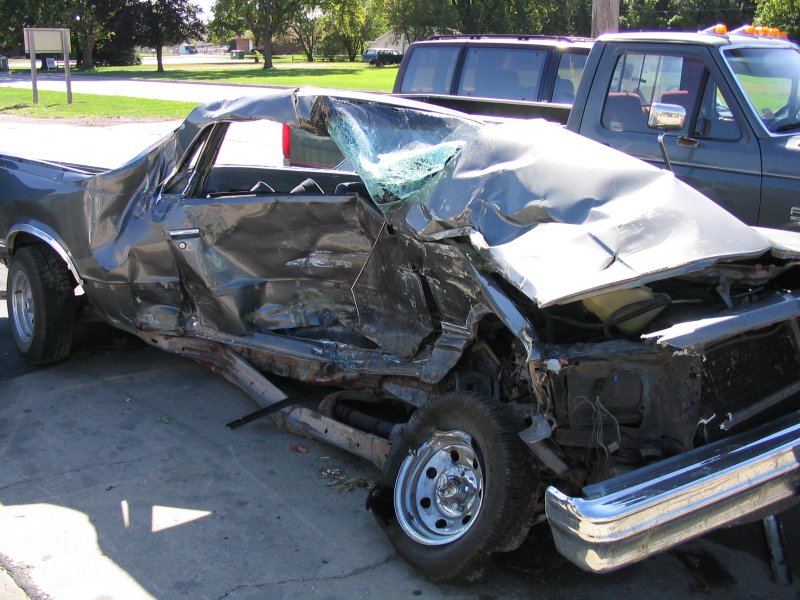
Car_crash_2

Motor Vehicle Accidents: the number one
killer of NCAA athletes

The title of today’s post is striking.

In sports medicine we focus–rightly–on entities such as sudden cardiac death, cervical spine injuries, second impact syndrome, exertional heat illness, hyponatremia……There  is a long list of conditions that can befall athletes which can cause serious mortality and morbidity.

But from a public health perspective, our priorities are possibly misplaced. At the very least I wonder sometimes if we may ‘strain at a gnat and swallow the camel‘ when we focus intensely on chest protectors and commotio cordis and say nothing about the use of seat belts in our athletes.

In August CJSM published ‘ahead of print’  “Motor Vehicle Accidents:  the Leading Cause of Death in Collegiate Athletes,” a study authored by I Asif, K Harmon, and D Klossner, authors who have published other epidemiologic work on sudden death in young athletes.  The data presented gave me pause. For all our concern about sudden death from hypertrophic cardiomyopathy,  to name one example, the data show that far and away the greatest threat to the young athletes under our care are accidents or unintentional injury.

The authors conducted a 5 year retrospective analysis using two data bases:  an NCAA database, and the “Parent Heart Watch” database.  This second database has an interesting history: a non profit group which began tracking sudden cardiac death in American athletes in 2000.   Various death rates were calculated, notably: 1) an overall death rate for athletes was found to be 13.86/100,000 athlete-years; 2) a death rate from accidents of 7.36/100,000 athlete-years; 3) a death rate from cardiac causes of 2.28/100,000 athlete-years; 4) a death rate due to accidents found highest in the sport of division I wrestlers, with a rate of 28.2/100,000 athlete-years.   Deaths from unintentional injuries occur at “….nearly twice the rate of all medical causes of death combined,” the authors note. Read more of this post
Concussions and Computerized Neurocognitive Testing

axon sport macdonald

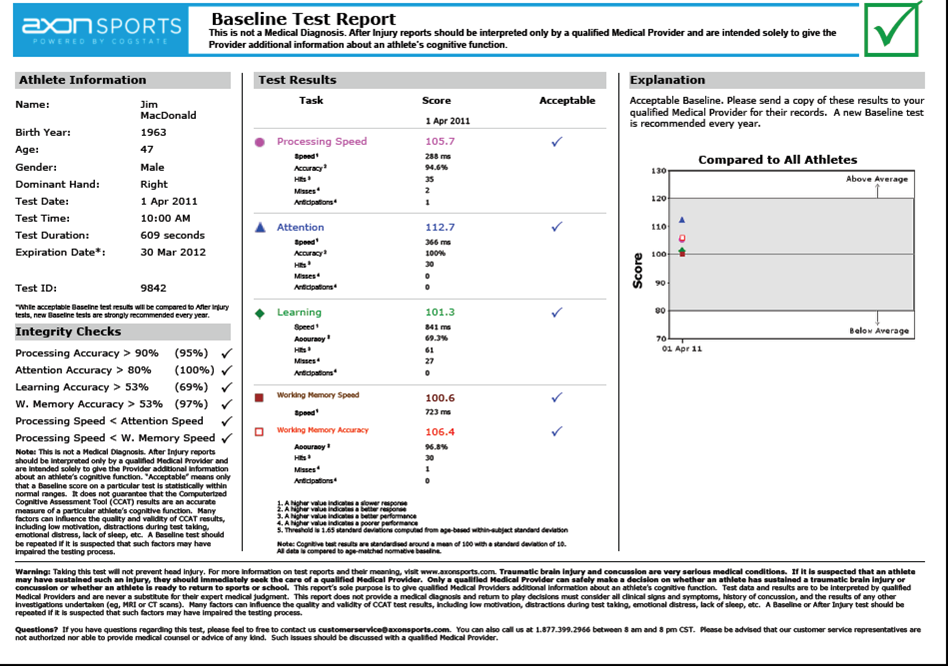
The author’s ‘baseline’ neurocognitive test results
(AxonSport).

It has become a rite of summer over the last few years, at least here in the United States:  ‘baseline’ neurocognitive testing (typically administrered by computer).

Our practice has at this point in the summer probably tested one thousand+ local athletes from middle school to high school, primarily focusing on ‘football’ players (American football and soccer).  It is a mass demonstration of an effort at secondary prevention.  The intrinsic idea underlying this ritual is that we are establishing for each individual athlete their ‘baseline’ neurocognition, so that if they were to have a potentially concussive injury, we can re-test them and use the comparative results as one more piece of data in helping us diagnose and manage a concussion (and a return to play).

Like a lot of sports medicine, however, this practice is controversial.

An excellent article on the reliability of computerized neurocognitive tests was recently published in the Archives of Clinical Neuropsychology:  “Test-retest Reliability of Four Computerized Neurocognitive Assessment Tools in an Active Duty Military Population.” 

I am not a statistician nor a neuropsychologist, and so if some readers quibble with my definitions, I am open to hearing about it in the blog’s comments.  As I understand it, reliability is the property of a test that reduces in most respects to the concept of repeatability; some people describe it as the ‘stability’ of the test.  It is, arguably, the most basic psychometric property of a test:  one most first prove the ‘reliability’ of a test instrument before assessing other properties of the test (e.g. validity, and responsiveness).

I plan to talk more about this idea, and the study on the computerized neurocognitive tests in the Archives, in an upcoming post.  For now, I’d encourage you to don two things.

First, click on the link and read at least the abstract of the paper referenced above……the reported results from the study may surprise you.

Second, take the poll below and let us know your thoughts on this new, ‘rite of summer.’  I’ll report the results, and discuss the paper, in an upcoming blog post.   See you then!

Le Tour et La Corse

800px-Panorama_view_mountains_in_Corsica

Les montagnes de L’Île de Beauté: La Corse

…et La Centieme:  The 100th edition of Le Tour, the Tour de France, begins today, with the Grand Start in Corsica for the first time in the race’s history.

750px-Flag_of_Corsica_svg

Who needs the Tricolor? The Flag of Corsica: once an independent republic, now part of France, still with its own language and distinct customs.

What a way to celebrate the centennial of the Tour!

Corsica, or La Corse, is a French island in the Mediterranean, and is comprised of two of that nation’s departments: Haute-Corse and Corse-du-Sud.  It is the only region of France which has not previously hosted a stage of Le Tour.

The island has a long history, perhaps best told in one of the finer travel books I have ever read, The Granite Island, by Dorothy Carrington.  The island has passed through many hands over its history:  the Carthaginians, Romans, Genoans and others have all claimed the island for their own.  The island even enjoyed an independent existence for some years:  the Corsican Republic was formed in 1755 under the leadership of Pasquale Paoli.  Corsica’s most famous son, Napoleon, was born there in 1769.  And it was during the time of the “Napoleonic wars” that he set loose on Europe that the island became part of France.  It has remained a part of that country ever since.

I have a special fondness for this land, known by the French as  L’Île de Beauté:  the Isle of Beauty.  I have visited Corsica twice, and was smitten with the island from the first my eyes lay sight on the port of Calvi. (Some readers may recognize Calvi as the site of the 2011 IOC Advanced Team Physician course.)

Corsica is quite simply arresting:  from its mountains and trails, to its beaches, to the very smell of the island (its vegetation, known as the ‘maquis’, has a distinctively lovely fragrance), it can put anyone under its spell.

That said, I suspect the cyclists in Le Tour this year may be smitten in a different way than I was on my visits.  Like any beauty, Corsica has its caprices.  The mountains I found lovely will almost certainly pose extraordinary challenges to the competitors.

GR_20_Cirque_de_la_solitude

Cirque de la solitude: in the mountains of central Corsica

corte

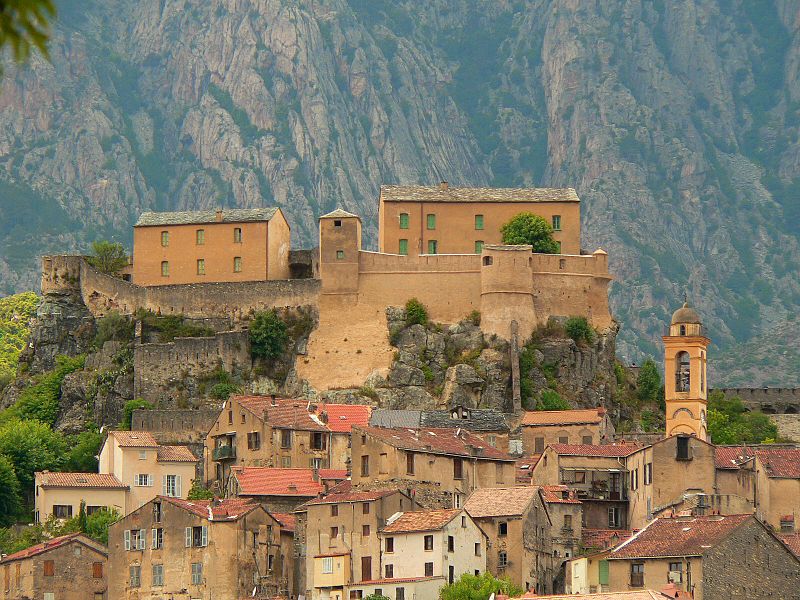
The capital of Corsica: Corte, through which the 2nd stage of the Tour will pass


The second stage of the Tour this year will traverse the mountains that form a spine through the center of the Island, heading from Bastia on the east coast, through the mountainous capital of Corte, and ending on the west coast in Ajaccio, the birthplace of Napoleon.  The Tour’s website describes the ride as a rollercoaster; “Expect some real damage,” the site boasts menacingly!    Let’s hope no one meets his ‘Waterloo’!

Read more of this post

Exercise Deficit Disorder in Youth: Thinking Outside The Sandbox

avery

Avery Faigenbaum, Ed.D, FACSM: Jersey boy energizes the crowd

As a pediatric sports medicine specialist, I typically spend my days ministering to the maladies of the active child or adolescent; but as a public health advocate, I worry more about the other end of the spectrum:  the growing (pun intended), global pandemic of childhood underactivity and obesity.

The global problem of underactivity in youth is being investigated by many people.  One of the leaders in this field is a Jersey boy; no, not Jon Bon Jovi…… I have been a big fan of Dr. Avery Faigenbaum, from the College of New Jersey, for some time.  From his work investigating the safety of resistance training in children to his new focus on “Exercise Deficit Disorder” (EDD), his work has been an inspiration to me.

Last summer, I had the pleasure of working with him here in Columbus, Ohio, and we even got to record a session of Nationwide Children’s Hospital’s “Pediacast” where we discussed the problem of EDD.  This summer, I got to catch up with Dr. Faigenbaum at the American College of Sports Medicine meeting in Indianapolis.   Though he could probably bench press three of me, I successfully arm-wrestled him into doing a guest blog.  Just in time:  Dr. Faigenbaum is heading to Argentina in July as a guest professor.

And so before he can run away, it is with great pleasure that I present to the readership Dr. Faigenbaum’s blog post:  “Exercise Deficit Disorder in Youth:  Thinking Outside the Sandbox.”

___________________________________________________________________________________________

The pervasive reach of physical inactivity has now spread worldwide and some authors have appropriately described this issue as a “pandemic” (4). Levels of physical activity among modern-day youth are down while time spent watching television and surfing the Internet are up. Researchers from Canada recently assigned a letter grade of D- to physical activity levels in 5- to 17-year olds (1) and findings from the Youth Risk Behavior Surveillance survey indicate that one-third of high school students in the United States played video or computer games for 3 or more hours on an average school day (5). The decline and disinterest in physical activity appears to emerge early in life, and by the time students enter high school their sedentary habits are difficult to break. As a professor of pediatric exercise science, I am deeply concerned that regular physical activity has become a neglected dimension of health that has yet to garner the medical power and political clout of other pediatric and adolescent health issues such as cigarette smoking or super-sized beverages.

Read more of this post