November…….already

10665120_10206556329240539_8534250178254214982_n

Transitions: November in the USA.

Really?  Can it be that November is here?

I just covered my last high school football game of the fall, a loss in the playoffs. A season which began in the heat and humidity of August [with its attendant muscle cramps and concerns of exertional heat illness & exercise-associated hyponatremia] is now over, and injuries sustained on wrestling mats and in basketball gymnasia are beginning to show up in my clinic.  Before you know it, the skiiers and snowboarders will be filling out the waiting room.

November also brings with it the publication of our last CJSM of 2015, and it is a good one.  We have profiled two offerings in particular, both of which currently are freely available on line:  original research looking at potential limitations of American Heart Association recommendations for pre-participation cardiac screening in youth athletes; and a provocative editorial [and just right for the change of seasons] arguing for adult autonomy in deciding whether or not to wear helmets when skiing.

Both subjects are among the more controversial in sports medicine.  Whether or not to consider pre-participation screening with ECG when taking care of our younger athletes–well, that’s a question whose answer can vary depending on what side of the Atlantic one is on, or what part of the United States you may live in.  It’s a question whose answers may lie in much of the research we publish in our journal, with luminaries such as Jonathan Drezner and William Roberts weighing in.

Whenever we publish research or commentary on the question of mandatory personal protective equipment, I sometimes feel as if we have entered the ‘blood sport’ arena of sports medicine.  This issue’s editorial  on the ‘Ethics of Head Protection While Skiing’ has already generated some buzz on our twitter feed. Two years ago, we published the Canadian Academy of Sport and Exercise Medicine (CASEM) Position Statement on the Mandatory Use of Bicycle Helmets, and our social media feeds erupted.  I have never seen so much discussion on the blog site.

There is much more to be read carefully in this November 2015 issue.  A very interesting piece of original research, from one of our more prolific authors (Dr. Irfan Asif), looks at the potential psychological stressors of undergoing pre-participation cardiovascular screening.  As a pediatric sports medicine specialist, I’ll be reading with great interest a study on the potential prognostic implications of post-injury amnesia in pediatric and adolescent concussed athletes–lead author Johna Register-Mihalik continues to make major contributions to our understanding of that injury in that population.

So, enjoy this issue.  And brace yourself–2016 is on its way.  It will be here before you know it!

The Controversy Over Grass

madison plains

Where Pigskin Meets Grass

To be clear, my topic today is NOT a survey of what cannabis legalization has wrought in states like Washington or Colorado [as an aside, in our own little corner of the USA the question of legalization will be on the ballot in Ohio this fall].

The grasses we’re discussing are ‘Bermuda,’ ‘Fescue,’ ‘Bluegrass’ and the like.

And the question today is not whether ‘the Dude abides’ [he most certainly does], but is this: which is the safer surface on which to play sport, grass or turf?

The subject came to mind after reading about a recent kerfuffle in the NFL.  The Houston Texans have played on a specially designed grass surface over the years. This season, they are switching to turf in response to concerns voiced about the field quality by opponents such as the Kansas City Chiefs.  In the NFL, in this season for this stadium, there’s a push toward turf.

On the other hand, readers may remember the controversy that raged much of this year regarding the use of turf [as opposed to grass] for the FIFA Women’s World Cup. And that ‘other’ world cup, Rugby World Cup 2015, is taking place right now in England, with  Twickenham Stadium and its grass pitch as that event’s centerpiece.

Grass vs. turf?  The perennial question.  Looking at it solely from the perspective of injury prevention [as opposed to factors such as sports performance or maintenance costs], we have looked at this question from time to time in the blog and in the journal.

For instance, this summer, in the July 2015 CJSM, O’Kane et al. published their timely findings looking into shoe wear and surface type on injury rates in female youth soccer players.  They found that a grass surface and wearing cleats on grass raised rates of lower extremity injuries; they concluded: “When considering playing surfaces for training, communities and soccer organizations should consider the third-generation artificial turf a safe alternative to grass.” Something to consider in this population and this sport and a countervailing argument to the push for grass in future iterations of the Women’s World Cup? Perhaps.  Or might that be too great of a generalization, extrapolating from the youth to the elite sport level?  Very likely.

What about you: your thoughts on this matter?  Taken purely from the perspective of sporting safety and injury prevention, what are your thoughts, your read of the medical literature?  Grass vs. Turf:  which is safer?  Does the sport matter?  Does the level of play matter?

Tell us in the poll!


Football. Texas style.

grand prairie texas weather

It’s big–and HOT–in Texas.

The Lone Start state, in August.  Grand Prairie, Texas–next to Arlington, within sight of Cowboy Stadium (alright, so it’s officially AT&T stadium).  Deep in the heart and soul of American Football, that’s where my month began.

In addition to being an Associate Editor of CJSM, one of the hats I wear is as a Director sitting on the Board of a non-profit youth sport safety advocacy group, MomsTeam Institute. Yesterday, I participated in the group’s outreach to a youth football organization in Texas:  the Grand Prairie Youth Football Assocation (GPYFA).  The Chief Executive of MomsTeam, Brooke deLench, has organized a week long session to address issues of football and cheerleading safety; this week is preparatory to longitudinal work including injury surveillance to determine if certain interventions can lower injury rates in the 1000+ youth athletes participating in GPYFA sports.  Brooke has coined the term “SmartTeams, PlaySafe” to emphasize the important role education, knowledge transfer, and implementation can play in the world of youth sports.

Yesterday, I was one of a few individuals speaking to the coaches and parents of GPYFA.  My charge was to talk about preventing and identifying heat illness and overuse injuries, and review the pre-participation evaluation (PPE) with the assembled crowd.

s grand prairie hs weight room

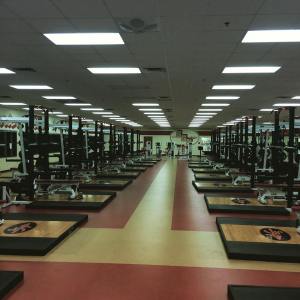
The weight room in South Grand Prairie High School It’s superior to a lot of college facilities I have seen.

The venue was South Grand Prairie High School, a magnificent structure with a beautiful, large auditorium, and just around the corner a magnificent and huge weight room and indoor turf facility. Boy, they do things big in Texas, they really do.

As I prepared for this talk, I found myself time and again dipping into the CJSM well–on the subject of youth overuse injury, I leaned heavily on the AMSSM position statement from Di Fiori et al. published in the January 2014 CJSM. When I touched on the topic of Exercise-Associated Hyponatremia, I turned to the 3rd International Consensus Statement and the podcast I just conducted with lead author, Dr. Tamara Hew. The PPE?  Of course, I would consult the joint ACSM/FIMS statement (CJSM Nov. 2014) and the podcast I conducted with its lead author, Dr. William Roberts.

It does indeed excite me to share with you all the resources this journal has.  As an educator and public health advocate, as well as a clinician, I use CJSM in a very real and practical sense.  Day in, day out.

My time in Texas was brief, but MomsTeam’s work will continue.  I am hopeful that our work will help these children and their families navigate some of the risks that are associated with the many, many benefits of youth sports such as football and cheer.  For one, I hope my talk helps prevent any cases of exertional heat illness (EHI) in this group. The forecast for  this week in Grand Prairie has the thermometer hitting 106F (41C)!!!  At least I think the humidity on an August day in Texas may be a little bit less than that seen in, say, Qatar, site of the 2022 World Cup.

As I flew home, I read the recent Sports Illustrated story on the 25 anniversary of the release of the iconic book,’ Friday Night Lights.’  I mused on the importance of youth football not just in Texas, but in the United States in general.  With 3.5 million players age 6 – 13 in this country (CJSM 2013), the sport keeps a LOT of kids active.  With the season now upon us, let’s all keep working on making this sport, and all sports, safer for our young athletes.  With the work done in this and other journals of sports medicine, we’ll continue to generate the evidence to support the decisions that will further this cause.


#ACSM2015

social media

Reading #ACSM15 twitter stream, two Fellows of the ACSM: Drs. Anastasia Fischer and Avery Faigenbaum

california coast

Even views from a train are apparently blissful on the California coast.

The 2015 annual meeting of the American College of Sports Medicine has not ended yet, but I’ve had to cut out early.  I’m sad to say I’m on my way from San Diego to L.A. Well, let me clarify my sadness:  I’m on a train heading up the California coast right now, with an absolutely stunning view outside of my window–talk about Exercise is Medicine!  I may not be burning calories while I blog, but there are plenty of surfers in the water this afternoon burning some for me.

No, I’m not sad to still enjoy a little bit of the California ambience.  I’m sad to bid #ACSM15 so long.  It’s been a great conference.

I can only give a superficial nod to all the sessions that have taken place already.  As the world-renowned Australian injury prevention expert Caroline Finch put it in a tweet of hers: “This conference size always stuns me ”

patricios gray

Drs. Aaron Gray & Jon Patricios, multi-tasking on the dais while talking about the power of social media for sports medicine clinicians.

Dr. Avery Faigenbaum was among a panel of youth sports researchers discussing a new IOC initiative regarding a “Youth Athlete Development Model.”  Pierre d’Hemecourt gave a great, live demonstration of hip ultrasound–I walked away from the session with a renewed sense of the importance of this modality to our profession, a topic CJSM has returned to on several occasions in the journal and on this blog.  Peter Kriz from Brown University gave a hands on demonstration of the clinical use of video analysis in evaluating baseball throwers.  I joined my fellow social media friends, doctors Aaron Gray and Jon Patricios (AKA @MizzouSportsDoc and @JonPatricios) in giving an enjoyable talk on the power of this—of social media in sports medicine.  The power of twitter, for instance, in curating content, in professional networking. The power of podcasting and blogging, whether a producer or user of content.

Of course, there is the socializing at conferences that provides memories as well. I enjoyed a fine diner with Kate Ackerman, the subject of a recent blog post,and Dai Sugimoto,an author of a recent CJSM published study on gender differences in hip abduction/adduction peak torques.

#ACSM15 is not nearly done; there is plenty left today and tomorrow.  But for me, San Diego is well down the train tracks.  Fare well until ACSM 2016 in Boston.  Now that is something to look forward to.