Published Ahead of Print

Time to time, I like to share with readers of this blog some of the features of CJSM with which they may not be familiar.  Our journal’s website has a wealth of resources that I’d encourage you to check out regularly.

For instance, besides publishing the full journal every two months, we frequently disseminate breaking sports medicine research in a more fluid, continuous fashion via our “Published Ahead of Print” (PAP) feature.  PAP allows us to pursue a major goal we editors have:  to contribute to the world of clinical sports medicine in a contemporary fashion, taking advantage of the multi-media offerings of the digital world.   This goal is reflected in this blog itself; in the podcast feature we have just begun; in our engagement with you on social media; and in the journal’s iPad functionality.

“When you want it….where you want it…the way you want it.”  That’s the motto.

And so, today I wanted to share with you a ‘Practical Management’ research article that was just published via PAP:  “Surgical Management of Traumatic Avulsion of the Ischial Tuberosity in Young Athletes,‘ by Roland M. Biedert, MD.

It is one of the many interesting, hot-off-the-press articles you’ll find in the CJSM PAP collection.

I was particularly interested in this article, as I see many adolescent athletes and pelvic apophyseal injuries arrive at our clinic in droves.  It is rather uncommon to see an acute, purely tendionous injury in my clinic population:  last week when I saw an acute rupture of the proximal long head of the biceps tendon, in a 17-year-old pole vaulter, I was intrigued indeed!  The acute achilles tendon rupture in my clinic makes me wonder whether a fluoroquinolone has been used recently; seeing a patient in my own age group, I’d more likely say, c’est la vie…..

cjsm blog xray

An ischial tuberosity avulsion injury which can be managed conservatively.

The more common story in my day-to-day clinical world is for a chronic or acute injury to the apophyseal cartilage, to which a muscle-tendon unit attaches.  The tendon holds, I tell a patient; it is its attachment to the growth cartilage that gives way.

Read more of this post

#YouthSportSafety: Early Sports Specialization in Youth Athletes

youth sports julie young

My colleague and Athletic Trainer Julie Young,
pool side and talking about injury prevention
in young swimmers

I’ve been thinking a lot about youth sports specialization lately.

It’s likely the nexus of the Olympics, my reading of the book The Sports Gene, and our own journal’s publication of the AMSSM Position Statement on Youth Sports Specialization and Overuse that has prompted this.

Readers of this blog will recall that I recently profiled the AMSSM Position Statement and interviewed the lead author, Dr. John DiFiori. Likewise, I  recently reviewed the excellent book The Sports Gene, which looks into, among many other things, the application of the ’10 000 hour rule’ to athletes’ pursuit of elite sport excellence.  What does it take to make an Olympian?  Many would argue that part of the answer lies in identifying excellence early, and starting to groom that talent at a young age:  it takes about 10 years to fit in those 10 000 hours of dedicated practice.   These forces are at least part of what drive the growing phenomenon of youth sports specialization.

I have a professional bias toward this line of thinking, of course:  I practice clinical pediatric sports medicine, and most of my research interests lie in keeping kids safe and active.

For instance, Nationwide Children’s Hospital (NCH) and the YMCA of Central Ohio recently paired up to release a couple of educational videos on the Education and Prevention of Overuse Injuries in Youth Swimmers and the Risks for Early Specialization in Youth Swimmers.  The task combined my interests in youth sports and swimming (I am a member of the USA Swimming Sports Medicine Task Force).  It was a lot of fun working with folks like Julie Young, a swimmer and athletic trainer at NCH with whom I work and do research.  Click on the links to those videos and let me know what you think.

CJSM has made quite an effort over the years to profile high quality research that looks at the phenomena that impact youth sports.   Read more of this post

5 Questions with Dr. John DiFiori, AMSSM President

amssm overuse

Screen Shot of AMSSM
Infographic on
Youth Sport and Burnout

January represents the new year here at CJSM, as it does of course for all of you in the blogosphere.  But what really excites us is not the opportunity to set new year’s resolutions:  it’s  the new issue of the CJSM, and that’s what I want to share with you today.

There is a lot on offer in this issue, including studies exploring treatments of articular cartilage pathology, a study of functional ankle instability, and a journal club exploring the relative of benefits of PRP and ESWT on chronic patellar tendinopathy.

The lead study is a systematic review and position statement on the issue of youth sports, with an evidence-based  focus on the phenomena of overuse injuries.  This blog reviewed the statement in an earlier post.  It’s an important study, and we want to make sure as many people as possible get a chance to read it.

And so, we feel fortunate to have had the chance over the holidays to chat with the lead author of the paper, Dr. John DiFiori, and ask him ’5 questions’ about his recent work.

_______________________________________

1) CJSM: Dr. DiFiori, you are the lead author of the new American Medical Society for Sports Medicine (AMSSM) position statement on ’overuse injuries and burnout in youth sports.’  Can you tell us a bit about the genesis of this statement?  When was it first conceived?  How long did it take to go from initial conception to publication?  How did you gather together the group of experts who are authors on this statement?

JD: Given all of the issues currently surrounding youth sports, the AMSSM leadership felt that a position statement focusing on overuse injuries and burnout would be timely, and would help to address many of the concerns held by sports medicine professionals, as well parents, coaches, and the young athletes themselves. In late 2011, a nominating process was completed, and I was asked by AMSSM to lead this project. The six outstanding members of the writing group were identified through a similar process, based on their clinical expertise, and their record of educational and scholarly contributions in this area.

We began to develop the content areas and search strategy in early 2012. We endeavored to have the paper be as evidenced-based as possible. To this end, we utilized a systematic search process, followed by author review, to identify relevant literature. The writing process, multiple re-writes and editing to ensure accurate information, took about 1 year. Because of the length of the process, we performed another systematic literature search in mid 2013 to ensure the paper would be as up to date as possible. The draft then underwent critical review by several expert external reviewers, who provided some very valuable suggestions. Following this, the paper underwent another round of review by the AMSSM Board of Directors. And then it was off to CJSM. So, all in all it was a very thorough process. Hopefully the result is a document that will be a solid resource for the sports medicine community.

2) CJSM: The statement is a comprehensive review of some of the major phenomena in the world of youth sport:  overuse, early specialization, over scheduling, burnout. What do you think are some of the underlying forces driving these phenomena?  Are there different pressures being brought to bear on the modern youth athlete we didn’t see a generation ago?  And if so, what are they? Read more of this post

Overuse Injuries and Burnout in Youth Sports

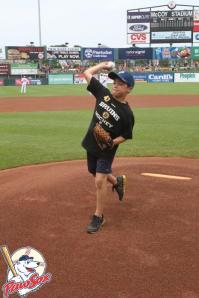
Pawsox_17937_2013-06-30

10,000 hours of practice, and
he might make the Red Sox?*

We’re very pleased at CJSM to open the New Year with a shout:  a fantastic systematic review and position statement on the subject of youth sport, from the American Medical Society for Sports Medicine (AMSSM).

The focus of the paper–in the January 2014 issue, which has just published–is on overuse injuries, which are thought to represent roughly half of all the injuries youth athletes sustain.

All readers of the journal, and of this blog, will find this a worthwhile read.  I have a selfish interest in the subject, as I am currently practicing pediatric sports medicine, and in my professional life I live and breathe the issues discussed in the paper. Moreover, I know several of the authors of this paper, and I think highly of them all.

But this is not about ’eminence based’ medicine.  No, it’s evidence-based all the way.  The paper is both a systematic review and the AMSSM position statement on the subject of “Overuse Injuries and Burnout in Youth Sports”.  The authors conducted a thorough review of the literature, identifying 953 papers and citing 208 unique references in their comprehensive analysis of this broad subject.  They go on to review what is known, and then make recommendations, classified using the Strength of Recommendation Taxonomy (SORT) grading system.

The paper is broadly organized into the following subsections:  epidemiology; risk factors (intrinsic and extrinsic); discussion of high-risk overuse injuries;  discussion of several concepts mentioned frequently in the literature of youth sports (readiness for sport; sport specialization; burnout); and prevention.

The study is so very comprehensive, I cannot do better justice to it than encourage you to read it yourself.  I thought I might here mention some of what stood out for me. Read more of this post