Disparities in sports medicine health care

Most days of the week I see my pediatric sports medicine patients in two very different clinics:  one is within the inner city of Columbus, Ohio itself; and one is in the foothills of Appalachia, a region described in the recent bestseller, Hillbilly Elegy.  Among the patients I frequently see, I have many who could be described as urban poor (the former location), and many as rural poor (the latter).

In my care of these patients, I frequently see them (and their families) struggle with several barriers to excellent care — these range from financial issues, to issues of transportation and distance traveled, to issues of understanding related to educational levels, to a relative lack of resources at their home schools or clubs (e.g. no certified athletic trainers).  I feel at a great loss, at times, in trying to help them achieve the same results I would want for any of my patients.

I read with great interest then, in the November 2017 CJSM, a newly published, original research study: Disparities in Athletic Training Staffing in Secondary School Sport: Implications for Concussion Identification.  I found it so impactful, that I wanted to talk with the author — and so I tracked down Emily Kroshus ScD, MPH for this episode of the CJSM podcast.

Dr. Kroshus is a Research Assistant Professor of Pediatrics at the University of Washington, who is developing a body of academic work that focuses on “….identifying social and contextual determinants of help seeking behaviors, with an overarching interest in addressing disparities related to gender, race, sexual orientation, and socioeconomic status.”(1)

I hope you are as interested in this sort of research as much as I am.  So take a listen to the podcast on iTunes or go to the CJSM website for the podcast (look for the radio button) and the study itself.

_____________________________________________

(1) Dr. Kroshus’ biography can be found at the University of Washington faculty page:  https://depts.washington.edu/uwgenped/directory/emilykroshus

Spondylolysis — when to begin PT?

SNL’s Jane Curtain and Dan Ackroyd may have found spondylolysis an interesting subject for debate!

One of the perennial ‘hot topics’ in pediatric sports medicine has to do with the diagnosis of spondylolysis — specifically, adolescent isthmic spondylolysis [an acquired stress injury of the pars interarticularis].  As with many controversies, people who treat this condition are often passionate about the specific issues under debate.

Among the more burning issues are to brace or not; what imaging modality to use (plain film, CT scan, SPECT scan, MRI); how long to ‘rest’ a patient before re-introducing a level of physical activity or instituting physical therapy (PT); and how to determine treatment success (clinical measures such as PROMs, or imaging to verify bony union of the pars interarticularis).

We recently published an original research article on the subject of when to begin PT in these athletes:  The Timing of Physical Therapy in Adolescent Athletes with Acute Spondylolysis

I am happy to report I was part of the team that conducted this study, and we found that in patients who began PT early, recovery to sport was faster:  ‘early PT’ athletes returned to their sport a mean of 25 days earlier than their counterparts who initially rested from all activity.  Moreover, there were significant differences in adverse reactions between the groups studied.

How do you approach the initiation of PT in your adolescent athletes with spondylolysis?  Take the poll and share your thoughts! 

PRiSM 2017 — Dallas

jim-andrews

Dr. Jim Andrews, one of the pioneers of pediatric sports medicine, gives the keynote address at PRiSM 2017, Dallas photo: Kevin Ford

The last time we wrote about the Pediatric Research in Sports Medicine Society (PRiSM) we were in sunny San Diego.  This year’s annual meeting took place in another sunny, albeit slightly cooler, locale:  Dallas.

PRiSM is a relatively young society, but one which is up and coming.  There were 250+ attendees at this year’s meeting, the 4th annual gathering.  What makes this organization special is its focus and membership:  1) its focus is pediatric sports medicine research; 2) its membership is multidisciplinary, drawing from physicians, surgeons, physical therapists, athletic trainers and radiologists.  One of the speakers this year, in fact, came from the world of veterinary medicine: Cathy Carlson of the Univ. of Minnesota gave several interesting talks on aspects of osteochondritis dissecans (OCD), focusing on the animal models (swine, caprine) she uses in her research.  Her insights into the early development of OCD were among the most powerful, I thought, of the conference.

The keynote conference was delivered by a true pioneer in the field:  the world-renowned Dr. Jim Andrews, from the Andrews Sports Institute.  He bemoaned the epidemic of pediatric sports injuries and spent time identifying many of the factors contributing to this important public health issue.  At the same time, he described some of the success stories out there — models for how we can improve injury prevention in our young athletes.  These include the @safekids initiative he is involved with.  I would add MomsTeam Institute to any list of such safety initiatives.  This is the non-profit youth sports safety group I am involved with.

[on a side note — I am presenting research that MomsTeam has done, along with Executive Director Brooke de Lench, at the IOC World Conference on Prevention of Injury & Illness in Sport in Monaco in March — expect posts a plenty coming from that conference]

c3s2hhxvyaen0hb

David Howell, of Boston Children’s Sports Medicine, wins the best scientific poster of PRiSM 2017. Photo: Greg Myer

The faculty at PRiSM 2017 was simply stellar, including several who have graced the pages of our journal and our blog: Read more of this post

Whatever happened to PE?

avery

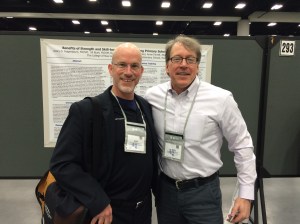
With my friend Dr. Avery Faigenbaum — who most definitely keeps the physical in physical education.

Like many of us, I wear several hats.  My ‘day job’:  sports medicine specialist.  I also, however, have other work that consumes a great deal of time and energy and brings with it a great deal of joy and fulfillment.  I speak of my……’moonlighting job’?  My ‘real job’?

I speak of fatherhood.

I am a father to twins, thirteen years old, which turns out to be a great side gig to work as a pediatric sports medicine specialist.  My day to day interactions with my son and daughter are great preparation for my interactions in the clinic.  The skills I develop in my two ‘jobs’ complement each other.

As a father, I am reminded frequently of the differences between the schooling I enjoyed and the education my children are receiving. One of the striking differences is in the area of  non-academic offerings.   Read more of this post