Atoms and Pee Wees – age classification nomenclature in Ice Hockey

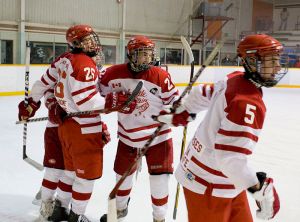
Raaii and colleagues’ article in this month’s CJSM concerning patterns of mouthguard utilisation in minor hockey players introduced me to the terms ‘Atom’ and ‘Pee Wee’ as applied to Ice Hockey.

I had heard of ‘Pee-Wee Herman’ before, Paul Rubens’ fictional comedic character, and ‘The Mighty Atom,’ Sydney Charles Wooderson MBE who was one of Britain’s greatest middle-distance runners in the 1930s and 40s,  but had not heard of the terms ‘Atom’ and ‘Pee Wee’ as applied to Ice Hockey. After a little research, I was able to find out that they refer to specific age categories.

The relevant age categories in Canada are as follows – Mini-mite (1-2 years old), Mite (3-4), Tyke (5-6), Novice (7-8), Atom (9-10), Pee Wee (11-12), Bantam (13-14), Midget (15-17), and Juvenile (18-20).

Interestingly, the nomenclature is quite different between Countries. In the United States, for example, the Mini-mites category of players are aged 5-6 years old, with Mites from 7-8, Squirts 9-10, Pee-Wees 11-12, Bantams 13-14, Midget-minors 15-16, Midget-majors 15-18, and Juniors of ages 16 and over.

In France, there are moustiques aged 9 and under, Poussins 10-11, Benjamins 12-13, Minimes 14-15, and cadets 16-18. The relevant age categories as defined by the German Ice Hockey Federation in Germany consist of Kleinstschüler (bambini) aged 8 and younger, Kleinschüler 9-10 years old, Knaben 11-12, Schüler 13-14, Jugend 15-16, and Junioren 17-18.

In Switzerland, the Schweizerischer Eishockeyverband (Swiss Ice Hockey Federation) defines ages categories for Bambini (9 years old and younger), piccolo (10-11), Moskito (12-13), Mini (14-15), Novizen (16-18), and Junioren (19-20).

The Swedish Ice Hockey Federation defines perhaps more conventional nominal age categories of U11 (11 and younger) and above for each age from U12-U16, with U18 and U20s categories.

A few issues come to mind here. One relates to the differences in the age categories for the same named categories in different Countries which could be confusing to some. For example, the Mite category in Canada describes those aged 3-4, but in the US the term would refer to the 7-8 year old category.

Another issue concerns the names for the age categories themselves. Whilst some of them might be considered as quaint by some, and might indeed possess a certain National and cultural heritage, to others the age category names might appear to be strange or at worst, even insulting. For example, the term ‘squirt’ is defined in the Oxford English Dictionary as a ‘puny or insignificant person,’ or in the US Oxford English Dictionary as an ‘insignificant, impudent or presumptious’ person, and as such would be seen as an insult to many people.

Should we be moving towards using an accepted International standard nomenclature for age categories in Ice Hockey based perhaps on the Swedish system, or do you think that we should continue to encourage the use of regional nomenclature? Let us know your thoughts. In the meantime, it would seem that it pays to know your Pee Wees from your Midget-majors !

(Original photographs by Thund3rh3art and Jason Bain)

Rodeo Catastrophic Injuries – ESPN video special

Some of you will have read this study by Butterwick and colleagues in last month’s CJSM entitled ‘Rodeo Catastrophic Injuries and Registry: Initial Retrospective and Prospective Report’ which highlighted the epidemiology of catastrophic injuries and fatalities over a 20 year period from 1989 to 2009.

The study found an incidence rate of catastrophic injury of 19.81 per 100 000 (19/95 892), with an incidence rate of fatality from 4.05 per 100 000 (21/518 286). The most devastating injuries in rodeo and bull riding were found to be due to thoracic compression injuries.


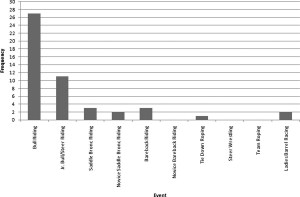
This graph, reproduced from the study, shows the distribution of injuries by rodeo event, highlighting that the greatest number of catastrophic injuries had occurred during either bull riding or junior bull riding/steer riding events (38 of 49; 77.5%).


Interestingly, the study concluded that there was no evidence that rodeo vests have any protective effect in preventing some of these catastrophic thoracic injuries, but that helmet use in bull riding and rodeo events did seem to offer some level of protection in preventing catastrophic injuries and fatalities.

The study by Butterwick and colleagues was recently presented and discussed on the ESPN website here with comments from Cody Lambert, a retired bull rider who designed the first vest used in professional bull riding some 20 years ago, mentioning that these have changed little in design over this period of time.

The website also has a link to a video interview with one of the co-authors of the CJSM article, Dr Tandy Freeman, Medical Director for the Professional Bull Riders Inc and for the Justin Sportsmedicine team. Dr Freeman gives a graphic description of what happens during the evolution of some of these injuries, which is accompanied by some startling film footage of some of these catastrophic events in the making.

Those of you involved in the management of rodeo injuries will also be interested to read this retrospective study by Sinclair and Smidt published in CJSM in 2009 which analysed some 10 years’ of injuries in high school rodeo, finding a total of 354 injury incidents from 43,168 competitor exposures (CEs).

Having reflected on these studies and having viewed the video footage for myself, I can safely say that I think that I will be sticking with soccer and golf as the sports in which I will be choosing to participate. I should also add that my last effort on a mechanical bucking bronco during a summer ball many years ago at medical school was particularly weak. Justin McBride has nothing to fear…

(photograph of rodeo event taken at the Calgary Stampede Rodeo by James Teterenko and graph reproduced from Butterwick DJ et al. Rodeo Catastrophic Injuries and Registry: Initial Retrospective and Prospective Report. Clin J Sport Med. 2011;21:243-248)

CJSM makes an even bigger impact

We are pleased to report that the Clinical Journal of Sport Medicine saw an increase in its 2010 Impact Factor, with a new figure of 2.110.

CJSM is now at #17 amongst all journals in the Orthopaedics category, a rise from #25 last year, and at #25 amongst all journals in the Sport Science category which represents a leap from #32 last year.

The message is simple – if you want your research in the field of Sport and Exercise Medicine to be cited, CJSM is the place to publish.

The concept of the Impact Factor was first introduced by Eugene Garfield in 1955, the founder of the Institute for Scientific Information which is now part of Thomson Reuters. For those of you who would like to learn a little more about Impact Factors, a good place to start is the Thomson Reuters Web of Knowledge website which goes into some detail in explaining the concept of the Impact Factor . Interested readers can find out more about the history and meaning of the Impact Factor from Garfield’s presentation given at the International Congress on Peer Review and Biomedical Publication in Chicago, 2005 which is freely available as a pdf file online (requires Adobe Acrobat Reader to view, available for free here).

The Clinical Journal of Sport Medicine – making a real impact in the world of Sport and Exercise Medicine.

A feat too far for Haye?

Injuries to the feet of prominent athletes have caused some high-profile headlines over the last few years. In the UK, most football fans will remember the National crisis over David Beckham and Wayne Rooney who both had metatarsal injuries prior to important International football tournaments.
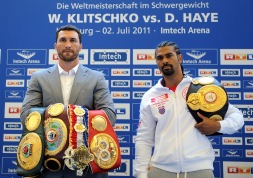
There was yet another cause for much discussion and debate following the World Heavyweight Championship boxing clash at the weekend between Wladamir Klitschko and David Haye in Hamburg, when Haye implicated a recent foot injury in his downfall.

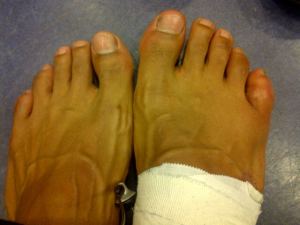
Haye mentioned that he had sustained an injury to his right little toe approximately three weeks prior to the fight which had interfered with his preparation, causing him to stop his pre-fight sparring. He also said that he had had a local anaesthetic injection just before the clash with Klitchsko, which was the reason for his late entry to the ring on the night. Haye told viewers that the toe injury had caused him to have problems pushing off in order to land his right hand punches, which he thought had possibly affected the outcome of the fight.

The issue was highighted by Haye himself the day after the fight on Twitter, when he posted this picture taken by himself of his feet, showing the external appearance of the alleged injury to his right little toe. This suggests a fracture of the proximal phalanx, but I have not seen an x-ray to confirm this. He was also to show off his injured toe at the post-fight press conference.

Perhaps predictably, Haye’s claims were met with derision by many prominent people involved in the sport including boxers and journalists who thought that he was making excuses for his ineffective performance in the fight. Klitschko himself thought that Haye had opened himself to being criticised as a ‘sore loser,’ and when showed the offending toe by Haye laughed saying ‘it’s a bee sting.’ However, some individuals, notably including the former World Heavyweight Champion UK boxer Frank Bruno, stated that they felt that the injury would have significantly hampered Haye during the fight and that he should not have fought.

The debate as to whether or not Haye’s injury affected the outcome of the fight rests largely on an understanding of the biomechanics of boxing, including the effect of the injury on posture and mobility around the ring, plus the effect on the delivery of punches and their power, together with an understanding of the principle of the kinetic chain. Torsion and ground reaction forces are important factors to consider. Haye claimed that he was unable to ‘explode off my foot with the Hayemaker’ (right-handed power punch), which would imply a problem most likely with initially shifting his weight towards the front and lateral border of his right foot whilst in a semi-crouching position in preparation to push forwards and upwards through the medial border of the right foot whilst throwing a full right-handed punch.

However, it is perhaps hard to imagine why it was this particular position which would have caused most of his problems as he would be required to adopt very similar positions whilst manouvering around the ring and dodging and weaving during defensive manouvres. The former Liverpool Football Club Physiotherapist, Mark Leather, wrote in the Mail Online that he felt that ‘the biomechanics of his (Haye’s) argument do not stand up.’  However, I could find nothing on the effect of toe injuries on the biomechanics of boxing and on performance in the literature, and nothing specifically on foot biomechanics as related to performance in boxing.

There are, of course, other considerations pertaining to Haye’s injury, for example the effectiveness of local anaesthetics and protective orthoses. Psychological factors must also be considered, including the effect on the performance of a boxer entering the ring for a World Heavyweight Championship fight with an injury.

At least Haye has a sense of humour about it all. Having been subjected to derision by many in the media and on Twitter, he had the ability to make a few quips, claiming to have been offered a movie role in next year’s remake of ‘Scarface’ playing Toe-ny Montana!

What do you think? Was Haye making excuses, or do you think that he had a point? CJSM would love to hear your views.

(image taken by David Haye and posted on Twitter here)