When Anatomy meets Technology – Learning and Educating with Anatomy Apps

With over 108 million iPhone sales since 2007 and rising, together with 60 million iPod touch sales and 25 million iPads, there is a now a huge global userbase for applications (Apps) on these devices with over 425,000 Apps in total available in the App store.  Android-capable mobile phones are also growing in popularity, and these have their own applications for use on these devices.

An App store search using ‘anatomy’ reveals 372 iPhone and iPod touch compatible anatomy Apps, together with 170 dedicated iPad anatomy Apps. Some of these show images of anatomy, some are ‘flash cards’ and some have integrated quizzes.

Anatomy apps can be useful for both learning anatomy and for using as an educational tool in  a patient consultation. Given the portability of the iPhone, iPod touch and iPad, it is easy to use these Apps in the clinic, at the training ground, or whilst on tour with teams, and most of the Apps do not require internet access to function once they have been downloaded.

Some of the better Apps have the ability to add notes and annotations to diagrams, and to view structures from multiple angles with magnification. Whilst the detail is sometimes limited, there is often more than enough to be able to use an App to help to explain the relevant structures to patients in order to improve their understanding of their injuries, and indeed to learn some of the anatomy that a Sports Physician might need. However, the extensive detail is often lacking, so there is room for improvement.

Here are my ‘Top 5’ Anatomy Apps currently available in the App store :

1) Pocket Body – The Interactive Human Body (iPad / iPod Touch / iPhone) (App store link here)

This App by eMedia Interactive LTD has a 9-layer graphic of the human body, with 4 views (anterior, left lateral, posterior and right lateral), and the images magnify up nicely without significant pixellation. Muscles, bones, tendons, vessels and nerves are all shown. Pins are attached to most of the muscles, and a quick press reveals the origin, insertion, key relations, functions, and innervation and vascular supply. In addition, some clinical notes are shown although these are somewhat limited in scope and not always accurate. It is possible to add your own notes, and to edit these. Many of the pins attached to nerves are red, and indicate the structures but give no additional detail although you can add your own notes and indeed can add your own pins on the model.

There are 3 different quizzes available – a ‘locate pins’ quiz, an MCQ, and a flash card type quiz and these can be set to examine any particular region. In addition, there is the ability to take a screenshot of an image and to share the image by email, post on your Facebook page or link to Twitter, or save to your device. This is a great App for learning the basics of musculoskeletal anatomy, and for showing relevant structures to patients.

2) Muscle System Pro II (Nova Series) and Skeletal System Pro II (Nova Series) (iPad / iPod Touch / iPhone) (App store links here – muscle & skeletal)

These are 2 separate Apps by 3D4 Medical, and show some really quite beautiful images, with the ability to view from many different angles. The image pins link to information boxes. The information on muscles shows origin, insertion, action, innervation and vascular supply. There is also the ability to add your own notes. Individual structures can be shown such as different bones, with excellent quality images when fully magnified, and with much anatomical detail. There are quizzes, although these are somewhat easy for anyone except novices. The images are probably the best available on these devices and are particularly impressive on the iPad, and these can be shared by email or social networking applications.
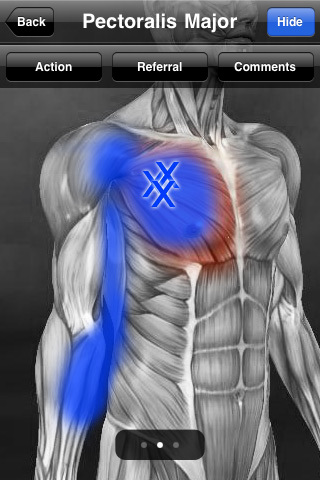
3) Muscle Trigger Points (iPod Touch / iPhone / iPad) (App store link here)

This App by Real Bodywork acts as a reference for common muscle trigger points. There is information on over 70 muscles and 100 different trigger point patterns, with information on the action of the relevant muscles and on the referral pain patterns. There is a 3D model which rotates in 2 animations to anterior and posterior images showing the different muscles, and muscles can be viewed individually from a list, or by choosing ‘zones.’ Real Bodywork provide a number of other anatomy Apps in addition to the Muscle Trigger Point App, including a ‘Learn Muscles’ App, a muscle and bone anatomy 3D for iPad, and skeletal anatomy 3D quiz and reference.

4) Instant Anatomy Lectures, Flash Cards, A/V Lectures and MCQ Apps (iPad / iPod Touch / iPhone / Android) (App store link here)

Robert Whitaker has been offering a number of excellent resources from his Instant Anatomy series for a number of years now. These originally started with books, going on to CD ROMs, and now a series of Apps. There are podcasts of anatomy lectures, video podcasts, and flash card Apps. This series of Apps offers some quite wonderful learning material, especially for the novice, and a great way to learn anatomy. The diagrams are easy to understand, although are more suited to learning than to explaining structures and pathology to patients. Some of the Apps are free on the App store, offered as ‘tasters’ with limited information, so you can try them out for yourself. Highly recommended for medical students and those re-engaging with anatomy after a while.
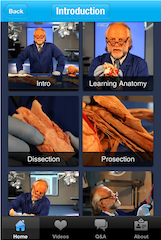
5) Aspects of Anatomy (iPad / iPod Touch / iPhone) (App store link here)

This App was developed by my one of my former anatomy teachers at University College, London, Professor Peter Abrahams, who is now Professor of Anatomy at Warwick University. He is also one author of the excellent ‘Essentials of Clinical Anatomy’ text. It consists of a series of 38 short (3-8 minute) lectures on a number of plastinated specimens, together with some related clinical information on related topics such as Colles fracture. In addition, imaging modalities are included, together with ‘spot’ quizzes (don’t I remember those during my Anatomy finals!) and clinically relevant MCQs. This is a wonderful resource for medical students and those revisiting anatomy.

CJSM would be interested to hear about your favourite Anatomy Apps, and how you use them in your clinical practice.

Cardiac screening of athletes with ECG – is it time to focus on the older athletic population?

Roy Shephard’s article in the May edition of CJSM , ‘Is Electrocardiogram Screening of North American Athletes Now Warranted?’ discusses the ongoing controversy of the appropriateness of the use of ECGs in screening College athletes for causes of sudden cardiac death. I’m wondering if it is now the time for us to focus our thoughts on ECG screening of the older athletic population.

My own awareness of the issues around ECG screening of athletes started some 20 years ago when I presented a session on ‘The Athlete’s Heart’ as part of my Physiology degree studies at University College, London. I remember being quizzed at the end of my presentation by the Course Tutor on the effects of detraining, and wishing that I had done a little more reading to back up my claims when I gave my answer stating that, as the adaptations to the normal heart were the result of normal physiological mechanisms, detraining should always result in changes to pre-training baseline on the ECG reflecting the anatomical and physiological detraining effects. His face at the time told me the story that he wasn’t entirely convinced, but I think I got away with it!

I have continued to revisit the issues and re-evaluate the evidence as my career in Sport and Exercise Medicine (SEM) has progressed. My first clinical experience of preparticipation screening came almost a decade ago whilst working in New Zealand when I was involved in providing care for New Zealand Academy of Sport athletes. Since then, another essay on the subject during my MSc SEM studies, teaching MSc and BSc students on an annual basis on ‘The Athlete’s Heart and Sudden Cardiac Death,’ and most recently conducting screening as part of the Football Association’s mandatory screening programme of young footballers, has kept me in touch with emerging research and clinical practice.

One thought has remained with me over the years – that of the importance of fundamental epidemiological principles such as Wilson’s criteria in screening, and linked to those, the need to consider what we are trying to achieve by screening . Essentially, the cardiac screening process seeks to identify individuals at an increased risk of sudden cardiac death. What we do not wish to do is to prevent healthy individuals from enjoying all of the benefits of sport and exercise. Sudden Cardiac Death in the young is still a rare event, mainly due to the underlying age-related population prevalence of associated conditions such as hypertrophic cardiomyopathy, but what about the older population?

The emerging importance of physical activity as an important, under-recognised independent risk factor for morbidity and mortality, often associated with lifestyle diseases such as type II diabetes mellitus, has led to an increasing global effort to engage the population in regular exercise as part of both primary and secondary disease prevention strategies. Whilst it is indisputable that the population benefits of exercise far outweigh the associated risks, it is nevertheless true that the risk of sudden cardiac death during exercise in the over 35’s is considerably higher than in the younger population due to the higher prevalence of associated conditions, mainly coronary heart disease.

ACSM guidelines and AHA risk stratification criteria for exercise testing and prescription offer clinicians guidance in the risk stratification of individuals who engage with healthcare professionals prior to becoming physically active, and point towards the appropriate use of ECG and Exercise Stress Testing as part of the preparticipation evaluation process. However, many individuals, including the older population who regularly exercise or those who may be about to commence regular exercise having been sedentary, will not come under the care of a healthcare professional. These individuals are therefore unlikely to participate in cardiac screening programmes.

Many questions about population cardiac screening prior to participation in sport and exercise come to mind, including :

1) What is the risk / benefit ratio and cost effectiveness of the adoption of ECG screening and exercise stress testing as per ACSM and AHA guidelines on a population basis for those wishing to engage in exercise?

2) How regularly should ECG screening and cardiac stress testing as part of preparticipation evaluation on an ongoing basis be conducted in the older athletic population?

3) What is the best and most appropriate way to engage older individuals involved in exercising, or about to become physically active, in order to conduct screening?

4) Should we be adopting targeted screening including ECG and cardiac stress testing in the older population who are involved in regular exercise?

My greatest concern is for the safety of the older, sedentary individual who decides to take up the sport they previously played perhaps 20 years ago at College, or perhaps who wishes to participate in a 10K run for a local charity, and who does not seek appropriate healthcare advice prior to increasing their physical activity levels.

Should we be focussing our efforts more at population level on screening these older individuals when attempting to prevent sudden cardiac death related to exercise?

Welcome to the Clinical Journal of Sport Medicine Blog

For those of you who might be new to all this, blogs (or web-logs as they were once known) have evolved from online diaries where individuals recorded their accounts of their personal lives. At the last count, there were over 180 million blogs in existence and now it is the turn of CJSM to enter the Blogosphere.

With the advent of the internet and social networking sites such as Facebook and Twitter and their unique ability to allow for almost instantaneous communication and interaction, the ever-improving availability and affordability of electronic devices, and the move towards paperless methods of communication, these are exciting times for CJSM.

We have three main ambitions for the CJSM blog :

1) To inform, signpost, and educate readers about topics and current issues in the world of Sport and Exercise Medicine ;

2) To stimulate debate and discussion  ;

3) To create a vibrant and active online community where readers can share their knowledge and experience so that we can learn from each other.

We will be highlighting recent research from the world of Sport and Exercise Medicine, with links to both our current and past Journal content and to other sources including both peer-reviewed Journals and websites. In addition, we will be discussing up-to-date current affairs in the world of Sport and Medicine.

Both subscribers and non-subscribers to CJSM will be able to read and respond to blog posts on the CJSM Blog, and we hope to engage a wider Sport and Exercise Medicine community in order to advance the Practice of Sport and Exercise Medicine.

From time to time, we will have guest bloggers to discuss topics of particular relevance, and we would be happy to hear of your ideas for topics for discussion. Let us know if there’s anyone in particular you’d like to hear from, and we’ll do our best to make it happen.

Most of all, we hope that you will find the blog useful, that you will engage with our blog and take an active part in the discussion, and that you will have fun along the way.

Looking forward to getting to know you better. Let the blogging commence!

Pre-game intravenous hyperhydration, anyone?

The editorial in this month’s CJSM by Coombes and colleagues on Intravenous Rehydration in the National Football League highlights the widespread prevalence of the practice of pre-game hyperhydration as reported in the study by Fitzsimmons and colleagues, also in this month’s Journal here .

Fitzsimmons and colleagues surveyed the head athletic trainers of 32 NFL teams using an online survey tool and managed to achieve an impressive 100% response rate. They found that 75% of all teams had used pre-game hyperhydration with iv fluids, with an average of 5 to 7 players per team per game receiving intravenous fluids prior to play. The most common reasons for this strategy cited by trainers were to prevent muscle cramps (23 out of 24), prevent dehydration (19), at the request of the player (17), to prevent heat illness (14), and to improve player exercise tolerance (8).

It is somewhat alarming to find out that this practice is so widespread, especially in view of the fact that iv fluid administration pre-competition and intra-competition is clearly prohibited under the prohibited methods category of the 2011 WADA anti-doping code , and as discussed by Coombes and colleagues, it will be interesting to see how WADA and the NFL react to the results of this study.

An additional point to note, again as highlighted by Coombes and colleagues, is that there is practically no evidence that pre-game hyperhydration actually achieves any of the desired outcomes cited by trainers.

This study highlights yet another example of a dubious and potentially dangerous practice being adopted by elite teams in the absence of evidence of effectiveness of the intervention to achieve desired outcomes.

One wonders why such widespread practice is allowed to occur without action being taken against individual Clubs and players engaging in the use of these methods, or why the practice is not specifically banned under the code of the NFL.

Surely now is the time for a formal investigation into this issue?

CJSM would like to hear your views.