5 Questions with Dr. Irfan Asif

Irf-AMSSM

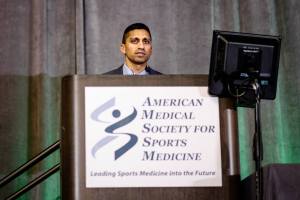
Dr. Irfan Asif, at the podium, AMSSM 2015 Conference

As I get ready to head out to South Africa as one of the ‘Travelling Fellows” of the American Medical Society for Sports Medicine (AMSSM), I can’t help but think what previous Fellows may have experienced on their own journey.

I decided to reach out to one of the 2014 Fellows, Dr. Irfan Asif, who happens also to be a rather productive CJSM author. Dr. Asif is Associate Professor in the Department of Family Medicine, in the Greenville Health System at the University of South Carolina Greenville School of Medicine, and is Vice Chair, Academics and Research Director of the Sports Medicine Fellowship there.  He is also co-chair for the fellowship committee within AMSSM.

In a tangential way, Dr. Asif came to mind this morning as I was driving to work, catching up on the overnight sports news while listening to ESPN’s Mike & Mike. Mike Golic, in commenting on Derrick Rose’s most recent injury, stated that a key ingredient to success in life boils down to this:  often times, the secret to ability is one’s availability.

I couldn’t agree more, and I couldn’t pick a better examplar of this notion than Dr. Asif.  With all the many, many hats he wears, with all the duties he has, he responded within minutes to my initial query about being a guest on “Five Questions with CJSM.” And within one day we got down to business and conducted this interview.

Talk about availability.  Talk about ability….and now, let’s talk about the AMSSM Travelling Fellowship and more, with Dr. Irfan Asif.

__________________________________________________

1) CJSM: In 2014 you were one of the inaugural travelling fellows for the AMSSM. Who joined you on your journey to Australia? What do you remember as some of the high points of that journey?

IA: It was an honor to be selected as one of the AMSSM inaugural traveling fellows to Australia. I was accompanied by my colleague Chad Asplund, as well as, one of the founders of AMSSM and current president/CEO of the ABFM, Jim Puffer.

The trip was fantastic. We had the opportunity to meet legends in the field of sports medicine including: Peter Brukner, Peter Fricker, and John Orchard. Each uniquely contributed to our trip. For example, Dr. Brukner demonstrated the power of dry needling, Dr. Fricker provided valuable insight into the medical care offered at the Australian Institute of Sport, and Dr. Orchard demonstrated the significance of developing league-wide (Australian Rules Football) research that can ultimately manifest as rule changes in sport to provide a safer environment for competition. In addition, we had the privilege of meeting Andre La Gerche and Chris Semsarian who are some of the premier thought leaders in sports cardiology.

Aside from these experiences, we participated in educational grand rounds and conferences on topics such as: Sports Cardiology, Sports Concussion,Heat Illness, Regenerative Medicine, and Exercise as Medicine.

The most meaningful memories, however, were getting to know Chad and Jim on a deeper level, including Chad’s personal stories of providing medical care during tours in Afghanistan, and Jim’s journey to becoming a leader in family and sports medicine.

TF Photo

The AMSSM Travelling Fellows, 2014 (L to R – Irfan Asif, Peter Brukner, Chad Asplund, Jim Puffer)

Special thanks to DJO Global for sponsoring our trip.

2) CJSM: What is your work like on a day-to-day basis? Can you tell us a little bit about your clinic responsibilities; your teaching and research; what sports teams you may have to cover?

IA:  Work is exciting, with heavy doses of family and sports medicine. My major roles within the Greenville Health System/University of South Carolina Greenville School of Medicine include being the Vice-Chair of Academics and Research for the Department of Family Medicine, and the Primary Care Sports Medicine Fellowship Director.

As Vice-Chair I oversee the training curriculum and environment for medical students rotating in family medicine, two family medicine residencies, and our fellowship programs. In addition, I am developing the research infrastructure for our research division, which is focused on patient-centered outcomes research, comparative effectiveness trials, and quality improvement initiatives. We partner with local programs such as USC Greenville School of Medicine, Furman University, and Clemson University to improve the healthcare of our region.

As the director of our sports medicine fellowship, I have the opportunity to lead one of the largest PCSM Fellowship Programs in the country (12 CAQ PCSM physicians with an athletic training network covering 50 locations and >20,000 athletes). Aside from high school sports, we assist in the care of athletes from USA Karate, USOC Para-athletes, professional baseball, and Division I & II Collegiate programs.

Currently, my clinical focus is centered on using lifestyle modification measures (exercise as medicine, healthy nutrition, behavioral modification, etc.) to prevent, manage, and treat non-communicable diseases such as cardiovascular disease, diabetes, and hyperlipidemia. We still see routine musculoskeletal injuries, but I believe that primary care sports medicine can also play a larger role in the health of the every day individual…everyone is an athlete; sometimes, they just don’t know it yet.

Last, my primary research focus has been on the prevention of sudden cardiac death in young athletes. Our research team has examined several different domains within this field, including: epidemiology, screening, resuscitation strategies, and the psychological impact of being diagnosed with cardiovascular disease. This year, we developed the “Connected by Hearts” program as a support mechanism for athletes who are diagnosed with potentially lethal cardiac disorders.

3) CJSM: You were chair of the 2015 AMSSM Annual Meeting’s planning committee, and we thought you did a fabulous job with that. What role do you have with the 2016 meeting, in Dallas? What are you looking forward to in Texas?

IA:  Thank you for the kind words regarding the 2015 AMSSM Annual Meeting. If I could be humble, this was professionally the most fulfilling task that I have completed in my career. None of it would be possible without the leadership of Jon Divine and the entire program planning committee…They were simply outstanding.

The 2016 Annual Meeting commemorates the 25th Anniversary of the AMSSM organization. Marci Goolsby has put together a phenomenal program using a “Back to the Future” theme that celebrates the work of our founding members. As part of the program planning committee, I have focused my efforts on Faculty Development, which you will see at least 6 times within the program. Most physicians equate faculty development solely with academic medicine; however, faculty development encompasses any environment of education, regardless of where it may be. We kick off the meeting with a special lecture by an invited speaker, Dr. Michael Wiederman, who will explain this paradigm during a session titled, “What is Faculty Development?” We then offer 4 free Faculty Development ICL sessions that cover how to provide feedback, masterful mentoring, journal club, and journal publication (Editors from CJSM, BJSM, and Sports Health will participate). Finally, we will offer a special session on how to implement and teach an ultrasound curriculum.

4) CJSM:  If you had to compose a 140 character tweet to describe how the AMSSM travelling fellowship has impacted your life, your career, what would it say?

IA:   New friends, novel therapies, and an incredible journey to the land down under. An educational experience like no other. #AMSSM2014TF (with Peter Brukner, Peter Fricker, and John Orchard) [a little over the 140 limit, but it comes from the heart–the tweet passes muster!] 

5) CJSM: You were lead author of a 2013 CJSM study on the leading cause of death in NCAA D1 athletes that got a lot of press. Were suprised by the results? Prior to that study’s initiation, had you any idea of the impact of MVAs on our NCAA student athletes?
IA:  This study was, no doubt, a surprise. While is it common knowledge that MVA’s are the leading killer in the general population for this age group, I wasn’t sure if this was the case for athletes or not. Often, we hear only about morbidity and mortality that occurs on the playing field. While sudden cardiac death, heat illness, and concussion are important health concerns in the athletic population, we must consider the impact of medical care for the athlete both inside and outside of competition. Simple questions that assess potentially risky behavior (e.g. Do you wear a seat belt, do you drink and drive, do you text while driving, etc.) can go a long way in ensuring the health and safety of the athletes we manage. We hope that this article, and some of our new work on mental health in the athlete, can go a long way in re-defining our role as sports medicine physicians.

_______________________________________________

Thanks a lot Irfan, for your time and your insight.  Exciting to hear about AMSSM’s celebrating its 25th anniversary:  we are doing the same here at CJSM!  We may just have to figure out a joint way to celebrate our organizational silver anniversaries in Dallas!

South Africa — here we come

FullSizeRender

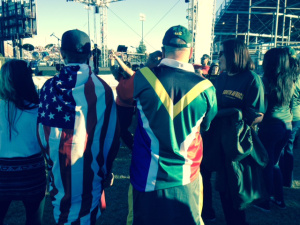
The flags of the USA & RSA: South Africa, here we come!

It’s Monday, and in a busy American football season that means a clinic full of Friday’s injuries.  Some interesting stuff came my way today, including a jersey finger, an angulated 1st metacarpal fracture which needed a closed reduction, and an OCD lesion of the knee in a youth.

When not focused on those clinical encounters, I find my mind straying elsewhere, as 10 days from now I will join a couple of other folks from the American Medical Society for Sports Medicine (AMSSM) for a 2+ week tour of the sports medicine scene in South Africa. Dr. Doug McKeag, a former president of AMSSM,  Dr. Alison Brooks and I will be the AMSSM ‘travelling fellows’ heading out on this tour.  Our hosts there will include Jon Patricios, Phatho Zondi and Piere Viviers, among others, of the South African Sports Medicine Association (SASMA), and we’ll be culminating the trip with a visit to the 16th biennial congress of SASMA taking place 20 – 22 October in Johannesburg.

South Africa has a powerfully strong sports culture, which I’ve witnessed first hand when I last travelled to that beautiful country 20+ years ago.  I think of the great rugby and cricket teams the country has fielded [the former battling in the Rugby World Cup right now].   I think of the dominant golfers, Gary Player, Ernie Els, and a new generation headed by Louis Oosthuizen and others. And who could leave out mention of one of the premier ultramarathons on the planet, the Comrades Marathon, or the cause celebre of Caster Semenya.

The country has fielded an equally powerful team of sports medicine physicians and researchers over the years, many of whom have graced the journal pages and other media of CJSM.  I think of Tim Noakes & Jon Patricios.  I think of the research on hyponatremia and exercise-associated muscle cramping and more.

1200px-Cloud_and_Table_Mountain

Table Mountain & its table cloth– we’ll be there soon. Photo: courtesy of Shizhao

As we AMSSM fellows travel from Cape Town, to Pretoria and Johannesburg, we’ll be telling our stories on this blog and on social media.  If you’re on Twitter or Instagram, be sure to follow the hashtag #AMSSMTravellingFellows as Drs. Brooks, McKeag and I share our stories and our pictures.  SASMA2015 will have a bevy of the world’s ‘top dogs’ in the sports medicine world.  Folks like Drs. Lyle Micheli, Jonathan Drezner, Cindy Chang, and Karim Khan will be speaking at SASMA2015, and we’ll profile what they have to say on hot topics in the world of sports medicine.

I’m off to pack.  I can’t wait to get to the land of the Springboks and Proteas, of Table Mountain and the Witwatersrand.  More soon!

The Controversy Over Grass

madison plains

Where Pigskin Meets Grass

To be clear, my topic today is NOT a survey of what cannabis legalization has wrought in states like Washington or Colorado [as an aside, in our own little corner of the USA the question of legalization will be on the ballot in Ohio this fall].

The grasses we’re discussing are ‘Bermuda,’ ‘Fescue,’ ‘Bluegrass’ and the like.

And the question today is not whether ‘the Dude abides’ [he most certainly does], but is this: which is the safer surface on which to play sport, grass or turf?

The subject came to mind after reading about a recent kerfuffle in the NFL.  The Houston Texans have played on a specially designed grass surface over the years. This season, they are switching to turf in response to concerns voiced about the field quality by opponents such as the Kansas City Chiefs.  In the NFL, in this season for this stadium, there’s a push toward turf.

On the other hand, readers may remember the controversy that raged much of this year regarding the use of turf [as opposed to grass] for the FIFA Women’s World Cup. And that ‘other’ world cup, Rugby World Cup 2015, is taking place right now in England, with  Twickenham Stadium and its grass pitch as that event’s centerpiece.

Grass vs. turf?  The perennial question.  Looking at it solely from the perspective of injury prevention [as opposed to factors such as sports performance or maintenance costs], we have looked at this question from time to time in the blog and in the journal.

For instance, this summer, in the July 2015 CJSM, O’Kane et al. published their timely findings looking into shoe wear and surface type on injury rates in female youth soccer players.  They found that a grass surface and wearing cleats on grass raised rates of lower extremity injuries; they concluded: “When considering playing surfaces for training, communities and soccer organizations should consider the third-generation artificial turf a safe alternative to grass.” Something to consider in this population and this sport and a countervailing argument to the push for grass in future iterations of the Women’s World Cup? Perhaps.  Or might that be too great of a generalization, extrapolating from the youth to the elite sport level?  Very likely.

What about you: your thoughts on this matter?  Taken purely from the perspective of sporting safety and injury prevention, what are your thoughts, your read of the medical literature?  Grass vs. Turf:  which is safer?  Does the sport matter?  Does the level of play matter?

Tell us in the poll!


Rugby World Cup 2015: “All In”

Wallabies_vs_Springboks_lineout

Wallabies vs. Springboks: a potential fixture in #RWC2015 England Follow @CJSMOnLine during the World Cup to find out more.

The Rugby World Cup begins tomorrow in England, and I, like many others around the world, have been looking forward to this day for some time. It’s been on my mind at least since this blog post [‘Rugby’s Big Year(s)’], which I am republishing today.

Interest in the sport continues to grow here in the United States.  This interest is growing both in its own right–an awareness of the special excitement of rugby– and it is growing as there is increasing awareness of the sport’s impact on the broader world of football in general.  Rugby played midwife to American football, so to speak. The familial bond is still present: Jarryd Hayne, an Australian rugby player, just made his debut in an NFL regular season game; and the Wall Street Journal published an intriguing story today on the ‘thing or two’ that American football might learn from its mother sport.

I’ve written frequently on the sport in the pages of this blog, and the journal has published just as frequently on the subject.  And so we are ‘all in’ for the World Cup over the next six weeks.  Expect timely, topical posts on the sport medicine issues that arise as the games begin.

Among the other twitter feeds I’ll be following (and you should too):  @RugbyWorldCup (the official RWC2015 twitter feed); @WorldRugby (the official governing body of the sport, formerly known as the ‘IRB’); @Sharief_H (aka ‘Rugby Science); and @RugbySciNetwork (Rugby Science Network or ‘RSN’).  RSN is actually having an international conference on the sport and associated sport medicine, in Cape Town, and following the hashtag #RSN2015 will bring you a wealth of valuable information.

I’ll be travelling through South Africa and visiting Cape Town myself during the tournament, and so I’ll be sure to follow @Springboks as well.  Who knows, maybe I’ll be following a winner?  Or will it be the Pumas?  The All Blacks?  The Wallabies? Maybe the USA, ranked 15th in the world, will pull off the mother of all upsets?

We will find out at the end of October!

sportingjim's avatarClinical Journal of Sport Medicine Blog

IMG_1008 Sam Boyd Stadium, Las Vegas Nevada, site of the annual Rugby 7s tournament.

It’s amazing how time flies.  How is it already March?

It’s almost 7 p.m. and I’m writing by the light of a sun that is still above the horizon, thanks to one of my favorite inventions of the modern world: daylight savings time, which arrived last night.

This realization is a personal reminder, however, that I have been delinquent: meaning to write a blog post about an event that took place three weeks ago…..but, my oh my, business has just swamped me, I guess.

As the swallows return annually to San Juan Capistrano, so do the Rugby 7 squads of Kenya, South Africa, New Zealand and other countries come each February to the desert:  Las Vegas hosted the USA leg of the HSBC Sevens Series Feb 13 – 15.  It is the largest annual…

View original post 534 more words