Achilles Tendon Ruptures and Kobe Bryant’s Injury

Image

Kobe Bryant, Joe Johnson Wikimedia

I woke up this morning to hear very sad news that occurred in the NBA last night:  Kobe Bryant has ruptured his Achilles tendon.

Kobe, who turns 35 this year, is one of the most recognized athletes in the world (maybe one of the few things that China and the USA can agree on). He had been leading his team to crucial victories as they were making a playoff run when he succumbed to this not uncommon injury in the middle aged athlete.

As he is quoted saying, he made a move he had executed a ‘million times’ when he felt like someone had kicked him in the leg, and he subsequently crumpled to the ground.  This is the classic history one might obtain when caring for an athlete with such an injury.  If you watch the video, you’ll see Kobe perform a classic move which can result in a ruptured tendon:   his left leg  pushes back  while he powerfully tries  to accelerate around the defensive player; this eccentric contraction is followed by a step and immediate inability to bear weight, and he falls to the ground. Read more of this post

AMSSM 2013 Conference in San Diego

The American Medical Society of Sports Medicine (AMSSM) is having its annual meeting in beautiful San Diego, California this year beginning April 17.  We’re less than a week away and very excited for what promises to be a great conference.

As the new editor for the CJSM blog, I am looking forward to meeting new people and seeing old faces, from the Executive Editor of CJSM (and former blog editor) Chris Hughes (a new friend) to people like William Meehan, one of the recipients of this year’s AMSSM Young Investigator Grants and an old and dear friend. Read more of this post

Consensus Statement on Concussion in Sport – the 4th International Conference on Concussion in Sport. Video introduction by Dr Willem Meeuwisse

Following on from the AMSSM Position Statement on Concussion in Sport published in the last edition of CJSM, this month sees the publication of the latest Consensus Statement on Concussion in Sport from the 4th International Conference on Concussion in Sport held in Zurich in November 2012.

The 4th Statement takes into account the most up-to-date research on the topic of concussion in sport, and is accompanied by the new Sports Concussion Assessment Tool (SCAT3), Child SCAT, and the Concussion Recognition Tool (CRT) for patients and parents. Printable copies of the new tools can be downloaded via the links provided on the CJSM website.

In this video, Concussion in Sport Group Member Dr Willem Meeuwisse, former Editor-in-Chief of the Clinical Journal of Sport Medicine, presents an introduction to the new statement and discusses the main new features therein including the new SCAT3, child SCAT3 and Concussion Recognition tools.

Leave a Comment

Leave a Comment

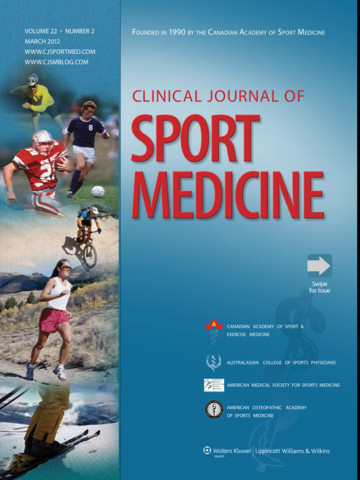
CJSM on your iPad – New CJSM iPad App

Freely available from the Apple iTunes store, the CJSM iPad app finally allows readers to download and read the journal on the iPad format. The app optimizes the best in digital technology to enhance a print-like reading experience with seamless multimedia integration, easy navigation and more.

Once editions are downloaded, they can be read offline and subsequently stored on your iPad or archived for future downloading should you wish to view in the future.

The iPad version of the journal is written in an intuitive format, and allows readers to read the journal in a similar way as if reading the hard copy using horizontal swipe motion to access different articles, and vertical swipe motion to advance pages within a particular article. In addition, there is a menu access which allows direct access to individual articles or pages within articles, together with a menu bar access at the bottom of the page which appears on tapping the page.

Articles may be favourited and added to your favourites list. Article links can easily be emailed to colleagues by using the mail icon next to the article presentation bar, and corresponding authors can be emailed directly by tapping the underlined email links at the bottom of each article.

Text size is easily adjustable by using the pinch and zoom feature. In addition, there will be more exciting multimedia content including videos, images, and supplements as these become available which will bring your edition of CJSM to life.

Supplemental data will be available by via links to the main CJSM website.

You can currently enjoy limited-time complementary access to download and view journal content using the CJSM iPad app without a sign-in.

The app is available via the link at the iTunes website. Give it a try, and don’t forget to let us know what you think of it.