Team Doctor AND fan? Avoiding conflicts of interest and issues affecting clinical judgement in Sports Medicine

This weekend was one of the weekends that I both look forward to and dread at the same time, in equal measure – when ‘my’ team play the team with whom I am currently working as team doctor.

I started supporting Sheffield Wednesday Football Club when I was around 5 years old, spurred on by my father who was, and still is, an ardent fan. He took me along to my first game against Peterborough United on a cold winter’s day and an exciting game led to a 3-3 draw. However, by all accounts, I was not particularly engaged with the game itself, choosing instead to run amok up and down the gangways of the main stand and only becoming particularly focussed at half time when I was given a bag of sweets to demolish.

Nevertheless, I grew into a diehard Wednesday fan myself and became a regular season ticket holder, attending games regularly with my father. Much of my childhood conversation at home and at school was on the topic of how the Owls were performing each week. I still remember well the first day that I became a member of the Young Owls Club, proudly sporting my Club badge, shaking hands with some of the players and collecting autographs. One of the players whose autograph I still have from that day was Gary Megson, an honest and hard-working midfielder. He was later to become Club Manager, having been appointed just last year to the role with the Club. I still have a close affiliation with the Club as a fan, and those conversations about the team with my father still remain as regular as they were over 30 years ago.

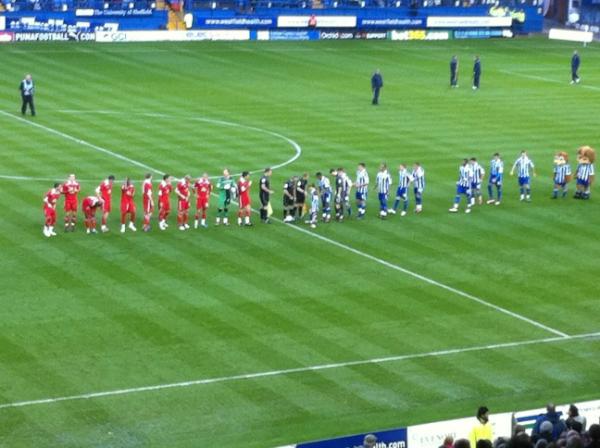
Although I have looked after several different teams in the past and have been involved in lots of different sporting events, the first time I was called to be involved in any sort of Professional capacity at an event at which ‘my’ team were playing was last year when Leyton Orient were due to face Sheffield Wednesday in Sheffield at Hillsborough, the ground in which I had spent so much of my time over the years watching my team.

In Football League 1 in the UK, it is standard practice for the home team doctor to care for both the home and away teams during the game itself, so there was no requirement for me to attend that day as club doctor for Leyton Orient. However, I was very keen to go along as a football fan, at least. Despite being invited to take up my usual position on the bench with Leyton Orient, my instincts told me that I would be much better off in the stands with my father and brothers watching the game as a fan. It was with a strange mix of emotions that I watched the match that day, feeling a desire for both teams to do well and certainly not feeling like a team doctor. Being up in the stand, I could enjoy the game as a spectacle rather than approaching the game as I usually do when I am on duty as team doctor.

Later on in the season, Leyton Orient played Sheffield Wednesday in London. Although I approached the game with a little trepidation at first, I felt much more professionally detached and objective on the day which was perhaps down to the familiarity of my usual working environment. I found it relatively easy to concentrate on my club doctor role and to care for both sets of players on the day.

There are a number of possible ways in which being a fan might potentially cause a conflict of interests or influence the clinical judgement of a team physician both in a conscious or  in a subconscious manner. Perhaps the most difficult situation is when a clinician is both team physician and a fan of the same team – a situation perhaps not as uncommon as one might think. The team physician may or may not start out as a fan of the team, but they may develop into a fan without being truly aware of this such that objective clinical judgement may be affected and insight might be poor. A decision might be taken, for example, to ‘patch up’ an important player in a vital game and let them continue to play rather than taking a different view.

Whilst conflicts of interest between what might be best for a player and what might be best for a team are not so uncommon and are well known to team doctors, matters of clinical judgement related to a doctor’s ‘fan status’ may not be so apparent, and there may be a lack of awareness on all sides.

Perhaps the most important requirement for a team physician in order to prevent any potential adverse effects on objective clinical judgement alongside a Professional approach is the capacity for self-reflection and insight.

Is it time for clear ethical guidance on this issue?

Should we have a section on a team doctor’s annual appraisal on probity issues related to ‘fan versus doctor’ to facilitate and encourage reflection?

CJSM would like to hear your views.

Leave a Comment

Leave a Comment

Working in teams – what about learning in teams? Interprofessional Education in Sports Medicine

There are a wide variety of healthcare professionals working in the sports medicine environment, whether that be in primary or secondary care, or within a sports team.

These might typically include physiotherapists, physicians, massage therapists, strength and conditioning coaches, nutritionalists, biomechanicists, sports psychologists and others.

Most of us working as healthcare professionals in a sports medicine environment are no strangers to the multidisciplinary team way of working, but how often do we think about how we learn together, and from each other, in teams?

The term ‘Interprofessional Education (IPE),’ as suggested by the Centre for the Advancement of Interprofessional Education (CAIPE), may be used to define a process that ‘occurs when two or more professions learn with, from and about each other to improve collaboration and quality of care.’ CAIPE go on to state that ‘IPE includes all such learning in academic and work-based settings before and after qualification, adopting an inclusive view of ‘professional.’

The unique concept of IPE is one of deliberately bringing together a group of heterogeneous healthcare practitioners to discuss educational topics. As a consequence of this, it is hoped that the diversity amongst the group together with effective knowledge sharing will allow for better learning for all within the group. Hopefully, this goes on to lead to improved patient care and patient outcomes.

IPE approaches to learning have been studied extensively, and Freeth (5) noted that some have indeed led to improved outcomes for patients, including improved preventative care, screening effectiveness and immunisation rates (1), improved teamwork and less perceived errors occurring in an emergency department (2), and increased interprofessional participation in planning and reviewing care (3, 4). However, there is a paucity of research on the implementation of IPE in a sports medicine environment, let alone on whether it leads to the outcomes we all desire for our patients and for our teams.

Whilst IPE can be delivered in formal settings, it is perhaps the informal settings where its practicability can be demonstrated., for example, during MDT assessments of athletes with injuries where complex contributing factors need to be assessed as part of the overall picture. Most of us involved in sports medicine will be familiar with MDT assessment in this way, and if an effective learning environment is created, then this represents a wonderful opportunity for each of the participants to learn from each other. I wonder how often we consciously think of MDT assessments as a real opportunity for learning, and treat them as such?

There are a number of possible barriers to the implementation of effective IPE. These include tensions between different professional groups such as negative stereotypes, status or salary differences, and demotivating and derogatory feedback between groups within the learning environment.

To some extent, these barriers can be avoided if one adopts appropriate ground rules. As mentioned by Freeth (5), these might be extrapolated from the ‘Contact hypothesis’ which suggests that one can reduce hostility amongst different groups by creating a learning environment where everyone has equal status, interaction is co-operative, participants are working towards a common goal, the ‘authorities’ support the initiative (eg Club management and Professional bodies), participants are made aware in advance of each others’ differences and similarities, participants share positive expectations, and participants from different groups perceive each other as typical of their group (6).

The extent to which these precedents are achievable is open for debate, and one might question whether with the wide range of healthcare practitioners involved in Sport and Exercise Medicine this might ever be achieved, or might even be desirable.

It is not uncommon to experience formal and informal IPE in the sports medicine environment, whether that may be at conferences, as part of social learning platforms such as blogs and twitter feeds, or within the workplace. In addition, formal postgraduate degree courses such as the MSc in Sport and Exercise Medicine at William Harvey Research Institute, Queen Mary University, London which I lead often have a student base made up of a wide complement of healthcare practitioners who participate and learn from each other. This is regarded as a real strength of the course.

CJSM would like to hear your views on IPE in the world of Sports Medicine– does it work for you, your colleagues, and perhaps more importantly for your patients?


Leave a Comment

Leave a Comment


1) Shafer M-A et al. 2002. Effect of a clinical practice improvement intervention on chlamydial screening among adolescent girls. JAMA 288:2846-52

2) Morey J et al. 2002. Error reduction and performance improvement in the emergency department through formal teamwork training:evaluation results of the MedTeams project. Health Services Research 37:1553-81

3) Berman S et al. 2000. Assessment training and team functioning for treating children with disabilities. Arch.Phys.Med.Rehab.81:628-33

4) Walsh P et al. 1995. An impact evaluation of a VA geriatric team development program. Gerontology and Geriatrics Education 15(3):19-35

5) Freeth D. 2010. Interprofessional education. In Swanwick T (Ed.) 2010. Understanding Medical Education : Evidence, theory and practice. ASME, Wiley-Blackwell, London

6) Hewstone M and Brown R. 1986. Contact is not enough: an intergroup perspective on the ‘contact hypothesis.’ In: Hewstone M and Brown R (Eds) Contact and Conflict in intergroup encounters. pp.1-44. Blackwell, Oxford

Seasonal influenza vaccination for professional athletes – who’s for the jab?

It’s that time of year for many of us in the Northern hemisphere when colleagues involved in caring for participants in elite sports are being asked, ‘Doc, should I have a flu shot?’

The decision may have already been made by the athlete (or, indeed, the Club or organisation) that they either ‘need’ or ‘don’t need’ influenza vaccination, which may make life easy or hard for clinicians if there is a difference of opinion on the subject.

Whilst our patients might perhaps expect an easy and straightforward ‘yes’ or ‘no’ answer on the question of seasonal influenza vaccination, the reality is that the decision to be made on requirements for seasonal influenza vaccination requires a consideration of a number of complex factors relating to the susceptibility of individuals and populations to the disease, together with the risks of serious complications to particular groups of individuals and their contacts in society.

These can be broadly grouped into extrinsic and intrinsic factors :

1) Extrinsic factors

– Regional projected population prevalence of viral load (based on WHO Health surveillance data)

– Regional variance in delivery policies and availability of vaccines (may include rationing)

– Meteorological forecasts

– Other socioeconomic factors (occupation, housing etc)

2) Intrinsic factors

– Co-morbidities such as asthma, diabetes

– Patient choice

In the United States, seasonal influenza vaccination is recommended for all individuals over the age of 6 months, but local recommendations vary considerably in different countries. In the UK, for example, universal vaccination is not currently recommended, with a more targeted approach being adopted towards vaccinating certain individuals.

When it comes to particular groups such as athletes, all of the considerations mentioned above apply but there is the added question about the effect of moderate-to-high levels of physical activity on immune system function and susceptibility to infection to consider. It may also be important to consider the effect of travel and time-zone adjustment. In addition, when it comes to hard outcomes, it’s important to consider the evidence for the effectiveness of influenza vaccination on disease prevention in individuals, and for prevention of cross-infection of colleagues within a team environment.

There is a whole host of guidance available to clinicians from organisations such as the World Health Organisation, the Centers for Disease Control and Prevention, and the Department for Health in the UK which describe recommendations for vaccination in individual groups related to age and co-morbidities.

However, there is little information in the literature based on good quality evidence to inform clinical practice when it comes to the immunisation of professional athletes based on a consideration of the effect of high levels of physical activity on immune system functioning.

Perhaps as our understanding of exercise immunology improves, the basic science knowledge will better inform clinical practice.

An interesting position statement on immune function and exercise and maintaining immune health, published this year over two articles in Exercise Immunology Review should help us to get there. The articles provide a comprehensive review of topics in exercise immunology, and are available on the web here (Part 1) and (Part 2).

In the meantime, for those of us in the UK and other Countries where universal seasonal influenza vaccination is not currently recommended, the references at the end of this post may prove useful for those of us making decisions with our athletic patients.

CJSM would be interested to hear your thoughts and strategies for seasonal influenza vaccination of athletes, especially from team physicians.

1)  Constantini N et al. 2008. Vaccinations in sports and recommendations for immunization against flu, hepatitis A and hepatitis B.  Harefuah 140(12):1191-5

2) Daly P, & Gustafson R. 2011. Public Health recommendations for athletes attending sporting events. Clin J Sports
Med. 21(1): 67-70

3) Schaffner W. Rehm SJ. File TM Jr. 2010. Keeping our adult patients healthy and active:the role of vaccines across the lifespan. Physician and SportsMed 38(4): 35-47

4) Malm C. 2004. Exercise Immunology : the current state of man and mouse. Sports Medicine 34(9): 555-560

5) Ross DS et al. 2001. Study indicates influenza vaccine beneficial for college athletes. West Virginia Medical Journal 97(5): 235

6) Tarrant M & Challis EB. 1988. Influenza vaccination for athletes? Canadian Medical Association Journal 139(4): 282

Leave a Comment

Leave a Comment

Quarter of a century up! What have we been talking about?

The CJSM Blog reaches its 25th blog post today since our launch back in June earlier this year. For those of you who have been on board with us since the beginning, we’d like to thank you for your interest and hope that you have found the content interesting on our journey in the World of Sport Medicine.

For those of you who may have joined us a little more recently, this is as good a time as any for a recap of some of the topics we’ve been talking about so far.

Our most recent post focuses on MRI use during clinical assessment by sports clinicians and asks the question, ‘Do Sports Medicine Clinicians overuse MRI scanning?’ This issue was recently highlighted in an article in the New York Times, with perhaps a premature conclusion being reached that MRI scans are indeed overused by Sports Medicine clinicians. What do you think? Come and let us know, and don’t forget to vote on our home page quick poll.
Just prior to that, the issue of concussion in sport was discussed relating to an incident in the recent Rugby World Cup Final where a player who left the pitch due to what looked to be a concussive injury was allowed back onto the field of play only to go off again shortly afterwards. In the context of the sideline assessment of concussion and return to play guidelines, the question asked was, ‘do we practice what we preach?’
The hype surrounding the use of platelet-rich plasma was highlighted back in august when, in the context of a recently published systematic review article in CJSM, we asked the question ‘Is PRP a magic bullet or a damp squib?’
A little earlier, the controversy surrounding the mandatory use of cycle helmets for recreational cyclists was discussed in a post which generated the most number of comments from our readers so far, some with very strong opinions either for or against mandatory use. Our quick poll on the topic was hugely against legislation and enforcement of cycle helmets, with a massive 81% of 137 responders saying ‘no’ to legislation.
Some of our other discussions have focussed on cardiac screening, pre-game hyper-hydration, ‘home or away’ care for athletes, and pre-participation evaluation. Other posts have highlighted sporting events such as the Women’s Football World Cup, Wimbledon Tennis, Le Tour de France, Boxing, Ice Hockey, Rodeo, and the Olympic preparation events in the UK, with associated information signposted relating to particular injuries in different sports. We’ve also mentioned e-learning apps for anatomy, the Ovid Sports Concussion Webinar, Ramadan and the 2012 Olympics, Abuse and Bullying in Sport and several other topics along the way.
We hope that you’re enjoying the ride. In the meantime, don’t be shy – come and share your thoughts with us on the blog. It’s not too late to add your contributions to any of our posts so far, and we’d love to hear from you. The more discussion we have, the more we’ll learn from each other. This blog belongs to all of us.
CJSM would like to know what issues you would like to see discussed on the blog. Let us know, and we’ll do our best to highlight your preferred topics of discussion related to Sport and Exercise Medicine.