Pre-game intravenous hyperhydration, anyone?

The #NFL #SuperBowlXLVIII takes place this weekend, and we revisit one of our most talked about studies in the last few years.  Thanks to our Executive Editor Chris Hughes, @SportsDoc_Chris, for this 2011 post.

Chris Hughes's avatarClinical Journal of Sport Medicine Blog

The editorial in this month’s CJSM by Coombes and colleagues on Intravenous Rehydration in the National Football League highlights the widespread prevalence of the practice of pre-game hyperhydration as reported in the study by Fitzsimmons and colleagues, also in this month’s Journal here .

Fitzsimmons and colleagues surveyed the head athletic trainers of 32 NFL teams using an online survey tool and managed to achieve an impressive 100% response rate. They found that 75% of all teams had used pre-game hyperhydration with iv fluids, with an average of 5 to 7 players per team per game receiving intravenous fluids prior to play. The most common reasons for this strategy cited by trainers were to prevent muscle cramps (23 out of 24), prevent dehydration (19), at the request of the player (17), to prevent heat illness (14), and to improve player exercise tolerance (8).

It is somewhat alarming to find out that this practice…

View original post 177 more words

Rugby and #VegasBaby

The Sands

The vintage casino,
“The Sands,” no longer
with us, but there’s still a
lot of fun to be had in Vegas!

Vegas!  Rugby!  What a pair!

I just got back from the USA Rugby Sports Medicine conference, associated with the International Rugby 7s tournament stop in Las Vegas.  What a great weekend it was!  Ranging from the clinical sessions, to the sport, to the weather….to all that Vegas has to offer, it was brilliant.  I would heartily recommend this conference to any one in clinical medicine with an interest in the sports of rugby union, rugby league and rugby sevens.

Every year at this time, in Las Vegas:  it’s worth the trip.
kerr macdoald

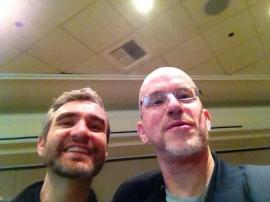
Drs. Hamish Kerr and Jim MacDonald:
‘selfie’ in between sessions.
Smiles = rugby matches about to commence


The conference proceedings began on Thursday night and wrapped up by late afternoon on Friday.  I had the chance to moderate some sessions.  I was so impressed with several of the speakers, recruited by my friend Michael Keating, Director of Medical Services, USA Rugby and the driving force behind this conference.

As the headline speaker on Thursday night Bob Cantu, MD. spoke about the 4th Consensus Statement on Concussion in Sport and Chronic Traumatic Encephalopathy (CTE).   Among the several other wonderful speakers on the two days, Hamish Kerr, M.D., Chair of the USA Rugby Medical and Safety Committee, spoke on several occasions, as did Jonathan Hanson, M.D. ( @SportsDocSkye ), coming all the way from the Isle of Skye in Scotland.  Dr. Hanson has worked with the Scottish Rugby Union for over a decade.  Between the two of them, the conference participants got a great domestic and international perspective on the state of the sport and the associated medical management.

One of the most important lessons I gleaned from the proceedings is the existence of the excellent resource developed by the International Rugby Board (IRB) known as ‘rugby ready‘. This is an on-line resource that can be used by clinicians, parents, players, coaches, referees.  Subjects range from those which introduce the sport and its rules to best practices on injury prevention and management.  It’s fabulous, and I think represents a ‘best practices’ model:  I yearn for something similar for American Football, a one-stop site I could share with parents of youth who question me about the medical issues of getting their kids involved in that sport.

American football has a lot to learn from rugby, indeed.
FIJI fan

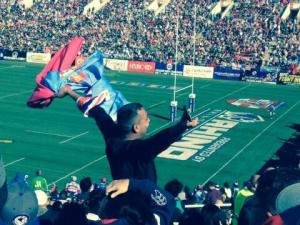
Fijian fan celebrating his team’s try.
Flags of all nations flew this weekend
over Sam Boyd Stadium, Las Vegas

So, after the conference proceedings, what was the natural next step?  Heading to Sam Boyd stadium, outside of the city, to take in the sport and pageantry of the Rugby7s tournament that took place this weekend.  Under sunny, dry, 70 degree blue skies, the teams played several competitive matches, culminating with a South African victory over New Zealand in the championship cup draw.  It was such fun to soak in the culture as well–yes culture and rugby do not represent an oxymoronic pairing of words!!!  Such fun to see the Samoan fans, the Kenyan and Uruguayan fans, the French, Fijian…..the flags, the chants, the celebrations, the dancing to the beat of Bob Marley.   It was a great scene.  To my mind, it was everything sport should be.

As I wrote in my last post, we feature rugby fairly frequently in the pages of CJSM (you can check this link to see some of the offerings under keyword ‘rugby’).   As ever, check the journal out for its rich offerings of a variety of sports and clinical medical topics, follow us @cjsmonline, and keep tabs on this blog.  It may be cold in the Northern Hemisphere, but we have some topics as hot as an Australian Open match coming up soon in the journal and blog.
the macarena

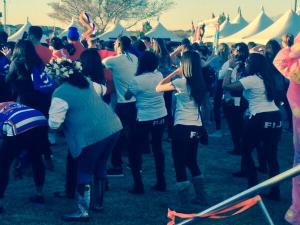
Fans doing ‘the macarena.’
EVERYONE, players and spectators,
exercising at Rugby7s!

Rugby 7’s

Rugbyball2

Looking forward to some sport
and some sun this weekend.

As I write, it’s early in the morning on another cold day here in the eastern half of the United States.  The “Polar Vortex” has descended again and I think colleagues in places like New York City and Philadelphia may be enjoying a ‘snow day’ today.

But if there are not an associated ‘blizzard’ of plane flight cancellations, I should be enjoying some balmy weather by tomorrow:  I’m heading to the USA Sports Medicine Rugby Conference and International Rugby 7’s tournament in Las Vegas.

As I had mentioned in my previous post about the upcoming FIMS/CASEM conference in June, among the many very interesting speakers headlining the USA Rugby event in Vegas:  Rob Cantu will be talking about “Short Term and Long Term Results of Repetitive Sub-Concussive and Concussive Head Injury” and Ann McKee will discuss “Emerging Concepts in Chronic Traumatic Encephalopathy” (CTE).

I’ll get a chance to listen to some great panelists and moderate some sessions, and then I’ll get the chance to watch same great sport at Sam Boyd Stadium.   I’ll be sure to share the highlights in my next post.

And, of course, I’ll get to enjoy ‘Vegas’.  But I won’t be blogging about that.  What happens in Vegas…..

I’ve previously had the occasion to write in this blog about rugby union as well as other football codes, such as Aussie rules football. I’ve had, as well, the opportunity to interview one of USA Rugby’s Team Physicians, Dr. Bruce Miller, who has been a guest on one of our “5 Questions with CJSM” posts.

Both rugby union and rugby league have featured regularly as sports we’ve studied in the pages of the journal itself.  Last year we looked at injury prevention in rugby union; in 2012 we looked at shoulder instability in professional rugby players; and also in 2012 we looked at the proportion of time-loss and non-time-loss injuries  in first team rugby league.  This brief sampling just scratches the surface of the multiple offerings we’ve had about these great sports over the years.

But CJSM has not had any study or article on Rugby 7’s, the variant of rugby union with 7 players as opposed to 15 on a side; shorter halves; and the version of rugby which will be making its debut as an Olympic sport in two short years in Rio.  We will have to rectify that!  I suspect as the prominence of this version of the sport increases over time, we’ll be seeing more manuscript submissions focusing on the injuries and injury patterns unique to it.  In the mean time, I may just have to look for some study collaborators in between my gaming—er, my studies at the conference.

sam boyd stadium

Sam Boyd Stadium, in Las Vegas:
site of the IRB Sevens Tournament stop
in the U.S.

More soon!

2014 International/Canadian Sports Medicine Conference

FIMS 2014

First stop on the 2014 conference
circuit is Vegas, but in the summer
we’ll be enjoying the charms of
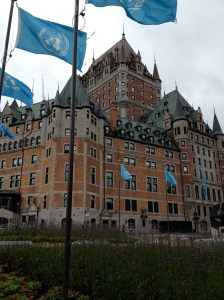
Vieux-Québec for FIMS/CASEM 2014

Turning the corner into the start of a new year, some of us can flag a little bit:  the holidays are behind us;  in the Northern Hemisphere the days remain short.

I find myself thinking about some of the travel and conferences I have planned for 2014.  For instance, in a little more than a week I’ll be heading to Vegas for the USA Rugby Sports Medicine conference.  Among the many very interesting speakers, Rob Cantu will be talking about “Short Term and Long Term Results of Repetitive Sub-Concussive and Concussive Head Injury” and Ann McKee will discuss “Emerging Concepts in Chronic Traumatic Encephalopathy” (CTE).

Among Dr. Cantu’s many, many contributions to the concussion literature, he is one of the authors on the Zurich 2012 Consensus Statement on Concussion in Sport.  Dr. McKee has done extensive work in the area of CTE, and we discussed some of that work in a blog post last fall.

I’ll be posting from Vegas on the highlights of the rugby conference.  Today, I wanted to share with you my enthusiasm for a conference coming up later in the year.  Early this summer, the XXXIII International Federation of Sports Medicine (FIMS) World Congress will take place in Quebec City, QC, Canada June 18-21, 2014.  This will be a joint venture with the Canadian Academy of Sports and Exercise Medicine (CASEM), which will be holding its annual conference at the same time.

The conference agenda is still being developed, and if you’re interested in submitting an abstract for consideration you still have a little time:  the deadline for abstract submission is January 31.  Get cracking on that!  I’ve got an abstract in myself, and hoping to hear a thumbs up from the education committee.

The CASEM conference is always a great one, and to have FIMS joining in on the education and fun makes the event doubly alluring.  Although the details are still in the works, the publisher and some of the editors for CJSM plan on giving a talk at the joint conference.  Our Executive Editor Christopher Hughes and myself will offer advice to potential submitting authors on how best to get their work published in CJSM.  We’ll also be discussing how authors can use resources such as our video abstracts to enhance and promote their work on all this journal’s media channels.

800px-Stonehenge_Summer_Solstice_eve_02

While they celebrate the solstice in Stonhenge,
we’ll be enjoying CASEM/FIMS2014 in Quebec!

So, we’re hoping to see you in Quebec City in June.  Until then, we’ll be dreaming of crepes and strolls on the bluffs overlooking the St. Lawrence, and the long, long days that will be all of ours to enjoy in Quebec come the conference, which coincides with the summer solstice.

Don’t put away those ice scrapers just yet, but there’s a whiff of summer in the air……