There Be Monsters

“In like a lion, out like a lamb,” that’s what they say about March.

To the extent that expression applies to the weather this month and to this blog, I think 2014 may be the exception that proves the rule!  We may be going out like a lion in both areas.

The east coast of North America is ready for spring, but this month that opened up with winter is ending the same way.  If there was an outdoor lacrosse game in Buffalo, New York this weekend, the players were dealing with snow!

Mike_Fisher_throws_check_May_29_2006

More like a lion than a lamb: an NHL body check.

As for this blog, we opened the month with a post that had both sound and teeth, like the proverbial carnivore itself:  our first podcast was a discussion with Drs. Neil Craton and Oliver Leslie, the authors of the March 2014 CJSM lead editorial, Time to Re-Think the Zurich Guidelines: a Critique on the Consensus Statement on Concussion in Sport.  I continue to hear about this editorial, on social media, on the American Medical Society for Sports Medicine email ListServ, and most recently at a symposium on concussions held at Ohio State University (OSU).  It has stirred a tremendous amount of interest.  And so I thought it would be fitting to end the month where we started, with the subject of concussion in sport.

The featured speaker of the OSU symposium was Kevin Guskiewicz, who spoke about “Sports concussions: paranoia or legitimate concern?”  Both he and Dr. Jim Borchers, the Ohio State Team Physician, mentioned the editorial critique in their respective talks.

If you follow the literature on sport-related concussions, you most certainly will come across Dr. Guskiewicz’s name.  He has contributed mightily to the research on several dimensions of this injury.  And so it was a pleasure to hear him speak for an hour on the subject.

As the title of his talk would indicate, Dr. Guskiewicz took as his theme the fear surrounding sport-related concussion.  Dr. Guskiewicz did an admirable job underscoring the importance of both the injury (concussion) and the need to avoid throwing out the baby with the bathwater:  eliminating collision sports such as American football out of possibly misplaced concern over short- and long-term deleterious effects on the brain.  The high points of his talk focused on the various aspects of sport amenable to change which can minimize injury risk and maximize participation.

I especially enjoyed his approach because, in many respects, it is the work that he and a few others have done (amplified by the media) that has helped unleash the beast of “concussion fear.” Read more of this post


Published Ahead of Print

Time to time, I like to share with readers of this blog some of the features of CJSM with which they may not be familiar.  Our journal’s website has a wealth of resources that I’d encourage you to check out regularly.

For instance, besides publishing the full journal every two months, we frequently disseminate breaking sports medicine research in a more fluid, continuous fashion via our “Published Ahead of Print” (PAP) feature.  PAP allows us to pursue a major goal we editors have:  to contribute to the world of clinical sports medicine in a contemporary fashion, taking advantage of the multi-media offerings of the digital world.   This goal is reflected in this blog itself; in the podcast feature we have just begun; in our engagement with you on social media; and in the journal’s iPad functionality.

“When you want it….where you want it…the way you want it.”  That’s the motto.

And so, today I wanted to share with you a ‘Practical Management’ research article that was just published via PAP:  “Surgical Management of Traumatic Avulsion of the Ischial Tuberosity in Young Athletes,‘ by Roland M. Biedert, MD.

It is one of the many interesting, hot-off-the-press articles you’ll find in the CJSM PAP collection.

I was particularly interested in this article, as I see many adolescent athletes and pelvic apophyseal injuries arrive at our clinic in droves.  It is rather uncommon to see an acute, purely tendionous injury in my clinic population:  last week when I saw an acute rupture of the proximal long head of the biceps tendon, in a 17-year-old pole vaulter, I was intrigued indeed!  The acute achilles tendon rupture in my clinic makes me wonder whether a fluoroquinolone has been used recently; seeing a patient in my own age group, I’d more likely say, c’est la vie…..

cjsm blog xray

An ischial tuberosity avulsion injury which can be managed conservatively.

The more common story in my day-to-day clinical world is for a chronic or acute injury to the apophyseal cartilage, to which a muscle-tendon unit attaches.  The tendon holds, I tell a patient; it is its attachment to the growth cartilage that gives way.

Read more of this post

What to do about concussions?

clairey

Calling aspiring
blog post writers!

There is a lot of discussion about concussions in the world of primary care sports medicine.

Breaking news?  Not!

But truly the conversation extends and deepens by the month, it seems to me.  It might be my personal, professional myopia–during football season possibly 25% of the patients in my clinic are youth athletes with sport-related concussions (SRCs).  As a consequence of that, I try to stay on top of the literature and have begun doing research in the area myself.

I hope you all have been as interested as I have over the March CJSM offerings in this area.  The journal opens with an editorial, Time to Re-think the Zurich Guidelines?  It continues with an interesting study looking at the use of those same guidelines along with the Buffalo Concussion Treadmill Test in determining return to play in adolescents following concussion.

And this blog has profiled the Zurich guidelines as well in a recent post and podcast, our first in what will be an on-going offering here at CJSM.

We are aware that there is much more to clinical sports medicine than concussion, and we make a concerted effort at the Editorial Board level to offer a continuing, rich, and diverse set of research focussed on the panoply of sport conditions we might see as clinicians.  As we move forward, we are always interested hearing from you about areas in the world of clinical sport medicine that are of special interest to you.

You can comment on these pages, tweet us @cjsmonline, or if you are especially eager and want to take the bull by the horns:  consider being a guest blog post writer for an issue that is of special interest to you.  Our blog post guidelines can be found here and include instructions on how to contact us if you are interested.

In the mean time, take the poll here (offered concurrently on the CJSM main website).  As you know, we love to hear from you!

Female Athlete Triad: The 2014 Consensus Statement

Did you know that the most recent issue of CJSM contains the recent, important consensus statement on Female Athlete Triad (F.A.T.):  2014 Female Athlete Triad Coalition Consensus Statement on Treatment and Return to Play of the Female Athlete Triad?

Did you also know that we are always keen on having guest bloggers on this site?  Our guest blog post guidelines will help you get some idea of what we are looking for.  I am especially keen to see readers of CJSM studies write critical appraisals of commentary on those journal offerings; but we will also consider potential posts that look at anything new and exciting in the world of sport and exercise medicine (evidence-based preferred).

stacy fischer

Dr. Fischer: when not caring for patients
or researching Female Athlete Triad.
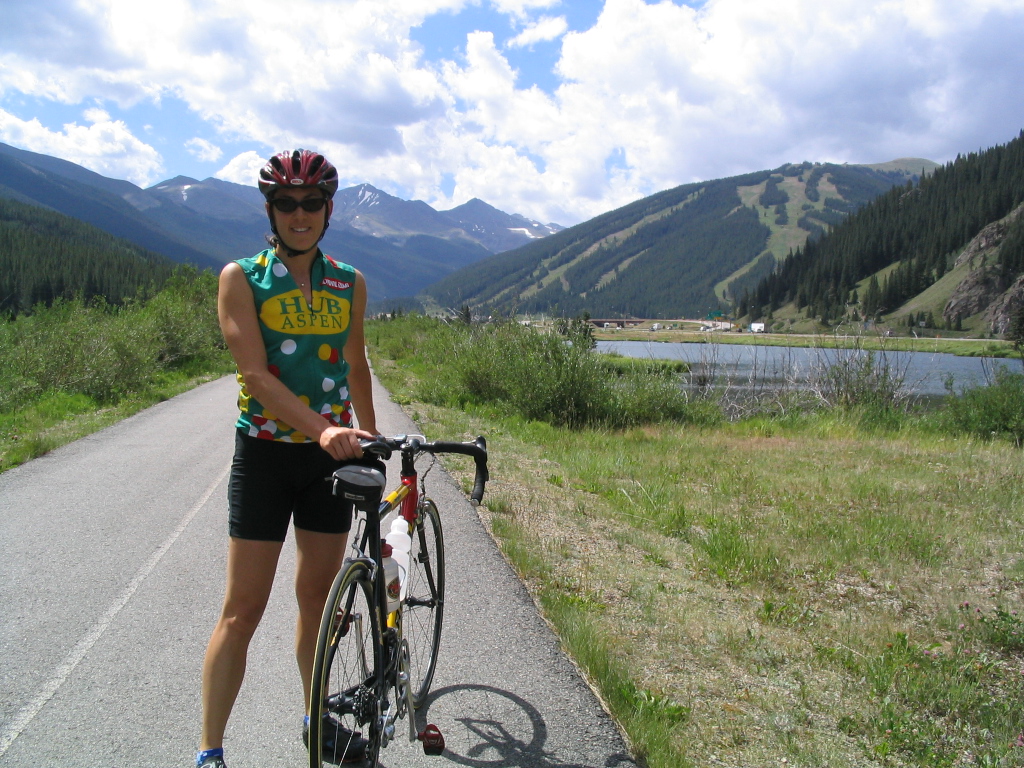
Eating up the roads in Vail pass.

This month, figuring you all might grow weary of my writing ‘voice,’ I sought out a colleague of mine with experience in the area of F.A.T. to write a post about the consensus statement.  Dr. Anastasia Fischer is a pediatric sports medicine specialist at Nationwide Children’s Hospital, and is leading that group’s investigations of F.A.T. in adolescent and younger female athletes.  In the brief amount of time she has between seeing patients, doing academic medicine, taking care of three children, and biking, she sat down to share some of her thoughts below.

_______________________________________________________________________

So what’s so cool about the new 2014 Female Athlete Triad Coalition Consensus Statement on Treatment and Return to Play of the Female Athlete Triad (link to article)?  EVERYTHING.  Seriously, everything.  For any professional who takes care of female athletes, this is a must read and will become part of your reference library.  This new consensus statement offers several features – first, it gives a comprehensive overview of the Triad, encompassing where the science started and how it evolved, where it is, and where research is needed or headed.  It gives a comprehensive review of treatment strategies that have been proposed or studied and evaluates their efficacy for athletes, in a straightforward, bulleted manner that has never before been published.  Finally, the icing on the cake is an evidence-based risk stratification point system that takes into account the magnitude of risk to assist the physician in decision-making regarding sport participation, clearance and return to play.  Truly, this document can be used as a guide to managing the female athlete from youth to maturity, across any spectrum of athletic performance, and give physicians a framework for screening and managing athletes across their careers.  It can help providers (physicians, athletic trainers, dieticians, etc.) optimize the performance and ultimately, the health and wellbeing of their athletes for years to come.

A few standout points of the statement: Read more of this post