Pain Management in Athletes: A Conversation with South Africa’s Wayne Derman

Wayne E. Derman MBChB BSc (Med)(Hon) PhD, of Stellenbosch University, South Africa

Our guest for our newest podcast is Wayne E. Derman MBChB BSc (Med)(Hon) PhD.

Dr. Derman was the Guest Editor of our September 2018 CJSM, which was a thematic issue focusing on pain management in athletes.  He hails from South Africa, where he is Director and Chair of the Institute of Sport and Exercise Medicine, at the Division of Orthopaedic Surgery, Stellenbosch University. Dr. Derman does research in Sports Medicine, Rehabilitation Medicine and Cardiology and lectures widely around the world.

If you have not heard him speak, now is your chance. We had an exciting discussion about the challenges of pain management (and the challenges of guest editorship) which we have entitled:

No pain no gain? NO WAY!

Take a listen to this episode, and all of our podcasts, at the CJSM link on iTunes or on the journal’s home page on the web.  Then consider reading Dr. Derman’s lead editorial, or any number of the published studies in the thematic issue, and share your thoughts which him or us on Twitter: @wderman @cjsmonline.

CJSM Blog Journal Club — Can Cold IV Saline Mitigate the Effects of Exertional Heat Illness?

Can cooling this down prevent the sequelae of EHI? Photo courtesy of Wikimedia, NIAID

It’s November, and our sixth and final edition of 2018 has just published.  One of the original research articles in this edition is: Effects of Intravenous Cold Saline on Hyperthermic Athletes Representative of Large Football Players and Small Endurance Runners. 

Our Jr. Assoc. Editor Jason L Zaremski, MD  is today reprising his role as guest author for the CJSM blog journal club  and will take us through his read of the study.  Join in the conversation over this important new, original research by reading the article and the blog post below.  As ever, we love your comments:  you may give them here on the blog or Tweet them to us at @cjsmonline.

We’re nearing the end of 2018.  As the Journal publishing crew gets ready to celebrate Thanksgiving, we want to thank you for visiting us on this blog and reading and contributing to CJSM.

___________________________________________________________________________________________________________

Jason Zaremski, MD

Introduction:  The winter Journal Club commentary for the Clinical Journal of Sports Medicine (CJSM) will be a review of an original research manuscript highlighting an alternative method for treating exertional heat illness (EHI). As many of us in the sports medicine community are fully aware, EHI is a potentially devastating pathophysiological process that is treatable if timely and efficient action is taken.  Speed is of the essence. Heat stroke, a type of EHI where core body temperature is greater than 40°C/104°F, can result in significant central nervous system morbidity, and even death, if not treated immediately.

Morrison and colleagues performed a novel study assessing the effects of intravenous cold saline (IVCS) on hyperthermic collegiate football players and cross country runners. As the authors note, the use of cold saline infusion has not been studied for its effects on hyperthermic athletes, though it has been studied for rapid cooling for patients who have had cardiovascular and/or neurological insults in order to induce “therapeutic hypothermia.”

Purpose/Specific Aim(s):  To evaluate the cooling effects of IVCS (4°C/39°F) on hyperthermic athletes and compare to the effects of room temperature normal saline (RTNS) (22°C). A secondary aim was to assess if body composition had an effect on IVCS cooling rates.

Methods/Design: Read more of this post

Dr. John Orchard on pain management in elite athletes: The CJSM Podcast

Dr. John Orchard, Chief Medical Officer of Cricket Australia (and so much more)

The September 2018 CJSM is a thematic issue on an issue of central importance in sport and exercise medicine:  the management of pain in the athletes we serve.

Many authors contributed to this special issue, with only a few more prolific than our guest on today’s podcast: John Orchard MBBS BA PhD MD.  Dr. Orchard was a contributing author on three of the original articles included in this issue:

Dr. Orchard is a wonderful interview, and so I hope you get to listen in — as ever you can go to our journal website to find all of our podcasts or to iTunes. We covered a lot of ground in a short time during our conversation.  Among the stories Dr. Orchard shared with me was one of immediate relevance:  that of Cooper Cronk, rugby league player in the NRL played in that league’s Grand Finale with a fractured scapula (and a local anesthetic injection).

The readers of this blog and the listeners of the podcast should all know that Dr. Orchard is also a wonderful tweeter — one of our profession’s most important ‘follows’ I think. I you don’t already have him on your Twitter list, please find him @DrJohnOrchard and remedy that situation!

Thanks for following us here on the blog, on the podcast, and on our journal’s website.  As ever we appreciate your feedback, and we’d ask you specifically to comment on the podcast on iTunes if you are willing.  We are always interested in improving our content.

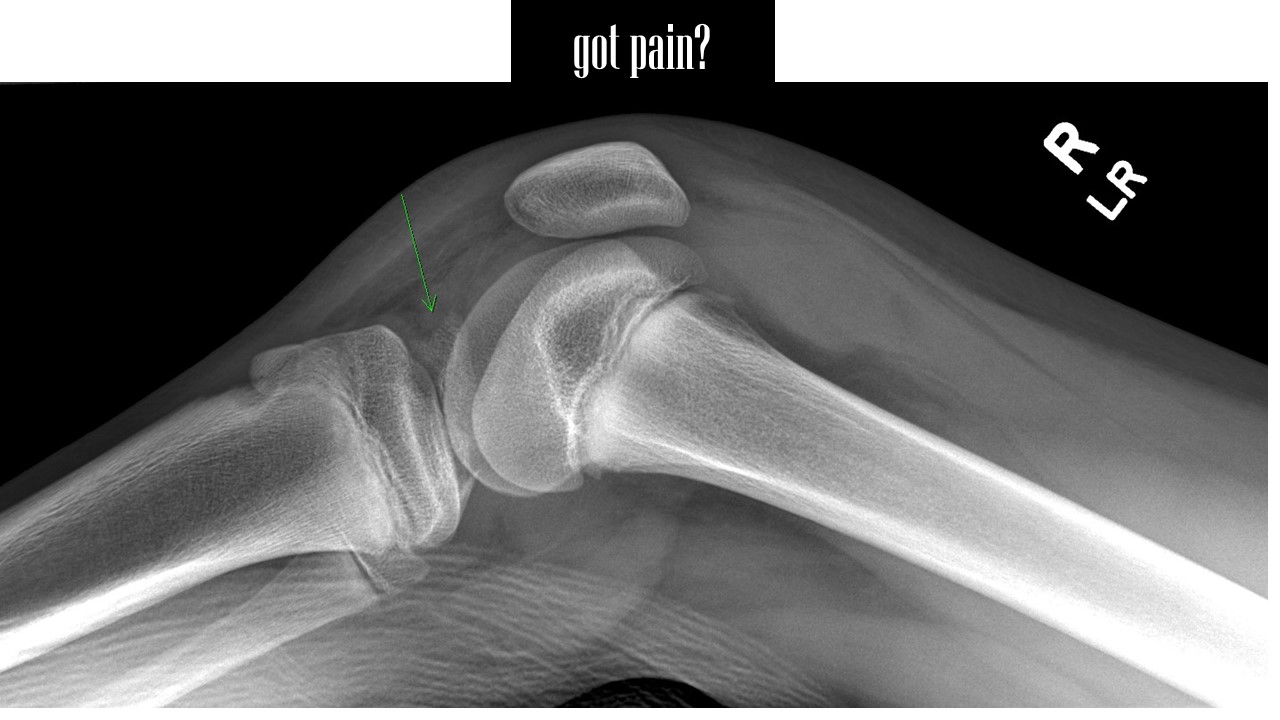
“got pain?” Get the new issue of CJSM

A tibial spine avulsion fracture — an injury requiring surgery, and significant pain management.

The new academic year has begun in North America, and with it a new set of sporting seasons and a surge in sports’ injuries in our clinics.  Youth and school soccer and football provide many of the injured patients I manage.  For instance, a few days ago, on a Friday, I saw a 12-year-old boy who described a twisting injury to his knee, with immediate disability and an effusion.  I saw him in my clinic the day after his injury and discovered he had sustained a tibial spine avulsion fracture.

These injuries typically occur in skeletally immature patients aged 8 to 14 who sustain twisting or valgus moments to a hyperextended knee.  Though relatively uncommon, a tibial spine avulsion fracture is seen rather often in a specialty center like mine that focuses on the care of the pediatric and adolescent athlete.

In the USA (perhaps everywhere?), these will almost always require surgical fixation.  Since I am a primary care sports medicine physician, this means I was on the phone immediately with my orthopedic surgical colleague, and the child was booked for the OR on Monday.

What remained for me to deal with were the important issues of splinting and pain management over the weekend.

Pain management in the injured athlete — a broad topic which challenges a clinician on an almost daily basis.  I would add that I have found the issue has become increasingly challenging with the opioid epidemic that has ravaged the USA, most especially in states like Ohio, where I practice.

Over the nearly 25 years I have been a physician, I have seen the conversation about analgesia change from one putting an emphasis on ‘pain as a vital sign’ to one asking the question:  in the physician’s efforts to alleviate pain, has patient safety been compromised?

(L to R) Three greats from South Africa: Martin Schwellnus, Wayne Derman, Pierre Viviers

It is an ever-timely contribution, then, that our September 2018 issue is a thematic issue devoted to the topic of pain management in the athlete.  I am delighted to add that our Guest Editor this month is Professor Wayne Derman who is Director and Chair of the Institute of Sport and Exercise Medicine at the Division of Orthopaedic Surgery, Stellenbosch University, Cape Town, South Africa.

I count Wayne as a friend, and I am happy to let you know I plan to conduct a podcast with him in the next month so you can hear directly from our guest editor how he brought this issue together.

In the meantime I urge you to go to this issue  and check out the many interesting articles, ranging from the excellent editorial about ‘deromanticising’ the image of athletic pain authored by Prof. Derman to the open access study on Cannabis and the Health and Performance of the Elite Athlete.