Whatever happened to PE?

avery

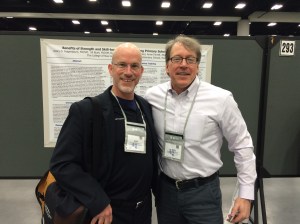
With my friend Dr. Avery Faigenbaum — who most definitely keeps the physical in physical education.

Like many of us, I wear several hats.  My ‘day job’:  sports medicine specialist.  I also, however, have other work that consumes a great deal of time and energy and brings with it a great deal of joy and fulfillment.  I speak of my……’moonlighting job’?  My ‘real job’?

I speak of fatherhood.

I am a father to twins, thirteen years old, which turns out to be a great side gig to work as a pediatric sports medicine specialist.  My day to day interactions with my son and daughter are great preparation for my interactions in the clinic.  The skills I develop in my two ‘jobs’ complement each other.

As a father, I am reminded frequently of the differences between the schooling I enjoyed and the education my children are receiving. One of the striking differences is in the area of  non-academic offerings.   Read more of this post

Altmetrics

ga9jrnsf

Are you familiar with this logo?

As 2016 winds down, you’re all certainly aware of the power of social media. You would probably have to have been on a space ship heading to Mars to be unaware of the phenomenon of Donald Trump: TIME’s “Person of the Year”, and the president-elect of the USA, has achieved so much of his success arguably through his use of Twitter!

Imagine that.  Only a few years ago, I recall seeing people still smile at the absurdity of ‘tweeting’, of compressing ideas into a mere 140 characters.  And now we have the proverbial ‘leader of the free world’ ascendant at least in part because of his use of social media.

There is no doubt that Twitter, and other social media platforms (such as this blog, or our podcasts), have become major suppliers of information to the media consumer.  If not supplanting traditional media, social media is certainly nudging it to the side.  This is as true in the worlds of sports, sports medicine, and sports medicine research as it is elsewhere.

In the world of sports medicine research, the ‘impact factor’ has played the defining role as the measuring stick of a journal’s heft for a long time.  The metric has had its critics, but its importance has not waned.  I for one can vouch for that:  when I went ‘up’ from Assistant to Associate Professor last year, part of my application involved demonstration of publication in journals with a worthy impact factor.

At CJSM we just concluded our semi-annual associate editors meeting, bringing together a host of clinicians and researchers from around the world.  We are proud of our journal’s impact factor (2.308), but we are also self-critical and are looking for other measures of the journal’s role in the modern world.

Altmetric is one such measure.

Sound familiar?  Thinking you have heard about ‘alt-someting’ recently? Read more of this post

The Exercise Prescription — ‘BASEM style’

13221132_10156972281840422_7049619498526413481_o

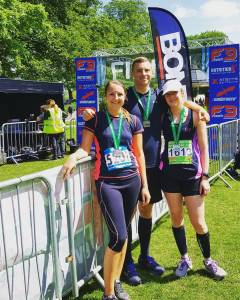
Author Dawn Thompson (left) with her siblings, at the end of a half marathon

Readers of this blog will be familiar with Dawn Thompson, a sports medicine physician in training and one of CJSM’s junior editors.

She is UK-based, and a member of the British Association of Sports and Exercise Medicine (BASEM).  I asked her to give a run-down of the recent BASEM annual conference for the CJSM readership.

What follows is her post from the conference, with a heavy dose of a subject near and dear to our heart — the worldwide physical inactivity epidemic, and how we sports & exercise folks can address this.

From our journal articles to our blog posts, CJSM is committed to putting the ‘exercise’ into the profession of Sports & Exercise Medicine.


____________________________________________________

Dawn Thompson

Last month I attended the British Association of Sports and Exercise Medicine Annual Conference – ‘From Plinth to Pitch’. This was an excellently put together series of talks and lectures covering everything from Rio 2016, injury management, the female athlete to even the medical considerations in less mainstream sports of Futsal and disability shooting.

As always with Sports Medicine conferences there was a good mix of medical students, trainees, GPs and Sports and Exercise Medicine (SEM) consultants. The budding SEM doctor got to learn from and meet the experts they aspire to be while the more seasoned attendees got to catch up with old acquaintances and make new ones along the way. The standout session for me was the discussion on physical activity and how you actually get someone to exercise. This is an area close to my heart that made me feel invigorated and inspired enough to choose this topic as the focus of  my newest blog post. Read more of this post

The new issue and a podcast to boot

jsm-podcast-bg-12016 is coming to a close, and that’s really hard for me to believe.  November brings with it our last issue of the year, and it is a good one……a good way to close out a memorable year.

Our highlighted Critical Review article this month concerns the subject of risk factors for lower extremity injury among high school athletes.  The lead author is James (Jimmy) Onate, PhD, ATC, FANA, from the Ohio State University.

The Buckeyes publish frequently in our pages — co-authors on this paper include former ACSM president Tom Best and current OSU Head Team Physician Jim Borchers, both of who are well-represented in the pages of CJSM.  Jimmy Onate is another in that lineage of great clinician-researchers.

Jimmy Onate, PhD, ATC

Jimmy Onate, PhD, ATC

I had an enjoyable conversation with Jimmy on the pros/cons of using the pre-participation evaluation (PPE) as a potential tool for screening high school athletes for risk of lower extremity injury.  I hope you enjoy it as much as I did.

The iTunes link for the podcast is here.