Dreams of South Africa

img_1943

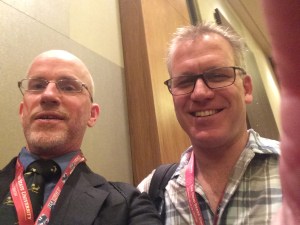
With Wayne Viljoen (@BokSmart), one of the authors of new rugby research in CJSM

It was just a year ago that I was preparing to travel to South Africa on an American Medical Society for Sports Medicine (AMSSM) Travelling Fellowship — dreams of Cape Town and safaris danced in my mind [see post reblogged below].

I haven’t stopped dreaming of South Africa. Should I ever have a mental lapse and not think of the Rainbow Nation for a day or two, I have only to turn to my Twitter feed or my medical journals to be reminded — the country punches well above its weight in both sports and sports medicine. I enjoy reading of the exploits of current South African Sports Medicine Association (SASMA) President Phathokuhle Zondi as she takes care of Paralympic athletes in Rio, for instance — she is a definite follow on Twitter….

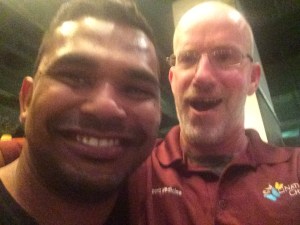
And I most certainly enjoyed reading some recent rugby research just published in our September 2016 CJSM: Incidence and Factors Associated With Concussion Injuries at the 2011 to 2014 South African Rugby Union Youth Week Tournaments.  It was a delight to read this epidemiological study, whose authors include good friends Sharief Hendricks, Clint Redhead, and Wayne Viljoen — researchers all of whom most definitely have made their mark internationally.
img_1644

Partying with Sharief Hendricks (@Sharief_H), author of new rugby research in CJSM, in Johannesburg

In the authors’ words, the “….study provides the first published incidence of concussion, per player-match-hours, in South African youth rugby union and falls well within what was previously published elsewhere for youth rugby.”  They found the incidence of concussion in youth rugby to be 6.8/1000 player match-hours.  Importantly, and what for me was new information, was that under-13s and under-16s had higher incidence rates than under-18s.  The younger kids were at greater risk for concussion.  This may have important implications for rules and policy making in youth rugby.

For anyone with an interest in rugby, or South African sports and sports medicine, the study, in our newest edition of CJSM, is a definite read.  And it’s never too early to start dreaming of the 2017 SASMA biennial congress, which will take place in Cape Town 2017.  To stay ‘in the know’ for the timing and details of that pre-eminent conference, follow President Phathokuhle Zondi and SASMA itself on Twitter.

sportingjim's avatarClinical Journal of Sport Medicine Blog

IMG_1630Every so often, sports takes a back seat to other world events. So too for sports medicine.

We all know this, whether in our personal lives or in our interactions with the world at large.  There is the NFL player who is torn between performance on Sunday and ‘being there’ for his young daughter with leukemia.  There are cases where the athlete him- or herself is felled with illness–think of Lou Gehrig and amyotrophic sclerosis.  The issues of who won the last game, the intricacies of a salary negotiation, or the season missed from a knee injury pale in comparison with such ‘real world’ contingencies.

In sports medicine we sometimes experience directly the intersection between serious illness and athletics.  I think immediately of the young gymnast I saw with anterior knee pain that turned out not to be Osgood-Schlatter’s but osteogenic sarcoma of the tibia…….a ‘game changing’ event…

View original post 497 more words

Hot child in the city

tami

Tamara Hew-Butler on TruTV’s “Adam Ruins Everything”

My topic for today is not that glorious piece of 70’s bubble gum pop from Nick Gilder — no, it is a topic much more directly related to sports medicine.

It’s August and it is hot indeed, with a day here in Ohio set to be one of those classic 90/90 days (>90 F and > 90% humidity).  And it’s the first day of high school Friday night football, with middle school and Pop Warner following this weekend.   These are days we need to do all we can to prevent exertional heat illness (EHI), most especially in our children and adolescents.

In our zeal to prevent EHI, we must be careful not to overhydrate.  A year ago CJSM published the Third International Consensus Statement on Exercise Associated Hyponatremia and followed this up with a blog post and a podcast where we discussed the risks of overhydration with lead author, Tamara Hew-Butler.

The hashtag that came out of those discussions — #Drink2Thirst — spread over social media last year.  The concept is an important one, and one which remains controversial.  There are still many proponents of mandatory water breaks, or of drinking to a certain color of urine.  Others argue that while both are potentially life-threatening, the risk of EHI outweighs the risks of the much rarer condition of EAH — better to err on the side of overhydration they say.  On the other side, some note that hydration is pushed on athletes as something of a panacea, touted as helping to prevent exercise associated muscle cramping (EAMC) when the science argues against that concept.

Now, Adam Ruins Everything, on TruTV, has weighed in on the issue of overhydration in sports, with hilarious effect. And I see Adam has recruited Dr. Hew-Butler herself to debunk some of the hydration mythology and spread the mantra of #Drink2Thirst

Watch the video, and laugh.  Then check out some of the links in this post that will take you to the consensus statement and podcast and you’ll get more of the hard science from Dr. Hew-Butler.  It might change your thinking, and you may start translating some of this science to how you approach the athletes you manage.

Stay cool out there and #Drink2Thirst!

5 Questions with Dr. Jane Thornton — what is the physical activity prescription?

Canadian Women 8+ jane thorton

Jane Thornton MD, PhD (2nd from left) — Canadian Olympian and Lead Author of CASEM Position Statement

We are having a sit down with Jane Thornton, MD PhD today as part of our recurring  blog offering, ‘5 Questions with CJSM.’  Among many other things, Dr. Thornton is the lead author of the new Canadian Academy of Sport and Exercise Medicine (CASEM) Position Statement on the ‘Physical Activity Prescription.’  This article, published in our July 2016 issue, has already drawn an immense amount of interest — it is currently free, so do not hesitate to check it out and print out/download the PDF to fully appreciate its contents.

Dr. Thornton is an extraordinarily accomplished individual who is finishing up her family medicine/sport medicine training at the University of Western Ontario.  Besides a medical degree, she has earned a Masters and PhD, doing her studies CJSM Associate Editor Connie Lebrun while at the Fowler Kennedy Sports Medicine Clinic.

With the Rio Olympics set to begin in a few days, it is perfect timing to conduct this interview with Dr. Thornton.  While doing all of that academic work noted previously, she was also training for the Canadian national rowing team. She rowed in the 2008 Olympics in Beijing with the Canadian women’s eight.  She knows a thing or two about physical activity, no doubt. In addition to her authorship of the CJSM manuscript, Dr. Thornton has co-created along with Dr. Mike Evans a website about how to #MakeYourDayHarder, advancing the notion that our every day activities offer abundant opportunity to get in meaningful levels of physical activity.

At CJSM, we have had an abiding interest in research on various aspects of physical activity (e.g. check out our recent post on #PEPA16 and Ann Gates, another mentor of Dr. Thornton’s), and so it is with great pleasure that we share with you our ‘chat’ with Jane Thornton.

____________________________________________________________________________

1) CJSM: How effective is an ‘exercise prescription’?  What is the evidence for this intervention?

JT: It may sound like common sense that physical activity is good for us, but it has taken us a long time to understand just how important it really is as a component of treatment. When we understand that it can lead to improved clinical outcomes in over 30 different chronic diseases, and can be as effective as medication in many instances (hypertension, stroke, and mild-to-moderate depression, to name a few), then we can’t ignore the fact that it should be something we talk about with our patients.

To best illustrate its effectiveness, though, let’s compare exercise prescription with smoking cessation counseling.  When we examine the number needed to treat (NNT), studies tell us that we need to counsel 50-120 patients to see one patient successfully quit smoking. When it comes to getting one patient to meet the globally agreed upon physical activity guidelines (150 minutes per week of moderate-to-vigorous physical activity), however, that number drops to 12 – meaning we have an incredible opportunity to help patients make a life-changing adjustment in their lives. No one, including me, would argue that smoking cessation counseling is not incredibly important. But given the recent findings that being inactive is almost as bad for you as smoking, we really should be expanding the conversation at each clinical encounter to include exercise.

2) CJSM: What are the barriers to its use?  Why aren’t more physicians actively engaged in giving their patients an exercise prescription?

JT: The most oft-cited barriers are time constraints, lack of education and training, complex comorbidities… and the most honest among us will also bring up the point that we just don’t think patients are motivated enough or willing to change. Interestingly, if we demonstrate a belief in patients, they will usually rise to the challenge. It may also come as no surprise that doctors who are active themselves are also more likely to counsel their patients to be active. A big obstacle in many countries is, of course, remuneration. It’s hard for some to justify time spent counseling on exercise if there is no billing code they can tack on. That one is a tougher nut to crack. Policy makers should take comfort in the fact that the practice of exercise prescription is also cost-effective.

3) CJSM: You are active on Twitter – if you could compose a 140 character Tweet for the CASEM position statement, what would it be?  Read more of this post

Open Water Swimming

IMG_1459

Sunrise over Lac St. Jean, site of FINA 10K and 32K open water swimming events

Amazing to think that the Rio Olympics opening ceremony takes place a mere week from now.

I am, currently, enjoying the good fortune of mixing with Olympians from several countries who will be headed there for the open water swim events.  This weekend I am in Roberval, Canada (3 hours north of Quebec City), at Lac St. Jean — where the FINA/HOSA 10K marathon World Cup and 32K Gran Prix events are taking place.

I am a FINA medical delegate at these events.  I have written about this experience before in a 2013 blog post:  the 32K Gran Prix event coincides with an historic open water swim that has been done for decades on this lake, the Traversee internationale du lac St-Jean.

It is a great pleasure to be involved in an international sporting event like this one.  The local organizing committee does fabulous work.  I am privileged to work with fellow FINA representatives from New Zealand and France. Outside of the work hours, we get to socialize some and partake in the hospitality of the Roberval community.

I also greatly enjoy working for the athletes, watching out for their health and safety.  I genuinely enjoy getting to know them and experience vicariously the thrill of their competition. The joy and challenges of sport are a special dimension of human culture —  I am sure this is what leads many of us to sports medicine.

I think it is those broader, aspirational aspects of sport that lead many of us in the sport medicine community to push back on efforts toIMG_2210 cheat, such as doping.  And it’s no surprise that for an elite, international event like this one FINA has doping surveillance as part of its core mission.  One of the roles I play during my time on site is to supervise the excellent work done by representatives of the Canadian Centre for Ethics in Sport, which conducts post-race testing on select individuals many of whom, as I have indicated, will be swimming soon in Rio, where we already have had headline-making doping news before the games have even begun!

We have published frequently on the issue of doping in the pages of CJSM and these blog pages.  We hope you take this chance to click on those links and look at some of that work, in advance of the upcoming Olympics.  And, since it’s Friday, it’s time to follow something new — I would suggest the Facebook page of FINA, which is so well done, and will be hopping with information about this weekend’s Traversee and next month’s Olympics.

Enjoy the Games!  Let them be competitive, safe, and clean.