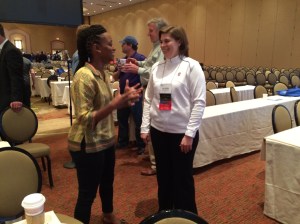
Current president of the South African Sports Medicine Association (SASMA) Phathokuhle Zondi (L) & AMSSM member Alison Brooks enjoying Dallas
I’m in Dallas for the annual American Medical Society for Sports Medicine (AMSSM) scientific conference, and I would typically be sharing a photo of the town in this post. There is the small problem of a veritable tsunami of rain doing its best to keep me indoors.
I have no complaints.
AMSSM is celebrating its 25th year, and it has every reason to pat itself on the back. The conference it’s putting on right now (hashtag: #AMSSM16) is so well put together that I am quite happy I do not have a pleasant, sunny day tempting me to head outdoors. I’d much rather be inside catching all the proceedings.
Among the especially interesting aspects of the conference are the research and case study abstracts being presented both in poster-form and as podium lectures. Our on-line version of the March 2016 issue has these abstracts available and there is some very interesting sports medicine information to be found there. I am actually presenting a case on spinal muscular atrophy in a high school runner later this afternoon, and I’ve been listening to some other very interesting talks all through the day.
The AMSSM “Wall of Honor,” giving a shout out to so many of the members who have contributed to the organization’s success
The keynote talks are emphasizing the all-important value of collegiality in our profession, and I couldn’t agree more. Read more of this post
And there is AMSSM’s current president, whose tenure is over 95% complete and will be handing on the reins to Dr. Gammons. That would be Jon Divine, M.D., Professor of Orthopedic Surgery and Medical Director of the University of Cincinnati athletics.
Preparatory to the AMSSM meeting, I thought it high time CJSM sat down and interviewed the president of our affiliated society, to get a sense of what this past year has meant to him and the organization. And so I present to you: 5 Questions, with Dr. Jon Divine.
CJSM: We have to begin by asking you about your year as President of the AMSSM. What were your major challenges this year? What were your high points?
JD: Thanks for giving me this opportunity to share my story with your readers. This year has gone by fast. I’m very proud of the work done by our Board. Under Chris Madden we generated our third organizational strategic plan, the road map our leadership utilizes to guide the working priorities of AMSSM, with a goal of completion in 5 yrs. As of now, we’re more than half way completed on the current plan. I half-jokingly mentioned to Kathy Dec and Chad Asplund this week that they will have to seriously consider developing the next strategic plan because the objectives for the organization spelled out in the current plan will be met ahead of schedule! As president, you could not be happier than when your team is skilled and willing to take on these tasks, do them very well, and complete them ahead of schedule.
In the New York Times article and in the BBC, former WADA-president Dick Pound has stated his opinion that Sharapova’s failed drug test was ‘reckless beyond description.’
I must say I take issue with this and empathize with Ms. Sharapova, who stated that she received in December the WADA email noting that meldonium was now on the banned substance list, but “…I did not look at that list.” Meldonium was a PED legal until 2016, when it was placed on the ‘banned substances list.’ As a professional inundated with emails, alerts, pronouncements, and more, I confess to a certain degree of information overload even when it comes even to items vital to my licensure and ability to practice. Have I ever received an email from the Medical Board that I have deleted? Have I ever received notification from my hospital staff office of some new change in policy which I glossed over? Yes and yes.
Regarding the WADA emails, other athletes in the NY Times article have offered this opinion: “Some dismissed the messages as irrelevant to their own regimens or too complicated to be useful.” That certainly resonates with me and my professional world.
I am not writing this to absolve Ms. Sharapova, and I applaud her for her prompt and open admission of personal responsibility. That stance is right and proper. But I would hardly deem her action “reckless beyond description.”
Rugby Sports Med panel (L to R): Drs. Kerr, Gerber, Viljoen, Cantu, Akhavan, Mjaanes, Landry
There is an ever-increasing debate on both sides of the Atlantic regarding contact and collision sports for youth. In particular, the issue of tackling (whether in rugby or American football) is in the cross-hairs of many. I’ve written about this recently after Dr. Bennet Omalu, the subject of the movie ‘Concussion’ and the pathologist who first described CTE in an American professional football player, wrote an op-ed piece in the New York Times arguing that contact football should be banned in those under age 18 [‘Don’t Let Kids Play Football’].
My impetus for this blog post is two-fold: 1) I am currently attending a rugby sports medicine conference, where the issue of tackling and brain injury is a ‘hot topic’ for discussion; 2) the issue of tackling in youth rugby has exploded after recent events in the UK.
USA Rugby sports medicine hosts a conference each year around this time, and this year there was a panel of experts who entertained the question: when should youth athletes take up contact/collision sports? There was a variance of opinion and a recognition that more research needs to be done to give an informed answer to this question.
In the background, occurring in the ‘real world,’ this same question was being debated in the media and social media after a group approached the UK government asking for a ban on tackling in youth rugby. The Sport Collision Injury Collective (@sportcic on Twitter) circulated a petition signed by 70 academics asking that touch rugby only be taught to schoolboys in the UK [“Our message is simple: Prevent injury, remove contact. Replace contact with touch in school rugby.”]
This is an important and healthy debate, one where I find most if not all stakeholders have the health and welfare of our youth foremost in mind as we try to gather more information and make decisions now, the ramifications of which may not be seen for years to come.
And so, I thought I would use this blog as one more platform where concerned folks could weigh in on their opinion of this question. Take the poll below,* ** follow the links above, and engage in the discussion which is taking place in the media.
*There have been many ages proposed for initiation of contact in youth sports, ranging from age 10 to 18. For the purposes of the poll, I have tried to give a variety of options, though I recognize the choices are not exhaustive.
**I have intentionally given poll takers the option for a limited number of answers, recognizing that there is room for many more (e.g. ‘we need more information’, ‘yes, allow contact, but we need to reduce the amount kids get’, ‘football and rugby are different, and my answers would be different for each sport’ etc.)
James MacDonald, M.D., M.P.H. Clinical Journal of Sport Medicine (CJSM) Deputy Editor
"The CJSM blog offers the opportunity for clinicians with a primary interest in sports medicine practice to discuss current issues in the world of sport and exercise medicine. The blog acts as a community platform for knowledge sharing; its goals are the promotion and dissemination of best clinical practices for our patients."





 Clinical Journal of Sport Medicine Blog