#SocialMedia + #SportsMedicine = #PerfectMatch

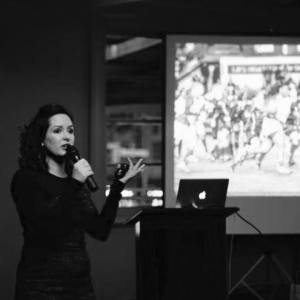
Sheree Bekker

Sheree Bekker, ACRISP

The power of social media in our field, the field of sports medicine — it has been something I have written about from time to time.  It’s something I have lectured about, too, on several occasions:  at American College of Sports Medicine(ACSM) meetings as well as at a recent National Athletic Trainers Association (NATA) meeting.

I think there are, indisputably, a number of reasons someone in our field should get on Twitter, or should identify a blog or podcast to follow…..Among those reasons: i) there exists an extraordinarily flexible, responsive, and timely method of staying abreast of ‘breaking’ news in our world; ii) there is a unique way of curating the research one cares about; and iii) there is the ability to have conversations and network with peers from around the globe.  No limits in space and time to the #SportsMedicine community that exists on #SocialMedia channels.

All that said, I also think Social Media does not exist apart from ‘real relationships’.  That is, in my judgment, the relationships formed in Social Media are grounded in the chance that they can be made physically real.  Social Media alone will not replace a handshake, or a face-to-face conversation at a conference. But Social Media can be that introductory acquaintance that can blossom into a more collaborative relationship when two colleagues finally meet.

Sheree Bekker — aka @ACRISPFedUni [The Australian Centre for Research into Injury in Sport and its Prevention], aka @shereebekker — represents, for me, precisely that sort of person, that sort of relationship  I first made her acquaitnace via her Twitter feeds. Then I was blown away by a  blog post she authored after her participation in a Mayo Clinic Healthcare and Social Media Summit in Australia.  And, finally, I met her.  The ‘real’ her, and not a Twitter avatar! Turns out that Sheree is originally from Botswana, and she was in southern Africa for a visit home and a swing through the South African Sports Medicine Association meeting in Johannesburg (SASMA2015) which I recently attended, as well.  From “Learners to Leaders,” that was the theme of SASMA2015; those of you who follow this blog know full well what a smashing success that conference was.

When Sheree came up to introduce herself to me in Johannesburg, well, it was like meeting an old friend.  And rather quickly, we decided we needed to do a joint blog post about Social Media and its place in the Sports Medicine world.

In the spirit of collaboration, here is Sheree, to talk more about how, in particular, Social Media can play a role in turning “Learners” into “Leaders.”

____________________________________________________________

Sheree Bekker: It is no secret that I am a big fan of slightly obsessed with the opportunity that social media affords emerging researchers to cultivate a voice in their field. I first shared my story of how I landed my international PhD scholarship through a Twitter connection in ‘Why you should use Twitter during your PhD’, and mused about how social media may play an even larger role in our academic careers than we realize (as an aside, today I would say: social media does play a large role in our careers – whether we want it to or not, whether we engage or not – this will become evident as you read on). I received an overwhelming response from post-graduate researchers on this post – and it soon became obvious that the common theme in these responses was that it was the sense of community and connection that draws people to social media. I also learned that those of us working in sports medicine are indeed very lucky, as our field has been an early and enthusiastic adopter of social media – and it can be disheartening for people in other fields to join the conversation eagerly, only to find that ‘I am stuck in a Twitter-desert, help!

Personally, as a current ‘learner’, I have found that Twitter has been invaluable in facilitating connections. One of the SASMA2015 sessions discussed the concept of ‘building a network’, which can often be highly intimidating for emerging researchers to do. How do I approach someone whose work I admire? What will we talk about? Read more of this post

CJSM Podcast 12: The Effect of Viscosupplementation in the Treatment of Knee Osteoarthritis

jsm-podcast-bg-1For our 12th podcast, we have invited Dr. Tom Trojian to talk with us about a new CJSM offering, just published ‘On Line First,” for which he is the lead author: “AMSSM Scientific Statement Concerning Viscosupplementation Injections for Knee Osteoarthritis:  Importance for Individual Patient Outcomes.”

Dr. Trojian is a member of our partner society, the American Medical Society for Sports Medicine (AMSSM), and is a professor in the Department of Family, Community & Preventive Medicine at Drexel University College of Medicine, and the director of the Sports Medicine Fellowship program there.

He is also a wonderful guest to have on  the podcast–I learned a great deal from him about not only viscosupplementation in the treatment of knee osteoarthritis, but also the specific study design of a ‘network meta-analysis’ he and his co-authors used to evaluate the clinical importance of this intervention in our patients.

Knee osteoarthritis (OA) is such a common condition–and is one which so many sports medicine clinicians treat as part of their practice–that we find ourselves publishing a great deal of research on the topic.  Just this month, in the November 2015 CJSM, we have three pieces of original research on managing knee OA: i) the relative effectiveness of hip vs. leg strengthening  in treating the problem; ii)  the effect of lower body positive pressure (LBPP)-supported low-load treadmill walking program on knee joint pain, function, and thigh muscle strength in overweight patients with knee osteoarthritis (OA);  and iii) a prospective study on the safety and efficacy of intrarticular platelet lysates in early and intermediate knee OA.

T Trojian Screen Shot

Dr. Trojian, ‘in action’ on the podcast.

Check all those studies out.  And check out our newest podcast:  get out those headphones, tune up that iPhone, and listen to what Dr. Trojian has to say on the subject of viscosupplementation in the treatment of knee OA.

Thanks very much for the time you spent with us Tom!


November…….already

10665120_10206556329240539_8534250178254214982_n

Transitions: November in the USA.

Really?  Can it be that November is here?

I just covered my last high school football game of the fall, a loss in the playoffs. A season which began in the heat and humidity of August [with its attendant muscle cramps and concerns of exertional heat illness & exercise-associated hyponatremia] is now over, and injuries sustained on wrestling mats and in basketball gymnasia are beginning to show up in my clinic.  Before you know it, the skiiers and snowboarders will be filling out the waiting room.

November also brings with it the publication of our last CJSM of 2015, and it is a good one.  We have profiled two offerings in particular, both of which currently are freely available on line:  original research looking at potential limitations of American Heart Association recommendations for pre-participation cardiac screening in youth athletes; and a provocative editorial [and just right for the change of seasons] arguing for adult autonomy in deciding whether or not to wear helmets when skiing.

Both subjects are among the more controversial in sports medicine.  Whether or not to consider pre-participation screening with ECG when taking care of our younger athletes–well, that’s a question whose answer can vary depending on what side of the Atlantic one is on, or what part of the United States you may live in.  It’s a question whose answers may lie in much of the research we publish in our journal, with luminaries such as Jonathan Drezner and William Roberts weighing in.

Whenever we publish research or commentary on the question of mandatory personal protective equipment, I sometimes feel as if we have entered the ‘blood sport’ arena of sports medicine.  This issue’s editorial  on the ‘Ethics of Head Protection While Skiing’ has already generated some buzz on our twitter feed. Two years ago, we published the Canadian Academy of Sport and Exercise Medicine (CASEM) Position Statement on the Mandatory Use of Bicycle Helmets, and our social media feeds erupted.  I have never seen so much discussion on the blog site.

There is much more to be read carefully in this November 2015 issue.  A very interesting piece of original research, from one of our more prolific authors (Dr. Irfan Asif), looks at the potential psychological stressors of undergoing pre-participation cardiovascular screening.  As a pediatric sports medicine specialist, I’ll be reading with great interest a study on the potential prognostic implications of post-injury amnesia in pediatric and adolescent concussed athletes–lead author Johna Register-Mihalik continues to make major contributions to our understanding of that injury in that population.

So, enjoy this issue.  And brace yourself–2016 is on its way.  It will be here before you know it!

Scientific Meetings

IMG_1595[1]

Carl Askling (L) & Phatho Zondi (R)

As those of you who follow CJSM on this blog and on our other social media will know, I have of late been enjoying the South African Sports Medicine Association’s 16th biennial congress (SASMA2015).  I am on the plane heading back home, and my head is swimming with what are now memories of some wonderful lectures and social experiences I enjoyed during my time in Johannesburg.

My ‘real world’ of clinical sports medicine, teaching and research await.  My ‘real world’ is where I hope, in my own way, I am making direct contributions to sports medicine:  where I can truly ‘care’ for athlete/patients and ‘create’ content from which others may learn.

But how enjoyable it is to punctuate my professional life with the chance to ‘recreate’ with peers in this special world—to break bread (and drink wine), share ideas and concerns from some great minds.  I return from such meetings re-energized for my real world, with new approaches to common problems [the dancers under my care will be benefitting from the knowledge I gained on hamstring injuries from ECOSEP’s Carl Askling, for instance]. And I return having made new friendships, including that of SASMA’s new president, Dr. Phatho Zondi.

This is an appropriate moment then to have one of our editors weigh in on her own experiences with a conference she attended recently.  I give you  Dawn Thompson, a physician who will share some of what she learned in Barcelona this month.

________________________________________________________________________

for cjsm blog HT

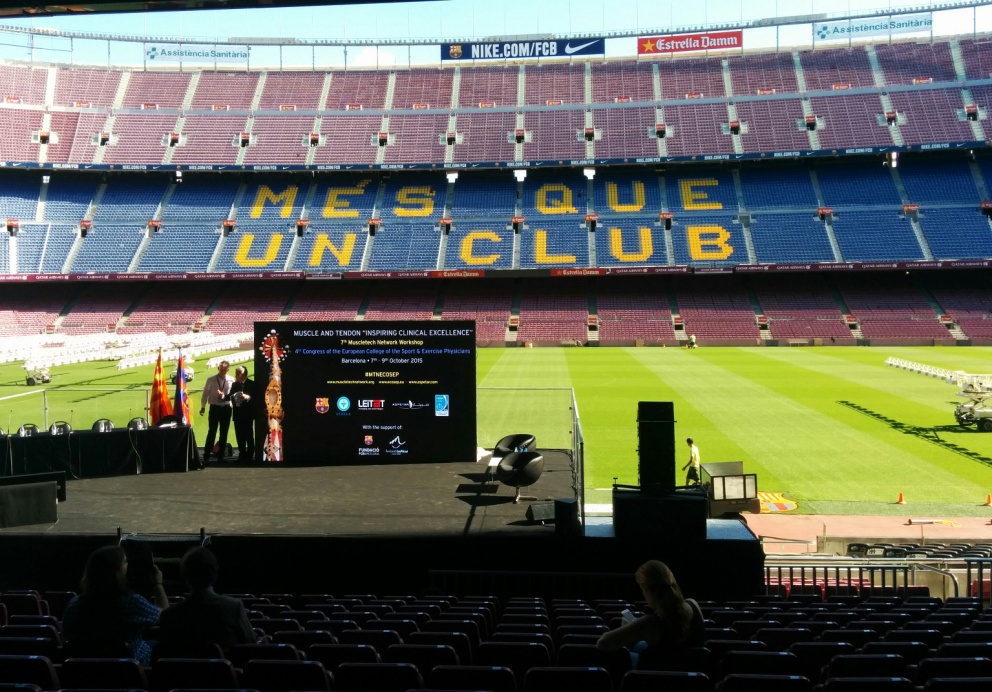
Camp Nou–home of FC Barcelona [and a recent ECOSEP conference]

It has been some time since my first blog on the use of ultrasound in musculoskeletal medicine and I have been mulling over what topics I not only have the authority to write on but also would be interesting to fellow readers and trainee doctors.

Last week I attended “Muscle and Tendon – Inspiring Clinical Excellence” conference in Barcelona organised by Muscletech and the European College Of Sports and Exercise Medicine (ECOSEP). Read more of this post