CJSM Podcast 1

JSM-Podcast-BG (1)We are delighted to bring you our first Clinical Journal of Sport Medicine podcast:

We begin this month with a look at the provocative editorial in our new issue: Time to Re-Think the Zurich Guidelines: a Critique on the Consensus Statement on Concussion in Sport. The article is authored by Drs. Oliver Leslie and Neil Craton, from Legacy Sport Medicine in Winnipeg, Manitoba, Canada.  I caught up with the authors last week for an exciting discussion about their argument that it’s “…time for us to reject (the) diagnostic and therapeutic algorithm” proposed by the Zurich guidelines.

Let us know what you think on the comments section of this page, tweet us @cjsmonline, or go to the CJSM main page and take the Zurich guideline poll we have for you there.  Check out our recent blog post on this same subject.  And be sure to check out the many other offerings we have this month in the journal.  We’ll be writing and talking about them in the coming weeks.

Enjoy the podcast!

(music: Jeff Manning)

The Effectiveness of Ankle Taping

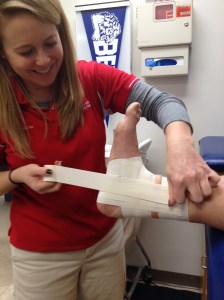
gail taping ankle

ATC Gail Swisher, Bexley High School
and Nationwide Children’s Hospital,
demonstrating her art

To tape or not to tape, that is the question.

And the answer is of interest to a lot of folks out there.

“Residual Mechanical Effectiveness of External Ankle Tape Before and After Competitive Professional Soccer Performance,” published in our January issue, has been our most emailed study so far this year.  On our twitter feed, @csjmonline, I can also tell you that the posts I’ve been making have been getting a lot of traffic.

There is a great deal of interest in this most utilitarian of subjects. It’s original research coming from a group out of Germany:  Best, Mauch, Böhle et al., and currently on the CJSM website it’s FREE!  It’s time to check it out!

All of us in clinical sports medicine can attest to the ubiquity of ankle injuries.  The authors of this study note, for instance, that aside from muscle strains, ankle ‘distortions” are the most frequent injuries seen in professional soccer, accounting for about 20% of all injuries.  They further note that bracing and adhesive taping of the ankle are commonly used to prevent and treat these injuries, though “….the effect of adhesive ankle tape remains inconclusive, in comparison to semirigid orthoses and braces….”

There is considerable debate over the residual effectiveness of taping over the course of a prolonged sporting session.  The issue is of practical significance, as the author’s note that during soccer matches, a disproportionately high number of injuries occur during the last third of each halftime.  To date, there have been few studies that have evaluated the mechanical, protective properties of tape beyond 30 minutes of exercise.

It is in this context, then, that the authors’ developed what amounts to their research hypothesis:  “…during realistic competitive soccer performance reflecting a halftime of 45 minutes–ankle tape might lose most of its assumed initial mechanical effectiveness to reliably prevent ankle distortions.”  They set out to test just that. Read more of this post

Snow Worries: Sochi Olympics, Second Week

SONY DSC

Winter in Sochi 🙂

I was reading the Washington Post the other day, and came across an article with a clever title:  “At Sochi Olympics, Finding Risk is Snow Problem.”

It took your less than clever blogger here a moment to get that…….

Now that I do, I’m modifying the word play for this post’s title.

But the story under the headline I ‘got’ right away.  The Post reporter was arguing that the Sochi snow (quality and quantity) was a danger to competitors, and was possibly increasing the incidence and severity of injuries seen this Olympics.

Like most of you, I have followed the Sochi Olympics with great interest.  The sport is central to my enjoyment; but I also am intoxicated by the scenes of the beautiful Caucasus mountains set so close to a warm, subtropical coastline.  I don’t know if any other Winter Games have been hosted in a city with palm trees.

So, the snow:  so central to a Winter Olympics.  Is it a problem?  We can wait to tally up IOC medical charts, but you can also weigh in with your opinion on our poll below!

And if you’re especially enterprising–and you’re collecting data on this or other epidemiologic issues central to the Sochi Olympics–by all means submit a manuscript to the journal!  We frequently publish studies looking at the Olympics or the effect of sporting surface on injury rates.  We’d love to hear from clinicians/researchers/epidemiologists who have written up their studies and are looking for a quality journal to review their work.

Until then:  take the poll!

*poll can also be found on the journal’s main website

#YouthSportSafety: Early Sports Specialization in Youth Athletes

youth sports julie young

My colleague and Athletic Trainer Julie Young,
pool side and talking about injury prevention
in young swimmers

I’ve been thinking a lot about youth sports specialization lately.

It’s likely the nexus of the Olympics, my reading of the book The Sports Gene, and our own journal’s publication of the AMSSM Position Statement on Youth Sports Specialization and Overuse that has prompted this.

Readers of this blog will recall that I recently profiled the AMSSM Position Statement and interviewed the lead author, Dr. John DiFiori. Likewise, I  recently reviewed the excellent book The Sports Gene, which looks into, among many other things, the application of the ’10 000 hour rule’ to athletes’ pursuit of elite sport excellence.  What does it take to make an Olympian?  Many would argue that part of the answer lies in identifying excellence early, and starting to groom that talent at a young age:  it takes about 10 years to fit in those 10 000 hours of dedicated practice.   These forces are at least part of what drive the growing phenomenon of youth sports specialization.

I have a professional bias toward this line of thinking, of course:  I practice clinical pediatric sports medicine, and most of my research interests lie in keeping kids safe and active.

For instance, Nationwide Children’s Hospital (NCH) and the YMCA of Central Ohio recently paired up to release a couple of educational videos on the Education and Prevention of Overuse Injuries in Youth Swimmers and the Risks for Early Specialization in Youth Swimmers.  The task combined my interests in youth sports and swimming (I am a member of the USA Swimming Sports Medicine Task Force).  It was a lot of fun working with folks like Julie Young, a swimmer and athletic trainer at NCH with whom I work and do research.  Click on the links to those videos and let me know what you think.

CJSM has made quite an effort over the years to profile high quality research that looks at the phenomena that impact youth sports.   Read more of this post