A Shout From Across the Pond: the “Lloris Affair”

CJSM is an international sports medicine journal.  We are the official journal of two American sports medicine societies (American Medical Society of Sports Medicine and the American Osteopathic Association of Sports Medicine); as well as the Canadian Academy of Sports and Exercise Medicine and the Australasian College of Sports Physicians.  I regularly liaise with our Executive Editor, Chris Hughes, who lives in London, our publisher in Philadelphia USA, and our managing editor in Calgary, Alberta.

Untitled

A small sampling of the twitter conversation
Our Executive Editor was engaged in
This weekend regarding the Lloris injury

Lots of science and lots of sports to keep track of, all over the globe.   And so it was that this weekend, residing in Columbus, Ohio, I remained blissfully unaware of the events surrounding the injury to Hugo Lloris until I noticed that the @cjsmonline twitter feed exploded with shouts of disbelief, as our executive Editor and others were busy deconstructing what they had just seen.

In short order, Chris let some other ‘tweeters’  know they could reach out to @cjsmonline, and one enterprising individual forwarded me a thoughtful piece on the situation:  voila!  The genesis of today’s guest blog.

@Daniel_Broman (Dr. Broman) is a Core Medical Trainee in London, and is currently based at Barts Health NHS Trust. He is keen to follow a career in Sport & Exercise Medicine and will be applying for specialist training in the coming months.

He shared these thoughts about the incident:

___________________________________

Concussion in Football – The Lack of Consistency in Management and The Need for Guidelines

 By Daniel Broman

The topic of concussion in sport has been placed in the media spotlight again recently, especially in the UK, with articles about the proposed new rules for Pitch-side Concussion Assessment (PSCA) in Rugby Union matches (“Rugby and Concussion:  Are Big Hits Bringing Big Headaches?” and “Rugby Union, Concussion and the Ultimate Need for Responsibility of Care”) and with several incidents in Premier League football, including the cases of:

  • Romelu Lukaku vs. West Ham United (21st September 2013), where the player completed the final 3 minutes of the match and post-match admitted that “I did not even know I had scored, I was out of it and the first thing I asked the doctor was “who scored?” and he said “you did”.”
  • Mathieu Flamini vs. Norwich City (19th October 2013) with the player taken off at the time. Arsene Wenger stated a few days later that “There is a five-day (concussion) rule that we will respect, not to take any chance. It was a concussion and the doctor advised us not to play him.”
  • Robert Snodgrass vs. Manchester United (29th October 2013) where the player was also taken off the field of play and taken to hospital. Chris Hughton stated “I think that (going to hospital) is very much a precaution”.

Clearly all incidents and cases are different and of varying severity, however the lack of consistency in their management is still concerning. Over the weekend, another particular incident, prompted several discussions both on social media and in the media, with ‘Match of The Day 2’ stating there needs to be “uniformity on a rule”. Read more of this post

Rugby and Injury Prevention

As I write, it’s early afternoon in the Midwest of the United States.  I hope wherever you are as you read this you are enjoying yourself.  If you’re reading this over the weekend, you may be taking advantage of the many sporting offerings around the globe that involve one of the football ‘codes.’

It took me a long time, as an American, to learn that the ‘football’ I grew up with was  only one of many games sharing a similar genealogy;  and, what’s more,  in most of the world, the word ‘football’ would be understood to refer to a completely different sort of game than what I saw on an NFL Sunday.

Paul-bunyan-at-msu

The Paul Bunyan trophy,
awarded to the winner of
Michigan v. Michigan State
Football (American!) game

I’m probably ‘preaching to the choir’ if you’re reading this, but today there are many different types of football games being played around the globe.  There are several NCAA American Football games (I have an eye on the Michigan v. Michigan St. (MSU) game, having grown up in Grand Rapids, Michigan); there are of course many ‘Association football’ (soccer) games going on (Arsenal v. Liverpool is one of the highlight matches in the Premiership).  England upset Australia in Rugby Union earlier today; and the Edmonton Eskimos face off against the Saskatchewan Roughriders in the Canadian Football League this evening.

And more out of ignorance than intent, I am probably forgetting to mention any number of fixtures happening in Australian Rules football, Rugby League, or Gaelic football this weekend.

Lots of ‘football.’  Many ‘codes.’

Though most of my current practice in the Northern Hemisphere fall is devoted to caring for injured American football players, I wanted today to look at a different code.  I thought it the proper time to write about a recent news item on rules changes in Rugby Union.

All_Blacks_Haka

The New Zealand All Blacks
performing their famous
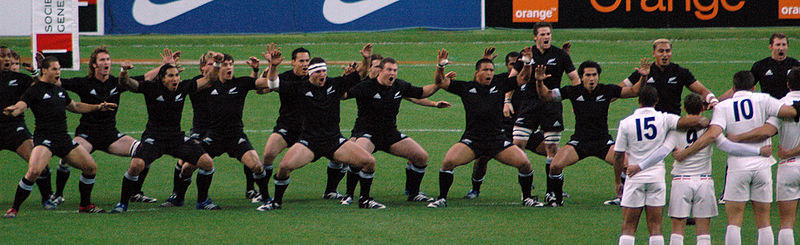
Haka before a match with France

What prompted me to tack in this direction was a BBC article I read on line yesterday, “Rugby and Concussion:  Are Big Hits Bringing Big Headaches?”  There is controversy in the world of Rugby Union, according to the BBC, over how to manage game day concussions.

Barry O’Driscoll, a well-regarded member of the International Rugby Board’s (IRB) Medical Committee, has resigned in protest over proposed new rules for Pitchside Concussion Assessment (PSCA) in Rugby Union matches.  The new approach will replace what previously was a mandatory end to a player’s game and week rest period if a suspected concussion had occurred.  PSCA incorporates a functional assessment by a medical provider, which the BBC states includes the following:

  • A Pitch-Side Concussion Assessment can be asked for by a team doctor or referee if they suspect a player is concussed
  • The referee signals a PSCA has been requested via radio link and with three taps to his head
  • A substitute comes on while the PSCA takes place in pre-agreed place, usually a medical room
  • The injured player is assessed for symptoms, asked a series of questions – Where are we? What’s the score? etc – and given a balance test similar to the ones in drink-driving cases
  • One failed question, four balance errors and the presence of one or more symptoms means the player is removed from game*

*PSCA summary taken from BBC article

Read more of this post

The CJSM blog, and more. Much more.

Presa_de_decissions

Interactivity: The Holy Grail
of On-Line Media

The CJSM blog was started by my predecessor and now CJSM Executive Editor, Chris Hughes, in June 2011.  We just passed the ‘century mark’ (this is the 103rd post for the blog) and, on a personal note, I am hitting the ‘half century’ mark:  this is the 50th post I’ve authored since taking over the reins in April of this year.  My first post, just over six months ago, was on the forthcoming 2013 AMSSM conference in San Diego.

Oh, and yes, I hit that half century mark earlier this year, but I hardly find that cause for celebration……

These blog post numbers have put me in a reflective mood, and I thought I might go over some of the ground we have covered and talk a little bit about where we might be going with our various on-line CJSM offerings in the world of Sports and Exercise Medicine (SEM).

If you look at the ‘word cloud’ in the right hand panel of the blog site, the largest phrase will be “Concussion in Sport.”  We’ve posted frequently on this topic, justifiably so given the breadth and the public health implications of the issue.  We’ve discussed the use of neuropsychological testing in concussion management in 2011 and more recently again in 2013. I recently reviewed the powerful PBS documentary “League of Denial,” which I think is one of the better produced analyses of the issue in the popular media.  We brought to you the Zurich Consensus statement in the journal earlier this year and discussed it on the blog as well as on YouTube.  Chris explored the issue of repetitive heading and it’s putative link to long-term neurological damage in a 2011 post.  There will be more posts on this topic coming, and the phrase in the word cloud will surely enlarge:  the more we learn about this issue, the more questions there are to answer, and that, of course, drives the sorts of research that will find its way on to the CJSM pages.

Some of the more popular posts have been about such wide-ranging issues as the effect of Ramadan on sports performance; the medical coverage of the 2013 Boston Marathon, which riveted the world; and Novak Djokovic’s gluten-free diet:  performance enhancing or not?  If you have an opinion on the matter, go to that link, where you will find a poll along with the blog post.  Such polls are just another of the interactive media we use here at CJSM. Read more of this post

Return to Play Decisions

535001_10201384038456502_1470889600_n

Though a beautiful time of year, fall is not
the most idyllic for a sports medicine clinician

Like many of the readers out there, my colleagues and I are deep in a football season, where we are managing various teams and their mounting injuries.  For a sports medicine physician, fall in America must be a bit like early spring for an accountant (tax day = April 15):  it’s the time to buckle down and crank through patients, the time, from a certain perspective, to see the volume of patients that will sustain the business through leaner times of the year.

When I’m out of the clinic and on the sidelines, I’m also doing one of the parts of my job that is the most fun, and I’m sure my colleagues out in the blog sphere will agree.  But I wouldn’t describe the work as an idyll.  I can be enjoying my team’s performance, and then called in three directions at once, treating players and making decisions on whether they can get back into the game:  decisions that can have significant consequences for the player and the team.

I thought I would write somewhat extemporaneously today, and in sharing some of the more interesting cases I have seen of late think in a more structured way about how we primary care sports medicine physicians make return to play (RTP) decisions.

RTP decisions make the headlines all the time.  In the professional leagues of North American sports, in just the last two weeks, we have seen discussions about Kobe Bryant’s return to the NBA from late spring Achilles tendon surgery; Rob Grownkowski’s ‘delayed’ return from a surgically treated forearm fracture; the much anticipated return of Derrick Rose more than a year after his ACL reconstruction; debate over RGIII and whether he has come back too soon from his own multi-ligamentous knee injury…….the list goes on!

pos elbow disloc

The end of a season?

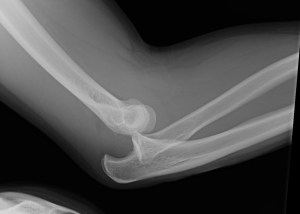
In my own practice, I have been trying to return players back to American football while they have recovered from a kidney contusion, a posterior elbow dislocation, a complete rupture of the ulnar collateral ligament, and a demyelination injury of the axillary nerve.  Of the four, two are back playing; the elbow dislocation is still rehabbing, and i hope to return in a hinged knee brace before the end of the year; and the axillary nerve injury continues to have pain and profound weakness of his deltoid, and his recovery will extend beyond the end of this season (much to the coach’s dismay).

Despite being one of the more important aspects of our job, there is very little in the way of evidence-based medicine to guide a clinician in these decisions. Read more of this post