Concussion Research Offerings on CJSM

We’ve been profiling sports-related concussions (SRCs) in the August posts here on the CJSM blog.

We’ve taken a peek at the use of computerized neurocognitive tests in the diagnosis and management of SRCs; conducted a poll on the entity known as “Second Impact Syndrome”; and interviewed Dr. Jason Mihalik of the University of North Carolina, who is one of the principal developers of a celebrated app helping laypeople identify when an athlete might be concussed.

In this post, I wanted to alert the readership to a special set of journal articles CJSM is releasing for free for a limited time, a set devoted to this issue of SRCs.
chris hughes 2

No, that’s not “Big Brother,”
that’s the CJSM Editor-in-Chief,
Christopher Hughes MBBS, MSc

Our Editor-in-Chief, Dr. Chris Hughes, describes the special collection of ten journal articles in this YouTube video.

I am very excited to pass this information on to the readership, as I am sure you will find this collection quite interesting.  The articles range from the Zurich 2012 Consensus Statement to insightful offerings on the use of neuropsychological tests and the risk of chronic neurological impairment from SRCs.  Not only are the offerings diverse but, to repeat, they are freely available for a limited time.

I plan to return to the specific issue of the use of computerized neurocognitive tests in the diagnosis and management of SRCs in the next blog post.  I had broached this subject in my August 5 post.  My clinical group has been busy doing literally hundreds of baseline tests prior to and at the beginning of the American fall sports seasons.  It is a big business, quite frankly, and I have some concerns about the clinical utility of these tests.  I certainly appreciate them as one tool to use among others; but in America, at least, their routine use–their de facto emergence as standard of care–has given me some pause.  So, though I may be dipping my toes into the waters of controversy, I will be critically looking at the use of these instruments in my next post.

I will be looking specifically at the Ian Shrier, M.D., Ph.D. study in the CJSM concussion collection  and a new and excellent article on the reliability of computerized neurocognitive tests from the Archives of Clinical Neuropsychology:  ”Test-retest Reliability of Four Computerized Neurocognitive Assessment Tools in an Active Duty Military Population.” 

Won’t you look at them too so we can engage in an on-line conversation?  As ever, I stay busy responding to the comments on this blog, as well as chatting with you on Twitter and Facebook.

Until next time, stay well!
Dr. Jason Mihalik guests on ‘5 questions with CJSM’: concussions and apps

We’re already seeing an uptick in our concussion clinics now that the football (both ‘American Football’ and soccer) seasons have begun.  It promises to be a busy few months.

jason mihalik

Dr. Mihalik and colleagues with their
pre-participation ‘sports drinks’

How fortunate my colleagues and I were, then, to have a special guest visit us a couple weeks ago:  Jason P. Mihalik, Assistant Professor in the Department of Exercise and Sport Science at the University of North Carolina and Co-Director of the Mathew Gfeller Sport-Related Traumatic Brain Injury Research Center.  

I first became aware of Dr. Mihalik from the work he has done regarding what is generally considered the most user-friendly layperson’s app for recognizing a concussion on the field of play.  The app, known as “Concussion Recognition and Response App,” can be downloaded to both iPhone and Android systems, has a version specifically designed for coaches and parents; it is designed to assist the layperson in recognizing when a concussion may have occurred.  Dr. Mihalik himself talks about the app in this YouTube video.

mihalik and pommering

From Left to Right:
Drs. Mihalik, Pommering, and Patrick,
on ‘Pediacast’

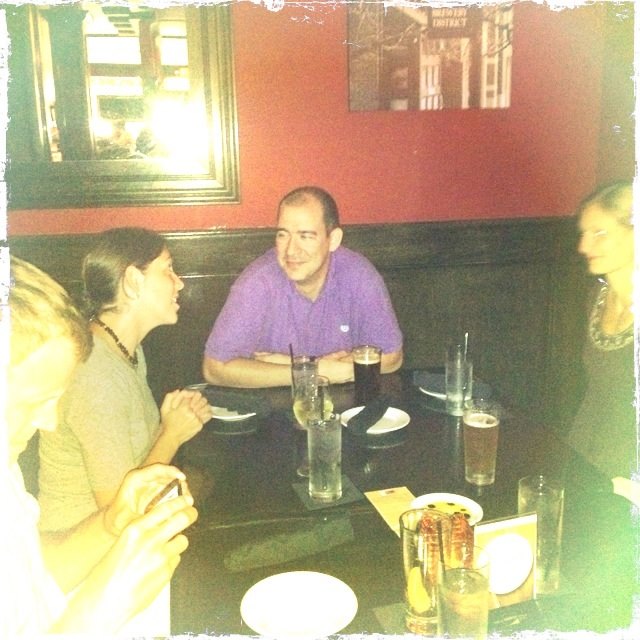
Dr. Mihalik ripped through his 24 hours with us with little time to breathe as he dispensed his wisdom concerning sports-related concussions, one of the hottest topics in the world of clinical sports medicine.  The highlights included the taping of a podcast; a lecture to the research staff and faculty; and the requisite beers and lounge experience in an informal setting.

I had to breakaway to cover a FINA open-water swimming event.  In lieu of attending the lecture Dr. Mihalik gave at our hospital, I tracked him down for a quick Q & A session.

—————Five Questions for Dr. Mihalik————–

1) CJSM: What do you think accounts for the dramatic rise in incidence of sports related concussions over the last decade? is it just a matter of recognition bias, or is something more going on?

Dr. Mihalik:  Research has shown a steady increase in the incidence of concussion across many sports. There is always an issue with incidence rates since precisely identifying the denominator (exposure) is always tricky at best. Notwithstanding, I believe this rise can be attributed to the increased hypersensitivity of this injury. More people know about concussions, which I feel biases recognition in more recent publications that highlight increases in concussion rates. I don’t think we should sensationalize these findings to suggest that concussion is now a problem when, in the past, it may not have been. Concussion has always been there, but we are now educating parents, coaches, and athletes to recognize the signs & symptoms. Read more of this post

The Polls are Open: Vote Early, Vote Often

35218_418761694580_6127199_n

Starting young on the skis

I’m on vacation, and will return next week to write more about the world of clinical sports medicine.  There will be new studies to report on, new injuries (unfortunately) in athletes to profile.  August is a wonderful month for sport:  The PGA Championship in golf commences; the U.S. Open in Tennis as well.  The English Premiership season kicks off, as does the Collegiate American Football season.

In the mean time, I wanted to offer those of you not lounging on a beach to visit some of the polls we’ve profiled in this blog over the last several months.  If you haven’t been able to share your opinion on some crucial questions in the world of clinical sports medicine, now is your chance!

So, it’s not November, and in American politics it’s an ‘off’ year for elections.  But the polls that really matter to sports medicine clinicans are open right here, right now:

1) We recently asked your thoughts on Baseline Computerized Neurocognitive Tests

and on the existence of “Second Impact Syndrome”

2) A month ago, we asked if you thought gluten-free diets enhanced athletic performance.

3) And at the beginnng of the summer, we asked you which you thought was the safer playing surface for footballers:  turf or grass?

When I return from my northern lake idyll, I’ll check on these polls and see what you all think, and I’ll be sure to report the results in an upcoming blog post.  Keep your eyes peeled to this site:  we’ll be profiling concussions in August, the start of the football (both soccer and American football) seasons here in North America and Europe.  I’m sure you, like me, will be expecting a tsunami of concussed athletes coming into your clinics this month.

The Games We Play: From Open Water Swimming to Croquet

photo (20)

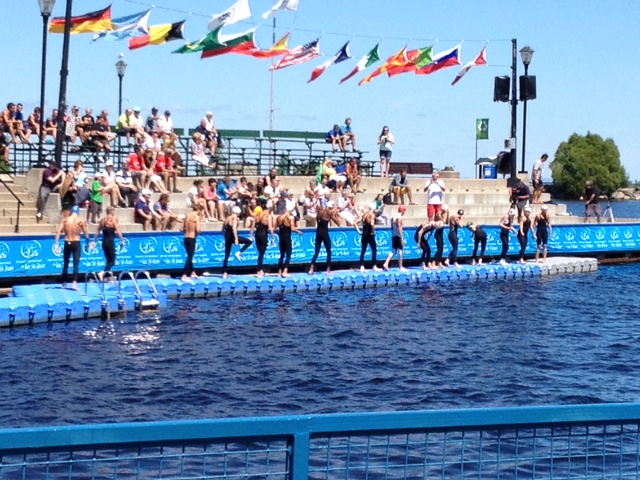
And they’re off:
the start of the 32K Traversee

The swimmers have entered the 19 C water and have begun their 6+ hour journey to Roberval:  the Traversee of Lac St. Jean, a FINA 32km open water swim has begun.

photo (14)

The start of the Lac St. Jean
10 K FINA event

I last wrote a post about the FINA World Cup 10km event that took place two days ago at the same venue.  The organizational structure, medical facilities, and WADA doping control stations are the same for the 32km Traversee.

photo (15)

The infirmary at Traversee Headquarters.


The 10km race was an exciting finish, and more importantly from the viewpoint of a sports medicine clinician, the event was safe.  By that I mean that the facilities and staff were well organized, and there were no major injuries to the athletes.  As expected, given the cold waters of the racing venue, a couple of swimmers were treated for mild hypothermia, but no one required anything more than passive warming and supportive care.

photo (19)

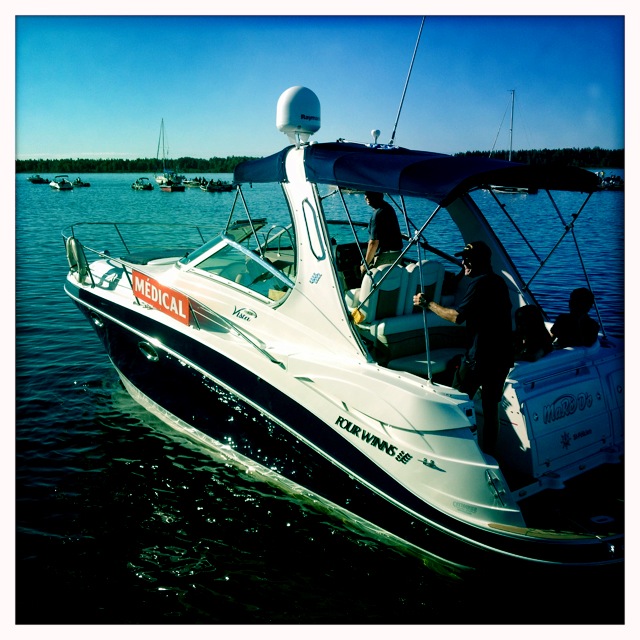
One of the Medical Boats accompanying
the swimmers as they make the 32K crossing

Hypothermia (body temperature < 35 C) can be a concern for any athlete (coach, athletic trainer, or physician) performing in an outdoor venue, but it is a special risk for open water swimmers.  FINA mandates that swims take place on courses with event-day water temperatures in a range from 16 to 31 C.  At the higher end of that range, swimmers may produce more heat than can be easily dissipated through convection and conduction, and may be at risk of hyperthermia.  Exertional Heat Illness is, of course, another environmental hazard sports medicine clinicians must be concerned with.  It is thought to have been one of the contributing causes to the worst outcome one can conceive in the field of sports medicine:  the death of an open water swimmer, Fran Crippen, occurred at a FINA event in the United Arab Emirates in 2010.

At this venue in Lac St. Jean, we have the opposite concern.  The early morning temperature on race day Thursday was 18 C, and I was happy to see the temperature climbed one more degree by race time.  The swimmers’ opinions of those conditions ranged from neutral to notable (cold!), but, as I said, only two swimmers needed attention.  The other 15 emerged from the water with their biggest concerns ranging from 1) washing the lanolin off of their bodies to 2) producing urine for doping control. Read more of this post