Dr. Jason Mihalik guests on ‘5 questions with CJSM’: concussions and apps

We’re already seeing an uptick in our concussion clinics now that the football (both ‘American Football’ and soccer) seasons have begun.  It promises to be a busy few months.
jason mihalik

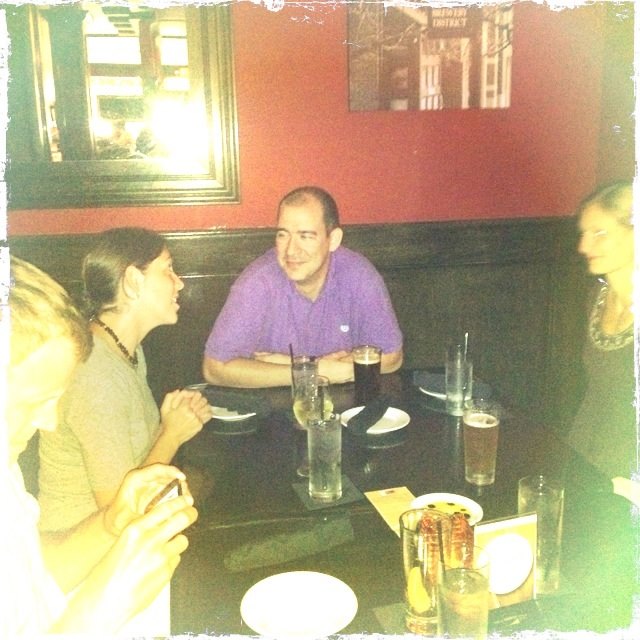
Dr. Mihalik and colleagues with their
pre-participation ‘sports drinks’

How fortunate my colleagues and I were, then, to have a special guest visit us a couple weeks ago:  Jason P. Mihalik, Assistant Professor in the Department of Exercise and Sport Science at the University of North Carolina and Co-Director of the Mathew Gfeller Sport-Related Traumatic Brain Injury Research Center.  

I first became aware of Dr. Mihalik from the work he has done regarding what is generally considered the most user-friendly layperson’s app for recognizing a concussion on the field of play.  The app, known as “Concussion Recognition and Response App,” can be downloaded to both iPhone and Android systems, has a version specifically designed for coaches and parents; it is designed to assist the layperson in recognizing when a concussion may have occurred.  Dr. Mihalik himself talks about the app in this YouTube video.

mihalik and pommering

From Left to Right:
Drs. Mihalik, Pommering, and Patrick,
on ‘Pediacast’

Dr. Mihalik ripped through his 24 hours with us with little time to breathe as he dispensed his wisdom concerning sports-related concussions, one of the hottest topics in the world of clinical sports medicine.  The highlights included the taping of a podcast; a lecture to the research staff and faculty; and the requisite beers and lounge experience in an informal setting.

I had to breakaway to cover a FINA open-water swimming event.  In lieu of attending the lecture Dr. Mihalik gave at our hospital, I tracked him down for a quick Q & A session.

—————Five Questions for Dr. Mihalik————–

1) CJSM: What do you think accounts for the dramatic rise in incidence of sports related concussions over the last decade? is it just a matter of recognition bias, or is something more going on?

Dr. Mihalik:  Research has shown a steady increase in the incidence of concussion across many sports. There is always an issue with incidence rates since precisely identifying the denominator (exposure) is always tricky at best. Notwithstanding, I believe this rise can be attributed to the increased hypersensitivity of this injury. More people know about concussions, which I feel biases recognition in more recent publications that highlight increases in concussion rates. I don’t think we should sensationalize these findings to suggest that concussion is now a problem when, in the past, it may not have been. Concussion has always been there, but we are now educating parents, coaches, and athletes to recognize the signs & symptoms. Read more of this post

The Polls are Open: Vote Early, Vote Often

35218_418761694580_6127199_n

Starting young on the skis

I’m on vacation, and will return next week to write more about the world of clinical sports medicine.  There will be new studies to report on, new injuries (unfortunately) in athletes to profile.  August is a wonderful month for sport:  The PGA Championship in golf commences; the U.S. Open in Tennis as well.  The English Premiership season kicks off, as does the Collegiate American Football season.

In the mean time, I wanted to offer those of you not lounging on a beach to visit some of the polls we’ve profiled in this blog over the last several months.  If you haven’t been able to share your opinion on some crucial questions in the world of clinical sports medicine, now is your chance!

So, it’s not November, and in American politics it’s an ‘off’ year for elections.  But the polls that really matter to sports medicine clinicans are open right here, right now:

1) We recently asked your thoughts on Baseline Computerized Neurocognitive Tests

and on the existence of “Second Impact Syndrome”

2) A month ago, we asked if you thought gluten-free diets enhanced athletic performance.

3) And at the beginnng of the summer, we asked you which you thought was the safer playing surface for footballers:  turf or grass?

When I return from my northern lake idyll, I’ll check on these polls and see what you all think, and I’ll be sure to report the results in an upcoming blog post.  Keep your eyes peeled to this site:  we’ll be profiling concussions in August, the start of the football (both soccer and American football) seasons here in North America and Europe.  I’m sure you, like me, will be expecting a tsunami of concussed athletes coming into your clinics this month.

Concussions and Computerized Neurocognitive Testing

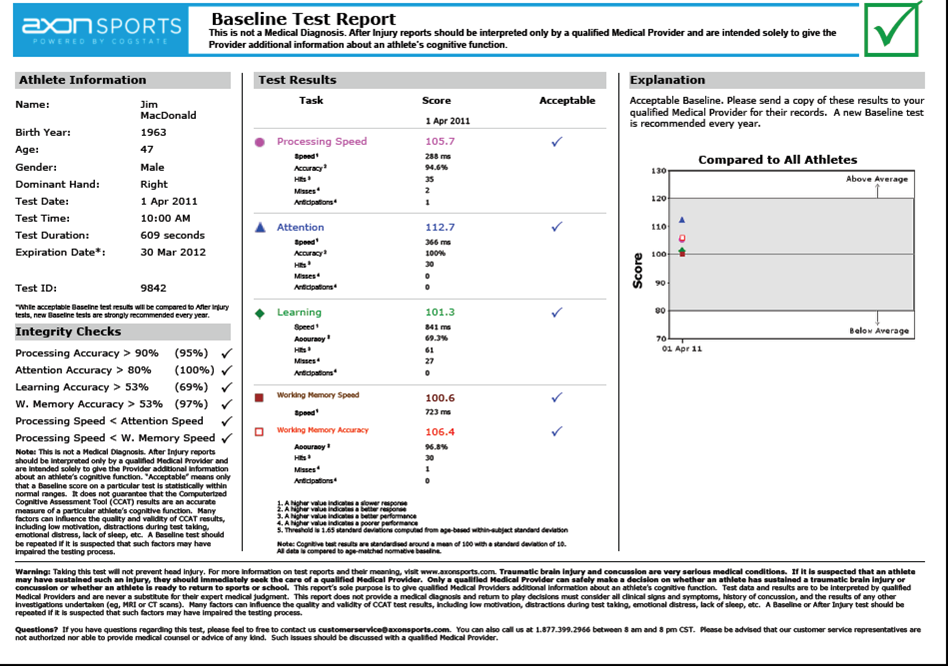
axon sport macdonald

The author’s ‘baseline’ neurocognitive test results
(AxonSport).

It has become a rite of summer over the last few years, at least here in the United States:  ‘baseline’ neurocognitive testing (typically administrered by computer).

Our practice has at this point in the summer probably tested one thousand+ local athletes from middle school to high school, primarily focusing on ‘football’ players (American football and soccer).  It is a mass demonstration of an effort at secondary prevention.  The intrinsic idea underlying this ritual is that we are establishing for each individual athlete their ‘baseline’ neurocognition, so that if they were to have a potentially concussive injury, we can re-test them and use the comparative results as one more piece of data in helping us diagnose and manage a concussion (and a return to play).

Like a lot of sports medicine, however, this practice is controversial.

An excellent article on the reliability of computerized neurocognitive tests was recently published in the Archives of Clinical Neuropsychology:  “Test-retest Reliability of Four Computerized Neurocognitive Assessment Tools in an Active Duty Military Population.” 

I am not a statistician nor a neuropsychologist, and so if some readers quibble with my definitions, I am open to hearing about it in the blog’s comments.  As I understand it, reliability is the property of a test that reduces in most respects to the concept of repeatability; some people describe it as the ‘stability’ of the test.  It is, arguably, the most basic psychometric property of a test:  one most first prove the ‘reliability’ of a test instrument before assessing other properties of the test (e.g. validity, and responsiveness).

I plan to talk more about this idea, and the study on the computerized neurocognitive tests in the Archives, in an upcoming post.  For now, I’d encourage you to don two things.

First, click on the link and read at least the abstract of the paper referenced above……the reported results from the study may surprise you.

Second, take the poll below and let us know your thoughts on this new, ‘rite of summer.’  I’ll report the results, and discuss the paper, in an upcoming blog post.   See you then!

Two for Tuesday: “Two-a-days” and Secondary Prevention/”Second Impact Syndrome”

Ebritton

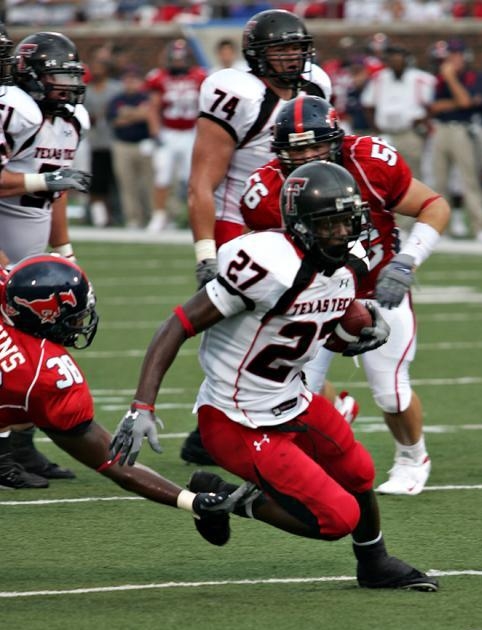
Photo courtesy of Jay Davis and
Wikimedia Commons

August.  How did that happen?

It’s Tuesday, and it’s still July; but August 1 is a mere two days from now,  and in the United States that means football season is cranking up (the NFL opened their training camps last week, with injuries already mounting).  August has represented historically the time of year when football teams run their notorious “Two-a-days”:  workouts morning and afternoon, intended to prepare the youngsters for the battles of the season (and weed out the poorly conditioned or poorly motivated.)

Two-a-days and August have typically represented a pair that leads to increases in Exertional Heat Illness (EHI), which is definitely something I plan to talk about later in the month.  The epidemiology of EHI in High School athletes is something that has been explored recently by Dawn Comstock  and her group, a team of researchers I have profiled before in these blog pages. 

Today, however,  I wanted to focus on another injury whose incidence is expected to rise this month:  concussions.

This is a topic I plan to return to several times during the month of August, with blog posts planned to look at the 2012 Zurich Consensus Statement on Concussion in Sport as well as the CJSM’s planned collection of free concussion research (up and running soon) and interesting perspectives on concussion from University of North Carolina researcher Jason Mihalik.

But just now, I feel like being somewhat provocative, and I most definitely want to hear from the readership on their views of a controversial subject:  Second-Impact Syndrome.

One of the new wrinkles in concussion management we will face in Ohio this football season is a “Zachary Lystedt” type law which will affect how we return youth athletes to sport after they have suffered a concussion or any head injury suspected of being a concussion.  These laws are predicated on the idea of secondary prevention:  that holding a youth player out from sport until a concussion has resolved will lower the incidence of the complication of ‘secondary impact syndrome.’

The subject of ‘secondary impact syndrome’ is controversial, with some authors arguing against its existence.  There is consensus on one extremely rare catastrophic complication of single brain impacts:  namely diffuse cerebral swelling.   This occurs more frequently in children and adolescents, and is a dreaded (albeit rare) complication of youth collision sports. However, there is more debate over whether having a prodrome of a previous, unresolved concussion raises the risk of having this post-traumatic cerebral swelling.  Paul McCrory, in a CJSM article from 2001 that has been widely cited, argues strongly against the existence of a separate entity known as ‘secondary impact syndrome.’  He updated this position in 2012 with a more recent review of the literature, and came to this same conclusion.

So, I’ll put it to the readership in the form of a poll (in the spirit of this blog, it will come as two polls:  here on the blog, and the same one on the main CJSM web site).   Let us know what you think, and we’ll let you know what the results are…..and what we think about this, and more of the associated issues around the big medical concern of concussions.