The Games We Play: From Open Water Swimming to Croquet

photo (20)

And they’re off:
the start of the 32K Traversee

The swimmers have entered the 19 C water and have begun their 6+ hour journey to Roberval:  the Traversee of Lac St. Jean, a FINA 32km open water swim has begun.
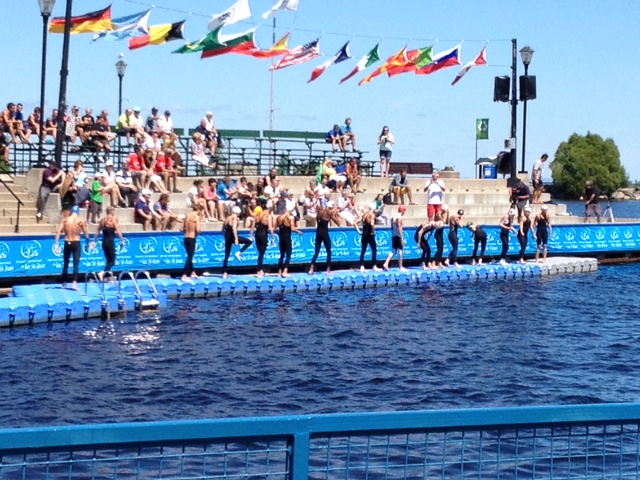
photo (14)

The start of the Lac St. Jean
10 K FINA event

I last wrote a post about the FINA World Cup 10km event that took place two days ago at the same venue.  The organizational structure, medical facilities, and WADA doping control stations are the same for the 32km Traversee.

photo (15)

The infirmary at Traversee Headquarters.


The 10km race was an exciting finish, and more importantly from the viewpoint of a sports medicine clinician, the event was safe.  By that I mean that the facilities and staff were well organized, and there were no major injuries to the athletes.  As expected, given the cold waters of the racing venue, a couple of swimmers were treated for mild hypothermia, but no one required anything more than passive warming and supportive care.
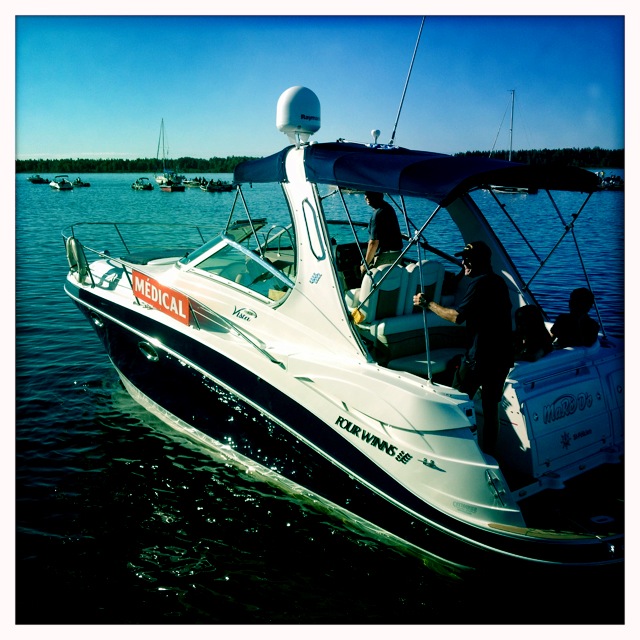
photo (19)

One of the Medical Boats accompanying
the swimmers as they make the 32K crossing

Hypothermia (body temperature < 35 C) can be a concern for any athlete (coach, athletic trainer, or physician) performing in an outdoor venue, but it is a special risk for open water swimmers.  FINA mandates that swims take place on courses with event-day water temperatures in a range from 16 to 31 C.  At the higher end of that range, swimmers may produce more heat than can be easily dissipated through convection and conduction, and may be at risk of hyperthermia.  Exertional Heat Illness is, of course, another environmental hazard sports medicine clinicians must be concerned with.  It is thought to have been one of the contributing causes to the worst outcome one can conceive in the field of sports medicine:  the death of an open water swimmer, Fran Crippen, occurred at a FINA event in the United Arab Emirates in 2010.

At this venue in Lac St. Jean, we have the opposite concern.  The early morning temperature on race day Thursday was 18 C, and I was happy to see the temperature climbed one more degree by race time.  The swimmers’ opinions of those conditions ranged from neutral to notable (cold!), but, as I said, only two swimmers needed attention.  The other 15 emerged from the water with their biggest concerns ranging from 1) washing the lanolin off of their bodies to 2) producing urine for doping control. Read more of this post

Major League Baseball: the All-Star game and more

799px-Citi_Field_2011

CitiField, Home of the New York Mets
and host to the 2013 MLB All-Star Game

Major League Baseball’s (MLB) All-Star game takes place tonight at CitiField, the home field of the New York Mets.  The All-Star game has a rich history and in the culture of MLB has always represented, at the very least, the mid-season pause where the collective baseball community could reflect on the game:  where it has been, and where it is going.

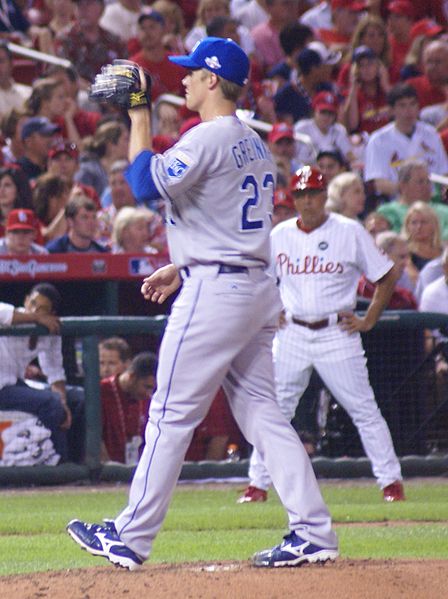
zack greinke at 2009 MLB all star game

Zack Greinke, pitching in the 2009 MLB All-Star game
(He will not play in the 2013 edition)


From the perspective of sports medicine, this baseball season has been a rich one already.  From Zack Greinke’s clavicle fracture and surgical repair, to Derek Jeter’s recovery from ankle surgery and quad strain, to the, er, inimitable ARod’s hip surgery and the ever growing issue of PEDs in MLB,  it’s been a very interesting spring and early summer.

In the spirit then of this mid-season pause, I wanted to sit back and review just a few baseball-related, clinical sports medicine issues before we all enjoy the game tonight. Read more of this post

Ramadan

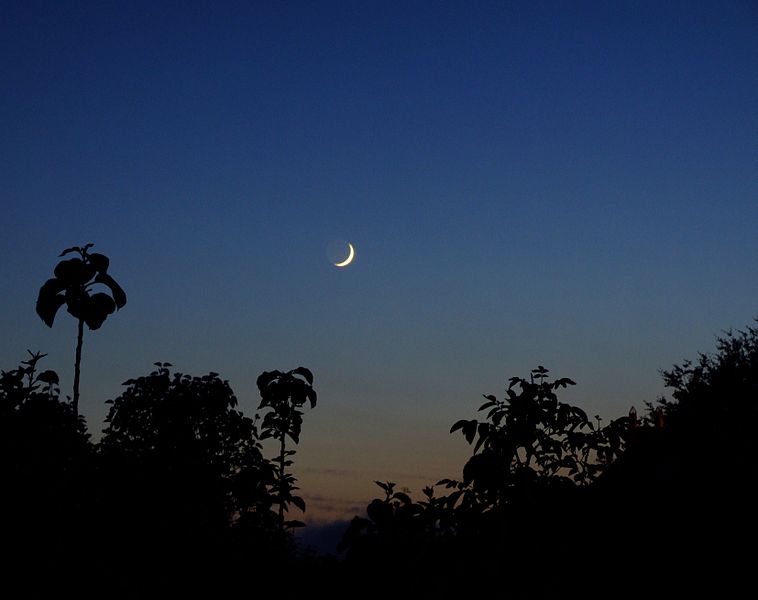
Crescent_Moon_(2558144570)

The Crescent Moon rising at sunset, marking the start of the month of Ramadan

The month of Ramadan begins tomorrow, July 9, and lasts until August 7.  As many of this blog’s readers will know, observant Muslims will fast from dawn until sunset:  no food, no liquids…..no sports drinks or power bars.  The questions of ‘carb loading’ or ‘gluten free’, (‘should i drink some chocolate milk after my workout?‘) can all be put on the table until the evening.  The diet is one of pure abstinence, morning until night.

Muslim athletes are not unique in observing a fast: Catholic Christians will consume much less than usual if observing the prescribed tenets of Lent on Ash Wednesday and Good Friday, and Jewish athletes will go a full 24 hours consuming nothing on Yom Kippur: friends have told me they will be loath to brush their teeth or even shower, lest anything whatsoever pass into their mouths on that, the holiest day in the Jewish calendar.

And, of course, there are athletes who experiment with fasts, juices and cleanses that have nothing to do with religious observance (I’ve tried the “Master Cleanse” myself once).

What may be unique, however, to Islam  is the duration of the practice:  a full 30 days, where an observant Muslim will forego all food and drink from dawn (Sahur) to dusk (Iftar).

I admire the discipline the act of fasting requires.  As a sports medicine clinician, I have often wondered how athletes observing such fasts might be impacted.  Of course, I am  not alone in this, as the subject of the Ramadan fast and its effect on athletes was, for instance, a subject of considerable interest in the 2012 London Olympics, which took place during Ramadan.  The effects of Ramadan on sports performance have even been discussed in this blog in a 2011 post.  And now  the most recent issue of the CJSM, which rolls out today, highlights a study looking at this very practice of fasting and its impact on footballers:  “Does Ramadan Affect the Risk of Injury in Professional Football.” Read more of this post

Novak Djokovic: Gluten-free and Gumbyesque

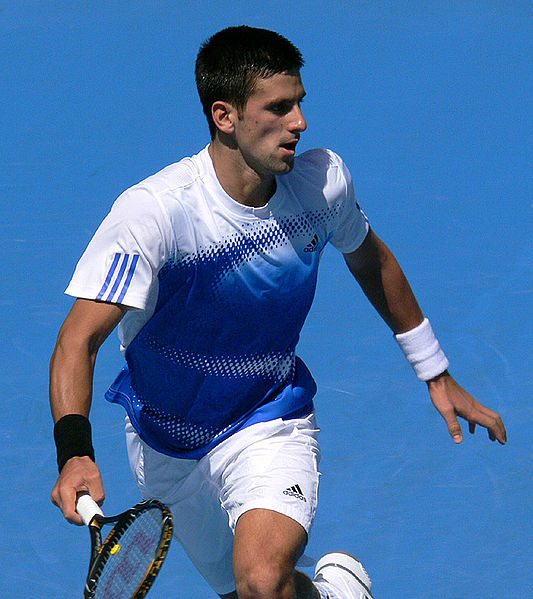
djokovic aussie open

Novak Djokovic at the Aussie Open

The Wimbledon Championships end tomorrow, with the Gentleman’s Singles Final pairing now set:  either Novak Djokovic or Andy Murray will raise the Championship Silver Cup by day’s end, barring rain delay or marathon tennis match…..

It has been another great fortnight of tennis, highlighted by Djokovic’s historic semi-final win over Juan Martin del Portro yesterday.  Djokovic seems to get involved in these epic five-set Grand Slam matches, having just been on the losing end of such a match at the French Open.  His opponent that day, Rafael Nadal, was quoted as saying:  “‘I learnt during all my career to enjoy suffering, and these kind of matches are very special….I really enjoy suffering.” This statement was given, mind you, by the victor!

I remain impressed with Djokovic’s supreme athleticism and his ability to inflict suffering on others on the tennis court!  It got me to thinking yesterday:  what are the sources of his talents?

There have been interesting discussions of at least two of his singular attributes:   his flexibility and his devotion to his gluten-free diet. Read more of this post