Tommy John Surgery

It’s the season for Tommy John surgery.

Tommy_John_2008_bronx

Former LA Dodgers pitcher, Tommy John, whose name will forever be linked with the successful elbow surgery he had.

Major League Baseball (MLB) began its season earlier this month…….Wait!  In truth, it began its season last month:  the Opening Series of the season took place in Australia on March 22! I thought it was a nice, antipodean, cross-cultural touch that MLB played the first game of 2014 at the Sydney Cricket Grounds (the LA Dodgers faced the Arizona Diamondbacks)…..

With the return of baseball comes an all too common injury:  UCL tears, partial and complete.  This season, it seems there is a veritable epidemic:  14 pitchers scheduled to have this surgery already (in comparison, from 2000 to 2011 there was an average of 16 MLB pitchers per year undergoing the procedure).

What was once a career-ending injury has been transformed into a season-ending one because of one man, Dr. Frank Jobe.  Dr. Jobe, as readers will know, passed away earlier this year.  Many in the sports world noted his incomparable legacy as the ‘savior of pitchers elbows’  He was a great doctor, and a decent man.

He devised the surgical approach to ‘ulnar collateral ligament reconstruction,’ and his first patient was the pitcher Tommy John, who went on to pitch 164 games in his career after the surgery (such success is arguably a major reason his name has ‘branded’ the procedure).

I’m not the only one thinking of Tommy John, Dr. Frank Jobe, and pitching-related elbow pain.  Sue Basile, a reader of this blog, reached out to me and asked if she could write a guest post on the topic.  Sue received her BS in  Biomedical Engineering from Columbia University, her MS in Biomedical Engineering/Biomechanics from the University of Tennessee, and is working on her PhD in Kinesiology/Biomechanics at Georgia State University.  Here are her thoughts on prevention of the injury that can lead to Tommy John surgery:

____________________________________________________________________

Stemming the Tommy John Tide begins in Little League – Sue Basile
Ivan Nova may soon find himself on a list that no pitcher wants to be on – the one of those undergoing Tommy John surgery.   Despite it still being the first month of the season, the elbow count is already high, with the Yankee pitcher potentially joining promising players like the Mets’ Matt Moore and the Braves’ Cory Gearrin  in having their season cut entirely too short.  Read more of this post

There Be Monsters

“In like a lion, out like a lamb,” that’s what they say about March.

To the extent that expression applies to the weather this month and to this blog, I think 2014 may be the exception that proves the rule!  We may be going out like a lion in both areas.

The east coast of North America is ready for spring, but this month that opened up with winter is ending the same way.  If there was an outdoor lacrosse game in Buffalo, New York this weekend, the players were dealing with snow!

Mike_Fisher_throws_check_May_29_2006

More like a lion than a lamb: an NHL body check.

As for this blog, we opened the month with a post that had both sound and teeth, like the proverbial carnivore itself:  our first podcast was a discussion with Drs. Neil Craton and Oliver Leslie, the authors of the March 2014 CJSM lead editorial, Time to Re-Think the Zurich Guidelines: a Critique on the Consensus Statement on Concussion in Sport.  I continue to hear about this editorial, on social media, on the American Medical Society for Sports Medicine email ListServ, and most recently at a symposium on concussions held at Ohio State University (OSU).  It has stirred a tremendous amount of interest.  And so I thought it would be fitting to end the month where we started, with the subject of concussion in sport.

The featured speaker of the OSU symposium was Kevin Guskiewicz, who spoke about “Sports concussions: paranoia or legitimate concern?”  Both he and Dr. Jim Borchers, the Ohio State Team Physician, mentioned the editorial critique in their respective talks.

If you follow the literature on sport-related concussions, you most certainly will come across Dr. Guskiewicz’s name.  He has contributed mightily to the research on several dimensions of this injury.  And so it was a pleasure to hear him speak for an hour on the subject.

As the title of his talk would indicate, Dr. Guskiewicz took as his theme the fear surrounding sport-related concussion.  Dr. Guskiewicz did an admirable job underscoring the importance of both the injury (concussion) and the need to avoid throwing out the baby with the bathwater:  eliminating collision sports such as American football out of possibly misplaced concern over short- and long-term deleterious effects on the brain.  The high points of his talk focused on the various aspects of sport amenable to change which can minimize injury risk and maximize participation.

I especially enjoyed his approach because, in many respects, it is the work that he and a few others have done (amplified by the media) that has helped unleash the beast of “concussion fear.” Read more of this post

The Effectiveness of Ankle Taping

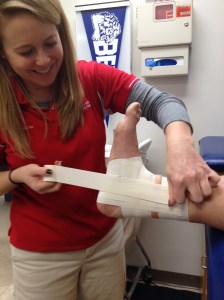
gail taping ankle

ATC Gail Swisher, Bexley High School
and Nationwide Children’s Hospital,
demonstrating her art

To tape or not to tape, that is the question.

And the answer is of interest to a lot of folks out there.

“Residual Mechanical Effectiveness of External Ankle Tape Before and After Competitive Professional Soccer Performance,” published in our January issue, has been our most emailed study so far this year.  On our twitter feed, @csjmonline, I can also tell you that the posts I’ve been making have been getting a lot of traffic.

There is a great deal of interest in this most utilitarian of subjects. It’s original research coming from a group out of Germany:  Best, Mauch, Böhle et al., and currently on the CJSM website it’s FREE!  It’s time to check it out!

All of us in clinical sports medicine can attest to the ubiquity of ankle injuries.  The authors of this study note, for instance, that aside from muscle strains, ankle ‘distortions” are the most frequent injuries seen in professional soccer, accounting for about 20% of all injuries.  They further note that bracing and adhesive taping of the ankle are commonly used to prevent and treat these injuries, though “….the effect of adhesive ankle tape remains inconclusive, in comparison to semirigid orthoses and braces….”

There is considerable debate over the residual effectiveness of taping over the course of a prolonged sporting session.  The issue is of practical significance, as the author’s note that during soccer matches, a disproportionately high number of injuries occur during the last third of each halftime.  To date, there have been few studies that have evaluated the mechanical, protective properties of tape beyond 30 minutes of exercise.

It is in this context, then, that the authors’ developed what amounts to their research hypothesis:  “…during realistic competitive soccer performance reflecting a halftime of 45 minutes–ankle tape might lose most of its assumed initial mechanical effectiveness to reliably prevent ankle distortions.”  They set out to test just that. Read more of this post

Snow Worries: Sochi Olympics, Second Week

SONY DSC

Winter in Sochi 🙂

I was reading the Washington Post the other day, and came across an article with a clever title:  “At Sochi Olympics, Finding Risk is Snow Problem.”

It took your less than clever blogger here a moment to get that…….

Now that I do, I’m modifying the word play for this post’s title.

But the story under the headline I ‘got’ right away.  The Post reporter was arguing that the Sochi snow (quality and quantity) was a danger to competitors, and was possibly increasing the incidence and severity of injuries seen this Olympics.

Like most of you, I have followed the Sochi Olympics with great interest.  The sport is central to my enjoyment; but I also am intoxicated by the scenes of the beautiful Caucasus mountains set so close to a warm, subtropical coastline.  I don’t know if any other Winter Games have been hosted in a city with palm trees.

So, the snow:  so central to a Winter Olympics.  Is it a problem?  We can wait to tally up IOC medical charts, but you can also weigh in with your opinion on our poll below!

And if you’re especially enterprising–and you’re collecting data on this or other epidemiologic issues central to the Sochi Olympics–by all means submit a manuscript to the journal!  We frequently publish studies looking at the Olympics or the effect of sporting surface on injury rates.  We’d love to hear from clinicians/researchers/epidemiologists who have written up their studies and are looking for a quality journal to review their work.

Until then:  take the poll!

*poll can also be found on the journal’s main website