Sudden Cardiac Death: The Israeli Experience

dr jose garza

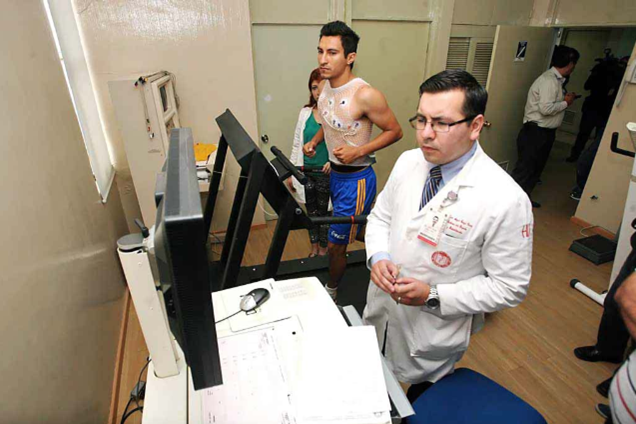
Dr. Jose Garza, conducting a stress test on an athlete, Monterrey, Mexico

Screening for sudden cardiac death (SCD) remains one of the more contentious debates in the world of sports medicine.  As a matter of public policy, consensus medical opinion in the United States still argues against universal, mandatory  screening with electrocardiograms (ECGs); whereas in Europe, specifically in Italy, ECG screening is more of a routine practice.

The debate over this screening is carried on at many conferences and in many medical journals, including ours.  We’ve previously looked at the question of whether it makes sense to screen North American athletes with ECGs, for instance.  Earlier this year, we published a review of the different approaches American universities are currently using regarding the issue of athletic cardiovascular screening.  Recently, the topic came up in the podcast discussion I had with Dr. William Roberts on new directions for the pre-participation evaluation (PPE).  American and European sport medicine bodies can find a lot of common ground in where the PPE can be improved, according to Dr. Roberts, with the principal exception of this one issue.

Recently, Dr. Sami Viskin, from the Department of Cardiology, Tel Aviv Medical Center, spoke at my home institution about how athletes are screened for SCD in Israel.  He has written extensively on the issue of screening athletes for SCD, including a study arguing that it is not a cost-effective strategy in the United States.  The title of his recent talk: “Mandatory ECG screening of athletes saves lives: proven fact or wishful thinking?”

Our Division of Sports Medicine has been hosting another international guest this past month: Dr. Jose Angel Garza, a sports medicine physician from the University Hospital of the Universidad Autonoma de Nuevo Leon (UANL) in Monterrey, Mexico. He was also present at Dr. Viskin’s talk, and I asked him for his reflections on the subject of mandatory ECG screening in athletes.

Thanks Joe!

________________________________________________

Among the sports medical community, there is an ongoing and often heated debate on whether mandatory ECG screening should be performed on athletes. Several countries such as Italy and Israel have implemented such measures. The European Society of Cardiology has issued recommendations about mandatory screening of athletes with ECG. So this begs the question: Does ECG screening save lives in athletes? Read more of this post

The Black Cyclone

Jrobinson

#42, Jackie Robinson Photo by Bob Sandberg, Look

The intersection of art and sport, that’s the subject of my brief post today.  And who can get away from the subject of concussion in sport medicine these days?  So that’s in the mix too……

First, a quiz:  who is the first African-American to play professional football in the United States?

We all know Jackie Robinson broke the ‘color barrier’ in Major League Baseball.  April 15, the anniversary of that day in 1947, is now celebrated as a holiday in MLB, and his #42 is retired across the league.

But what of football?  I had thought the answer was Marion Motley of the Cleveland Browns, but it turns out I had the wrong man, and the wrong era.

Charles Follis, a native Ohioan, played for the Shelby Athletic Club from 1902 – 06, and has the distinction of being the first black professional American football player.  He lived and played before the NFL even existed, and he is a subject of a play which I just watched, “The Black Cyclone.”

It’s a fascinating story and a wonderful play.  Malabar Farms, the venue where I watched the show, is equally enchanting, a true gem of central Ohio:  the working farm and former home of Louis Bromfield, an author and screenwriter as well as a man truly devoted to sustainable agriculture.  Malabar Farms is simply beautiful, and is perhaps best known as the place where Humphrey Bogart and Lauren Bacall (who died earlier this year) were married.

6531961_122590335060

Charles Follis, ‘The Black Cyclone’

The play was held in a barn on the farm, and was well attended.  The story of Charles Follis’ life has dramatic power and should deservedly be better known.  I felt somewhat chastened that I had never known his name prior to watching the play.  There is even a direct connection between Charles Follis and Jackie Robinson:  Branch Rickey*, the general manager of the Brooklyn Dodgers and the man who brought Jackie Robinson on to the team, was a friend and football teammate of Charles Follis.

One of the more fascinating moments of the evening was what I saw as the intersection of my sports medicine life and this story.

Charles’ younger brother Curtis died when they were both young men playing football. The scene is recreated on stage. Curtis is playing football and gets tackled roughly by players who are none to happy to be playing against a black man. The actor demonstrates symptoms of a concussion; he returns to the playing field and is hit again, at which point–in dramatic fashion–he succumbs to ‘diffuse cerebral swelling.’

Head injury fatalities in youth football remain, unfortunately, a contemporary subject.  Only a week before watching this play, the national news was running the story of a New York high school player who died on the field after an on-field collision.

In Curtis Follis’ case, one might hope that should these injuries occur on the field in 2014, an athletic trainer or team physician would identify the first injury and hold the player from a return to the game.  It certainly is incumbent upon those of us caring for athletes to monitor the situation on the field, as underreporting of significant head injuries remains distressingly all too common:  in high school football more than 50% of such injuries are not reported by the players, according to a well-known 2004 CJSM study by McCrea et al. 

Better concussion management is also the subject of one of our podcasts:  take a listen when you have the chance. 

I do not know what plans the producers of the play have for taking ‘The Black Cyclone’ on the road, but I do hope it comes your way.  The Charles Follis story is most definitely one that should be better known.  The same can be said for Malabar Farms:  if you’re ever in central Ohio, it’s well worth the visit.

_______________________________________________________________

*Branch Rickey is deservedly famous for his instrumental role in integration of American sports.  As he put it, “Ethnic prejudice has no place in sports, and baseball must recognize that truth if it is to maintain stature as a national game.”

He should also be known as being instrumental in the introduction of batting helmets, a major step toward improving baseball player safety…..but that’s a subject for another post!


Return to Play Decisions: The hits and the HIT (system).

It’s October, and I thought I’d share a blog post I previously wrote about return to play decisions (see below). The football teams I cover are smack dab in the middle of their seasons; I, like all my colleagues covering teams this fall, have been busy making plenty of ‘return to play decisions.’

What do you all do with your 7 and 8 year olds? Yes, your 7 and 8 year olds……little did I know when I started my career that I would be making ‘return to play’ decisions for this age group, but that is among my duties here at Nationwide Children’s Hospital in Columbus, Ohio. How about you?

With that sort of return to play decision in mind, I could hardly find a more relevant piece of original research than the study on head impact exposure in youth football in the September 2014 CJSM.  The authors–a group from Virginia Tech and Wake Forest–are well known for recently publishing various studies on head  impact exposure using the ‘Head Impact Telemetry’ (HIT) system.   The HIT system is being used more regularly at various levels of football in helping to determine when an athlete may need a sideline evaluation.  As we all know, athletes in the heat of competition are not always the most forthcoming in sharing when they may have had a symptomatic hit; for that matter, the collective body of sideline physicians, athletic trainers and coaches don’t always pick up on the hits that occur right in front of our eyes:  just ask Brady Hoke and the Michigan Wolverines.

Returning to youth sport…..as my friends at MomsTeam have written, “the day when monitoring of head impact exposure in football and other contact and collision sports becomes commonplace is closer at hand than one might think.”  Here’s a list of what’s available right now for players from youth level on up to the pros (again, thanks MomsTeam for the reference).

I can forsee the time when I will integrate head impact exposure data along with what I find with my other concussion assessments to determine when I will release one of my youth athletes back to the field.  Next season, I will likely be involved with coverage of a high school which uses “Shockbox” technology.  However, I don’t currently use such systems; that is to say, none of the teams I cover, high school or university, use the HIT system or any other impact exposure technology.  Are you already using such technology in your determinations? Let me know if you are.  I’d like to learn more.

Enjoy the reblogged post below.


sportingjim's avatarClinical Journal of Sport Medicine Blog

535001_10201384038456502_1470889600_n Though a beautiful time of year, fall is not
the most idyllic for a sports medicine clinician

Like many of the readers out there, my colleagues and I are deep in a football season, where we are managing various teams and their mounting injuries.  For a sports medicine physician, fall in America must be a bit like early spring for an accountant (tax day = April 15):  it’s the time to buckle down and crank through patients, the time, from a certain perspective, to see the volume of patients that will sustain the business through leaner times of the year.

When I’m out of the clinic and on the sidelines, I’m also doing one of the parts of my job that is the most fun, and I’m sure my colleagues out in the blog sphere will agree.  But I wouldn’t describe the work as an idyll.  I can be enjoying…

View original post 1,014 more words

Gymnastics: A Book Review and Guest Blog Post

Jenks-Level 9beam

Dr. Emily Stuart, then…..

I have the privilege of working with several excellent pediatric sports medicine specialists at  Nationwide Children’s Hospital.  I’ve hit up a couple of them to write guest posts for this blog, including a review of the 2014 Female Athlete Triad Consensus Statement (Dr. Stacy Fischer) and a first-person account of being the medical director of a mass participation event, the Greater Ohio Bike Adventure (GOBA) (Dr. Tom Pommering).

The newest doctor to join our group is Dr. Emily Stuart.  I’ve had her in my sights to provide a blog post for the past few months.

Besides being an excellent clinician, Emily was a level 10 gymnast until she retired at age 16 due to injuries. She coached for 10 years and now judges club and NCAA gymnastics. Although Emily enjoys taking care of athletes from all sports, she has a special interest in providing medical care for gymnasts.  It’s because of her expertise both as a physician and as a gymnast that I asked her to review a book that was recently sent my way, the Handbook of Sports Medicine and Science:  Gymnastics.

________________________________________________________________________

Handbook of Sports Medicine and Science: Gymnastics

A book review, by Emily Stuart, M.D.

It’s been over 2 years since the US Women’s Gymnastics Team dominated the team and individual medals at the London Olympics . And in less than 2 short years, gymnasts from all over the world will converge in Rio de Janeiro for the 2016 Olympics.  The Olympics is definitely the biggest event in gymnastics, but there is much more to the sport than what fans see every 4 years. Gymnasts spend years, if not decades, training to become the best in their sport.

As a former gymnast, coach, and gymnastics judge I was excited to read and review the Handbook of Sports Medicine and Science: Gymnastics by Dennis J Caine, Keith Russell, and Liesbeth Lim. This book is part of a series produced by the International Olympic Committee (IOC) Medical Commission. Multiple specialists both with gymnastics knowledge and medical expertise contributed to the book. Thus, each chapter is very detailed and provides any gymnastics enthusiast with a wealth of knowledge.

The book starts with a thorough history and evolution of the sport. Read more of this post