It takes a village: wrapping up 2017 at CJSM

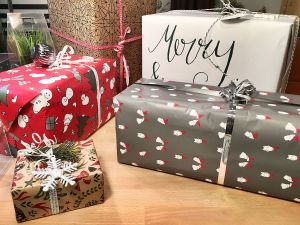
2017 — it’s a ‘wrap’ Photo: Marco Verch, Wikimedia

The end of the year, with its holidays of giving (e.g. Hannukah, Christmas, Kwanzaa and more), is a special time of reflection.

As the CJSM Associate Editor responsible for our emerging media (blogs like this, our Twitter and Facebook feeds, our podcasts) I am grateful for the community that supports these endeavors.

This group of contributors is far too large for me to mention in an exhaustive list.  But a non-random, representative sample might include:

It takes a village, as they say — and in CJSM’s case, it truly is a global village.  This worldwide community creates one of the premier sports journals in existence, one that offers one of the richest platforms for the publication of new, original research.

And it’s because of this village that I can report CJSM just received an early holiday present: this blog has been named in the top 60 sports medicine blogs (#8 to be precise) of 2017.

Joy to the world!

Thanks to all the readers of the journal and this blog, the authors and reviewers, the editors and the innumerable other members of the community with which we engage on social media.

Happy Holidays, and see you in 2018 for our first edition of the New Year.
Disparities in sports medicine health care

Most days of the week I see my pediatric sports medicine patients in two very different clinics:  one is within the inner city of Columbus, Ohio itself; and one is in the foothills of Appalachia, a region described in the recent bestseller, Hillbilly Elegy.  Among the patients I frequently see, I have many who could be described as urban poor (the former location), and many as rural poor (the latter).

In my care of these patients, I frequently see them (and their families) struggle with several barriers to excellent care — these range from financial issues, to issues of transportation and distance traveled, to issues of understanding related to educational levels, to a relative lack of resources at their home schools or clubs (e.g. no certified athletic trainers).  I feel at a great loss, at times, in trying to help them achieve the same results I would want for any of my patients.

I read with great interest then, in the November 2017 CJSM, a newly published, original research study: Disparities in Athletic Training Staffing in Secondary School Sport: Implications for Concussion Identification.  I found it so impactful, that I wanted to talk with the author — and so I tracked down Emily Kroshus ScD, MPH for this episode of the CJSM podcast.

Dr. Kroshus is a Research Assistant Professor of Pediatrics at the University of Washington, who is developing a body of academic work that focuses on “….identifying social and contextual determinants of help seeking behaviors, with an overarching interest in addressing disparities related to gender, race, sexual orientation, and socioeconomic status.”(1)

I hope you are as interested in this sort of research as much as I am.  So take a listen to the podcast on iTunes or go to the CJSM website for the podcast (look for the radio button) and the study itself.

_____________________________________________

(1) Dr. Kroshus’ biography can be found at the University of Washington faculty page:  https://depts.washington.edu/uwgenped/directory/emilykroshus

The impact of clavicle fractures on return to play in NFL athletes

Aaron Rodgers, quarterback of the NFL’s Green Bay Packers — photo Mike Morbeck Wikimedia

I love sports as well as sports medicine.  For many of us, our path to this field saw us grow from athletes or fans ourselves to physicians who kept ‘in the game’ by caring for other athletes and keeping them in the game.

I have written about my affection for my favorite professional team — the Green Bay Packers of the NFL. Anyone following the Packers this season, or the NFL in general, will know that Aaron Rodgers, the team’s franchise quarterback (and sine qua non), sustained a potentially season-ending clavicle fracture to his right, throwing shoulder in October. He has been out since — and his team, its fans (me!), and multiple fantasy football team owners are anxiously awaiting his return.  There is growing expectation he will be back next week for the Packers’ final three games of the season. Go Pack Go!

The waiting is the hardest part,” Tom Petty (RIP) has sung. And the waiting for Rodgers has been very hard for the Packers. Indeed, for anyone experiencing or managing a clavicle fracture, a lot of the frustration comes from the typically temporary but lengthy disability incurred — in the middle of an athlete’s season, a clavicle fracture can be the darnedest thing.  One is waiting as if for a batch of cookies to be done — take them out of the oven too early, you may be ruining a good thing; wait too long, you may unnecessarily be keeping your player out of the game.

With the ‘waiting’ for Rodgers on my mind, I read with special interest this morning a new, ‘published online first’ study from CJSM: Impact of Clavicle Fractures on Return to Play and Performance Ratings in NFL Athletes.   Read more of this post

Deck the halls.

Advent is here — a time of anticipation.  When I was a child, my mother would get all of us children an Advent Calendar, and each day I’d eagerly open up the windows of the calendar to find the chocolate inside.  You too?

I enjoy the holiday spirit that inspires many of the people/organizations I follow on social media.  Even the staid ones play with the mistletoe, so to speak.  The British Medical Journal (BMJ), for instance, puts on the holly and the ivy, and has a very clever, festive theme on its Twitter feed for the month of December:  a daily “Christmas Cracker,”(#BMJChristmasCrackers) that leads one to ponder issues like…whether Santa is a healthy role model or whether eating turkey really can make one sleepy.

Not quite Advent chocolate, but, at my age, I could use something low calorie. As the saying goes, you can’t outrun a bad diet (and, furthermore, I can’t run any more).

We, too, get festive this time of year at CJSM, notwithstanding the hard work our Editor-in-Chief (EIC) Chris Hughes will be doing throughout the Yuletide season taking care of his charges as a team physician for a Premiership football side. While you (and I) will likely be enjoying a quiet Boxing Day, he (and many team docs) will be taking care of business for the sides they cover.

Our elves busy at work packaging up the next edition of CJSM

Our last issue of the year (published in November)  is a bit like an Advent Calendar — open up the pages of the issue, and you’ll find a veritable smorgasbord of interesting topics to sample.  One I particularly liked explores disparities in access to athletic trainers and how this impacts concussion management in high school athletes.  The EIC himself has given a nod to a systematic review on the treatment of acute patellar dislocation.

Too busy to read because you’re travelling?  We’ll have a new podcast to add soon to the ever growing list of ones CJSM has already posted to iTunes.  So subscribe to the feed and listen to your heart’s content.

Whatever your plans this Season, if you are in sports medicine, be sure to include CJSM along with the requisite eggnog and fruitcake.

Ho ho ho!!!!