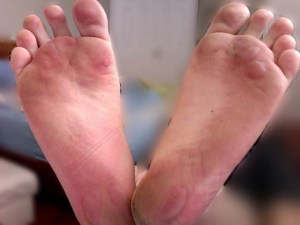
The bane of an ultramarathoner’s existence: no more!

Friction_Blisters_On_Human_Foot

Shoulda taped!!!! Picture courtesy Andry French, Wikimedia

One of the aspects of CJSM that I  love is our ‘published on line first’  function, whereby the articles which have gone through peer review and subsequent post-review author corrections are disseminated ‘on line’ before they can make it into the paper version of the journal.  It’s our version of ‘breaking news.’

The news that broke yesterday will be music to long-distance runners’ ears: say good-bye to blisters.

Yesterday, we published “Paper Tape Prevents Foot Blisters: A Randomized Prevention Trial Assessing Paper Tape  in Endurance Distances II (Pre-TAPED II)”.  The lead author is an emergency room physician from Stanford University, Grant Lipman.  Dr. Lipman has published other research on endurance running in our journal, most recently a well-received piece on “The Incidence and Prevalence of Acute Kidney Injury During Multistage Ultramarathons,” which was also published ‘on-line first.’

I must confess, the news of the Pre-TAPED trial was picked up so quickly by media outlets that I first heard about it on National Public Radio (NPR).  As an editor of CJSM, I normally have the ‘inside scoop,’ but this study generated so much immediate interest that NPR and others scooped me, including media outlets in the UK such as The Times of London.  These folks are already singing the praises of the ‘unlikely hero’ of this story:  inexpensive, surgical paper tape which can be found over the counter at any pharmacy and roughly costs a dollar a roll.  Cheap…..and effective.

Lipman and his study team recruited 128 runners participating in the 2014 250-km (155-mile) 6-stage RacingThePlanet ultramarathons in Jordan, Gobi, Madagascar, and Atacama Deserts.  The team devised a clever approach to testing their hypothesis that the paper tape would prevent blisters: Read more of this post

5 Questions with Dr. Jon Divine, AMSSM President

concussion

Dr. Jon Divine, in action as Team Physician for the Univ. of Cincinnati Bearcats

March is wrapping up, and that means that the annual scientific meeting of the American Medical Society for Sports Medicine (AMSSM) is just around the corner.  That meeting has been an April highlight on our calendar for years — #AMSSM16 is taking place in Dallas, Texas April 15 – 20 .  We’ve had our tickets for months.

On a personal note, there is so much I am looking forward to — reuniting with AMSSM colleagues like Alison Brooks, Irfan Asif, Holly Benjamin and also seeing Phatho Zondi, current president of the South African Sports Medicine Association (SASMA), who is coming all the way from Pretoria, South Africa.  I’m looking forward to catching up, as well, with AMSSM past presidents — Jon Drezner, Chris Madden, Doug McKeag, Cindy Chang — as well the incoming president, Matt Gammons.

And there is AMSSM’s current president, whose tenure is over 95% complete and will be handing on the reins to Dr. Gammons.  That would be Jon Divine, M.D.,  Professor of Orthopedic Surgery and Medical Director of the University of Cincinnati athletics.

Preparatory to the AMSSM meeting, I thought it high time CJSM sat down and interviewed the president of our affiliated society, to get a sense of what this past year has meant to him and the organization.  And so I present to you:  5 Questions, with Dr. Jon Divine.

_______________________________________________________

  1. CJSM: We have to begin by asking you about your year as President of the AMSSM. What were your major challenges this year?  What were your high points?

JD: Thanks for giving me this opportunity to share my story with your readers. This year has gone by fast. I’m very proud of the work done by our Board. Under Chris Madden we generated our third organizational strategic plan, the road map our leadership utilizes to guide the working priorities of AMSSM, with a goal of completion in 5 yrs. As of now, we’re more than half way completed on the current plan. I half-jokingly mentioned to Kathy Dec and Chad Asplund this week that they will have to seriously consider developing the next strategic plan because the objectives for the organization spelled out in the current plan will be met ahead of schedule! As president, you could not be happier than when your team is skilled and willing to take on these tasks, do them very well, and complete them ahead of schedule.

Two other moments were very special for me. Read more of this post

Dietary Supplements in Sports

2004_TX_Proof

Texas — site of upcoming AMSSM annual meeting [Dallas, 4/15 – 4/20]

One of the studies in our March 2016 CJSM which has generated substantial interest is original research from the Department of Military and Emergency Medicine, Uniformed Services University of the USA: “Dietary Supplements: Knowledge and Adverse Event Reporting among American Medical Society for Sports Medicine (AMSSM) Physicians.

The AMSSM, one of our affiliated societies, is having its annual meeting coming up in Dallas April 15 – 20, and we’re looking forward to joining in those proceedings [the official hashtag of the meeting is #AMSSM16 — keep that in mind you Twitter folks].  The physician membership is not infrequently surveyed about a variety of matters of interest to practicing sports medicine clinicians; the results of these surveys often provide invaluable data to researchers who have published in the CJSM pages.

Examples of this include “Concussion Practice Management Patterns among Sports Medicine Physicians” and “Cardiovascular Preparticipation Screening Practices of College Team Physicians.” 

Regarding the study on dietary supplements (DS), the authors looked at a variety of issues.  Of note, they found that majority of survey respondents (71%) reported that athletes under their care had experienced an adverse event associated DS use.

Not all of us who read this blog or subscribe to the journal are AMSSM members, of course, and so I thought it might be time for a poll, asking this very question: have you ever taken care of an athlete who has experienced an adverse DS event?  Please, take the poll, and if you can, send us a comment on this blog identifying the DS, the adverse outcome, and possibly the sport in which your athlete was participating.

We hope to see you in Dallas!

A Sharapova Moment

The world of sports medicine is never boring, but who knew things could get this interesting?

In the first weeks of March, there have been at least two major stories that have transcended the borders of ‘sports medicine’ and become topics of debate for the world at large — I speak of the proposed ban on tackling in schoolboy rugby (and the continued debate on tackling in American football) and Maria Sharapova’s admission that she failed a drug test at the recent Australian Open.  For both stories, the boundaries of the discussion have gone well beyond the lines of the playing fields and the walls of the academy.

Social media has seen these topics trending. The mainstream media have been profiling the issues as well.  The Economist weighed in on the debate about tackling. And this morning I found the New York Times prominently featuring Ms. Sharapova’s story, including articles on the drug meldonium [for which Sharapova tested positive] and on the issue of the World Anti-doping Agency’s (WADA) use of emails to notify individuals about changes on WADA’s banned substance list.

Many people have an opinion on the subjects.   We’ve been running a poll on this blog regarding the issue of tackling, while our friends at the British Journal of Sports Medicine (BJSM) have been running a Twitter poll on the Sharapova issue: who is responsible, the player or her support staff [currently the poll is 74%/26% stating it’s the athlete’s responsibility].

In the New York Times article and in the BBC, former WADA-president Dick Pound has stated his opinion that Sharapova’s failed drug test was ‘reckless beyond description.’

I must say I take issue with this and empathize with Ms. Sharapova, who stated that she received in December the WADA email noting that meldonium was now on the banned substance list, but “…I did not look at that list.”  Meldonium was a PED legal until 2016, when it was placed on the ‘banned substances list.’ As a professional inundated with emails, alerts, pronouncements, and more, I confess to a certain degree of information overload even when it comes even to items vital to my licensure and ability to practice.  Have I ever received an email from the Medical Board that I have deleted?  Have I ever received notification from my hospital staff office of some new change in policy which I glossed over?  Yes and yes.

Regarding the WADA emails, other athletes in the NY Times article have offered this opinion: “Some dismissed the messages as irrelevant to their own regimens or too complicated to be useful.”  That certainly resonates with me and my professional world.

I am not writing this to absolve Ms. Sharapova, and I applaud her for her prompt and open admission of personal responsibility. That stance is right and proper.  But I would hardly deem her action “reckless beyond description.”

In CJSM we have published over the years several studies on banned substances. One of the pieces of original research just published in our March CJSM sheds some further light on this issue, I think: Dietary Supplements: Knowledge and Adverse Event Reporting Among American Medical Society for Sports Medicine Physicians.  Read more of this post