#BikeToWork

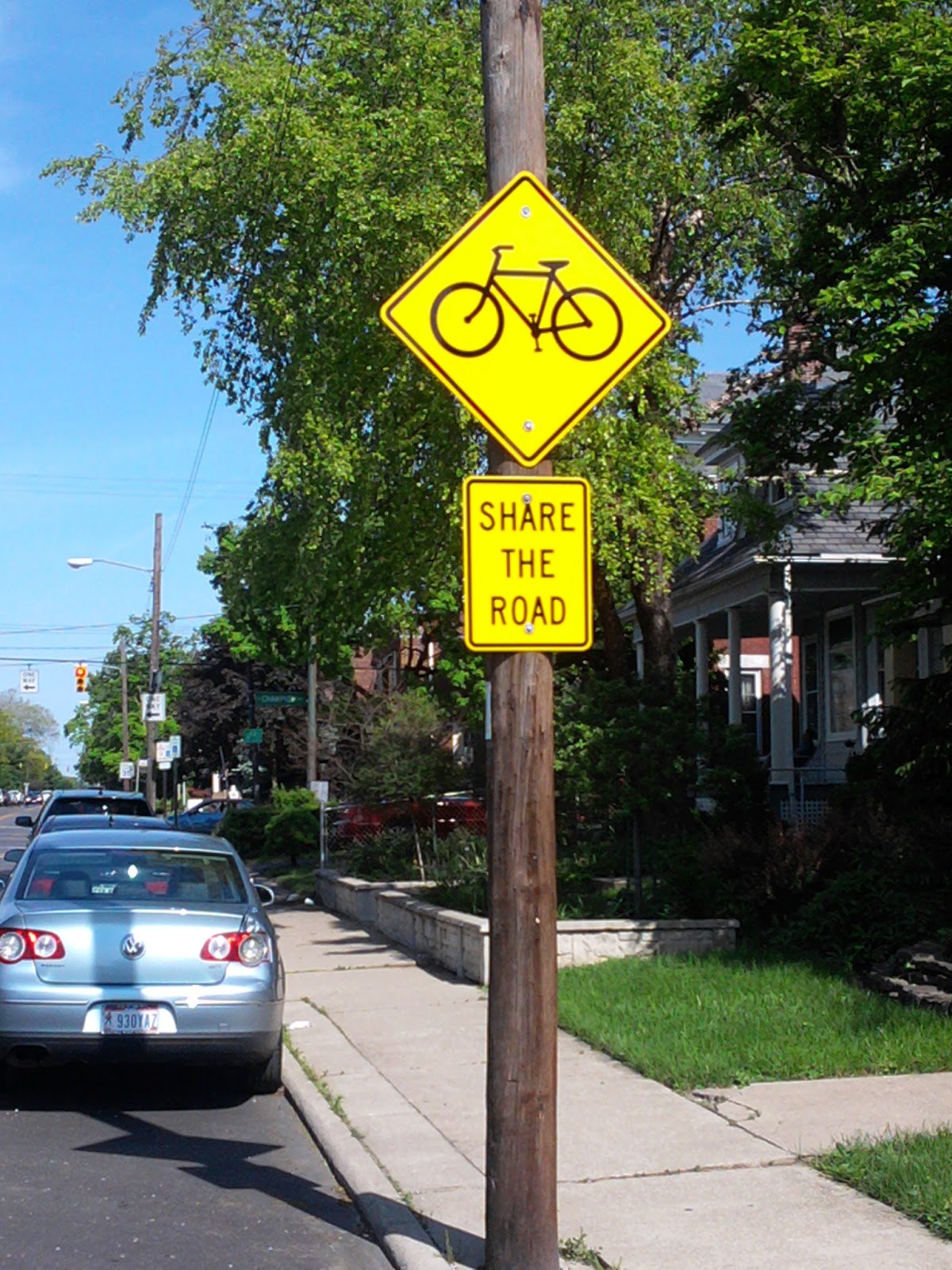
share the road

Amen to that!

It’s #BikeToWork week, a time to celebrate….by getting on your bike!

When I’m not on the bike, but instead wandering the ‘twittersphere,’ I have come upon some gems this week.  @NerdWallet posted a great set of slides profiling such data as the top American cities where people bike commute (Davis, California tops the list; but my previous home town of Santa Cruz, California is in the top 10–it’s number 5).

We publish frequently on the subject of cycling and sport medicine in the journal.  On the blog, too, we profile cycling:  from the Tour de France to the contentious issue of bicycle helmet use as injury prevention.

In celebration of this week (allowing me more time on the cycle, and less on the computer) I thought I’d direct you to my personal blog for a post I made a couple of years ago on the joys of discovery on the local bike paths here in Columbus, Ohio.

Enjoy your week, and make it better with an active commute!


CJSM Podcast 2

JSM-Podcast-BG (1)The May CJSM has been out for a little more than a week, and we hope you have been able to begin looking it over.

I had a chance to talk with Dr. James Carson of Canada, one of the authors of the new Canadian Academy of Sports and Exercise Medicine (CASEM) position statement highlighted in the new journal:  Neuromuscular Training Programs can Decrease Anterior Cruciate Ligament Injuries in Youth Soccer Players.

Neuromuscular training programs are gaining favor as cost-effective interventions for ACL injury; witness a recent article profiling their impact at a cost of only $1.25 per player!

It’s a wonderful paper, and I hope you get both a chance to read it and listen to the new podcast. Let us know what you think, by commenting here or tweeting us @cjsmonline.


(music:  Jeff Manning)


5 questions with Robert Zayas, New York State Public High School Athletic Association

State Wresting Championships 2013 II

Robert Zayas (left) at New York State Wrestling Championships 2013

We are delighted to have Robert Zayas, Executive Director of the New York State Public High School Athletic Association (NYSPHSAA), join us today for our “Five Questions with CJSM”  feature.

I met Robert at an inaugural meeting of the National Youth Council on Sports Safety (NCYSS) in Washington, D.C. last November, and I have been after him ever since to sit down with us to share his unique perspective on American youth sports.  He’s a busy man, as you’ll see, and so we’re all fortunate to have him join us.

With a clinical practice in pediatric sports medicine, youth sports are never far from my mind.  In D.C. Robert and I had a chat about some of the challenges facing the kids and adults involved in contemporary youth sports:  early sport specialization (the focus of an earlier blog post); the rise of youth league sports in parallel with interscholastic sports; the unique pressures the American athletic scholarship phenomenon places on young athletes; the evidence that participation rates are declining in landmark sports like football and soccer……it’s a world in flux, with lots of questions.

And so it’s great to have people like Robert Zayas involved in guiding the ship through these changing seas.

_________________________________________

1) CJSM: Congratulations! You have recently been named to the National Council on Youth Sports Safety.  Can you tell us a little bit about the goals of the council, and what you hope to contribute to the process?

RZ: Thank  you; it is truly an honor to serve as a member of the National Council on Youth Sports Safety.

In its first year, the NCYSS will meet quarterly to review existing research, explore alternative solutions, and develop a strategic plan for the implementation of a national set of guidelines on youth sports safety. The second year will include a best practices tour where the public will be provided with opportunities to learn about scientific and technological advancements, effective coaching and training techniques, and contribute feedback on methods that have led to a decline in injury in their respective communities.

I hope to represent the high school sports view-point on the council.  Most importantly, I hope to ensure interscholastic, education based sports are seen as an extension of the classroom and the impact concussions are having on the “student” in all areas of education.

2) CJSM: You are the Executive Director of the NYSPHSAA.  Can you tell us a bit about your background and what you see as the mission of the association?

RZ: My background in education and athletics spans a very short period of time when compared to other Executive Directors throughout the country.  Read more of this post
Going Higher: Risk Factors for Acute Mountain Sickness

In a recent post on this blog, we looked at the Canadian Academy of Sport and Exercise Medicine Position Statement:  Athletes at High Altitude.

Turns out, we’re not ready to get out of the mountains quite yet.

800px-Jiaming_lake

3310 meters high in Taiwan: Jiaming Lake

Among the many features of CJSM I have come to appreciate as a reader, a reviewer, an author, and now as an editor is our ‘Published Ahead of Print’  (PAP) section.  Articles that CJSM publishes ahead of print have gone through peer review and been accepted for publication; there may still be some final changes to the paper prior to full print publication.  PAP represents just one of the initiatives we make in keeping with our commitment to getting high-quality, peer-reviewed, clinically relevant publications disseminated as quickly as possible.

One of our most recent PAP offerings comes to you from a group primarily comprised of emergency medicine physicians from Taiwan:  Hsu T, Weng Y, Chiu Y, et al. have published an interesting study on the Rate of Ascent and Acute Mountain Sickness at High Altitude.

The authors share their results from a study conducted during an ascent in Yushan National Park, Taiwan.  In a prospective, non-randomized study design, the authors followed two groups of trekkers up to Jiaming Lake to ascertain whether rate of ascent, as they hypothesized, was related to onset of acute mountain sickness (AMS).  91 young adults chose one of two routes up and down a mountain:  43 chose a ‘fast ascent’ approach (going 8.4 km from 2370m to 3350m in one day) and 48 chose a ‘slow ascent’ approach (covering this distance in two days).  Significantly, given the groups were non-randomized, the authors looked at possible confounders which were not equally distributed among the participants and found statistically significant differences in history of alcohol consumption (more common in ‘fast ascent’–maybe higher rates of risk taking?!) and climbing experience above 3000 m (more common in the fast ascent group).  Otherwise, the groups were well matched by BMI, age, gender, smoking status, etc.

An a posteriori power analysis was done and demonstrated that there was a 5% chance of Type II error given the numbers studied. Read more of this post