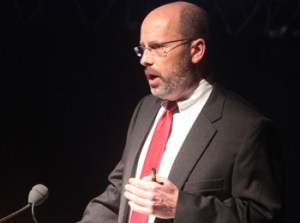
Avery Faigenbaum y Cinco Preguntas con Revista Clinica de Medicina Deportiva

You read that right.

Like the NBA teams that don a Spanish jersey for an evening, at CJSM we are getting our Spanish on.

Faigenbaum_diRoda (1)

Drs. Avery Faigenbaum and
Provincial Senator Cristina diRado
in Mar del Plata, Argentina

Our good friend and contributor to these blog pages and to the journal, Dr. Avery Faigenbaum, has agreed to sit with us for “5 Questions with CJSM.” We have been trying to catch up with him since his trip to Argentina this summer where he was lecturing on Exercise Deficit Disorder (EDD) and working on his own Spanish skills.  I’m know he’s a lot better in that area than I am.

Dr. Faigenbaum is a professor in the Dept. of Health and Exercise Science at The College of New Jersey.  He has written about EDD in youth (“Thinking Outside the Sandbox”) and about the benefits and safety of resistance training in youth.  He has lectured widely:  I’ve heard him speak in various settings in the United States, and he’s set to speak to the American Academy of Pediatrics in 2014 on EDD. Catch him if you can, you’re sure to learn a lot and be entertained as well: his energy is infectious.

And here’s just a taste of what you’re in for if you do get to see him:

________________________

Avery Faigenbaum: Five Questions with CJSM

1) CJSM: With the recent award of the 2020 Olympic games to Tokyo, can you comment on any evidence out there that such events stimulate activity in young fans/viewers?  Is there a ‘trickle down’ effect for youth athletics/exercise from events like the Olympics?

AF: Last summer James Bond and the “Queen” opened the Olympic Games in London by jumping out of a helicopter. This was followed shortly thereafter by stellar performances from world class athletes including sprinter Usain Bolt, swimmer Michael Phelps, boxer Nicola Adams, and 23 year old Rosannagh MacLennan who started jumping on the trampoline at the age of seven. But in stark contrast to these remarkable feats of athleticism, physical inactivity among the world’s population is now recognized as a pandemic. Read more of this post

Bruce S. Miller M.D., M.S. guests on “5 questions with CJSM”

800px-Michigan_Stadium,_17_September_2012

“The Big House”: the stadium
where Michigan plays, site of
this week’s game with OSU

Thanksgiving Day is near and, on a personal note, my twin children celebrate their tenth birthday this week. But here in Columbus, all celebrations fade in the face of “Hate Week.”

No it’s not something out of Orwell’s 1984.  It’s what my fellow citizens of this fair city call this week when their beloved Ohio State Buckeyes (OSU) play their northern rivals, the Michigan Wolverines (U of M), in their annual college football game.  It’s one of the oldest rivalries in the sport.

Having grown up in Grand Rapids, Michigan, with family members and multiple friends all attending the University of Michigan, I’m something of a Judas here in Columbus.  My paycheck comes from OSU and I even received my MPH from the school, but in the words of the Beatles, those things “Can’t Buy Me Love.” My sporting allegiances will stay maize and blue regardless of the fact that I will surrounded by a sea of scarlet and grey (and hatred) this week.

I thought it high time then to track down one of my dearest friends and have him answer ‘5 questions with CJSM.’  I need help from a fellow supporter of the Wolverines.

577494_10201377672658571_674303412_n

Dr. Bruce Miller with son Cameron at
youth hockey game.
Sporting the Maize and Blue!

Dr. Bruce Miller is an Associate Professor in the Department of Orthopaedics at the University of Michigan, and is a Team Physician for the U of M football team as well as USA Rugby. He publishes regularly, with a particular focus on rotator cuff pathology.  His accomplishments are legion (including being an All-American in rugby when he was in college), but I know him best as the man with whom I studied helminths back in medical school.  From worms to one of the premier positions in sports medicine, my how far he has come.

Here is what he had to say in answer to the questions we posed him:

_________________________

1) CJSM:  You are a busy orthopaedic surgeon and team physician, how did you get involved in clinical research?

At the beginning of my academic career, I was doing more basic science research, primarily focusing on articular cartilage and some biomechanical interests. However, I soon learned that the world of basic science can be quite “competitive”, especially in terms of securing funding. I recognized that as a busy clinician, I was at a competitive disadvantage in competing with full-time scientists. In addition, I enjoyed following my patients functional outcomes after surgery. I eventually came to the realization that I could be more successful in pursuing clinical research in the sense that my established clinical practice could serve as my “laboratory” . . . I simply needed to acquire some new research skills. I was fortunate that the University of Michigan School of Public Health offered a Masters program for clinicians, which allowed me to gain a new skill set while allowing me to continue with my clinical practice. I attended classes four days every month for roughly 18 months, and ultimately earned a Masters Degree in Clinical Research Design and Statistical Analysis. Through this program I gained a valuable skill set that allowed me to launch a successful clinical research program. Read more of this post

Dr. Keith Yeates guests on “5 Questions with CJSM”

keith

Dr. Keith Yeates revs up the crowd at
the International Brain Injury Association meeting
in Edinburgh, Scotland

I live and work in Columbus, Ohio, United States, and I am privileged to be surrounded by many leaders in the field of sports medicine.  One such figure, who is doing great work advancing the evidence to support the diagnosis and management of sport-related concussions, is Keith Yeates, Ph.D.

Dr. Yeates and I work at the same institution, Nationwide Children’s Hospital; I have found him to be a great resource to turn to for questions regarding the sport-related concussions in kids that I manage as part of my clinical practice.  He is a prolific researcher and writer, who has been a contributor to the pages of CJSM and journals beyond.  He is a lead neuropsychologist for a multi-site study of traumatic brain injury in children and adolescents, funded by the CDC.

I just learned from a press briefing that Dr. Yeates has become a millionaire of sorts:  he has been awarded a prestigious R01 grant to continue his work in the field of traumatic brain injuries.   And so I had to try to catch up with him and have him sit for 5 questions before his various other commitments overwhelmed him!  I got lucky, and here are Dr. Yeates’ thoughts on the state of concussion research.

___________________________________________________________________________

CJSM asks Dr. Keith Yeates 5 questions

1) CJSM: Congratulations!!  We understand you just received a $3M R01 grant for ‘predicting outcomes in children with MTBI.”  What areas of research do you plan on pursuing with this grant?

KY: The grant will fund research to examine how well diagnostic methods commonly used for children with mild TBI can predict persistent postconcussive symptoms (PCS) and functional deficits. Various methods are recommended for the diagnostic evaluation of children with mild TBI, including assessment of presenting signs/symptoms, acute mental status examination and balance testing, neuropsychological testing, and neuroimaging. Although these methods discriminate between children with mild TBI and healthy children, we don’t know whether they predict outcomes such as persistent PCS and functional impairments among children with mild TBI. As a result, decision tools are not available to physicians and other health care providers to guide the disposition and care of children with these very common injuries. This comprehensive study of common diagnostic methods and their incremental utility in predicting outcomes should have a major impact on clinical practice, particularly in acute care settings, by helping improve prognostic determinations, develop decision tools, and focus treatment efforts. The study should also add substantively to the scientific understanding of the outcomes of mild TBI. Read more of this post

William P. Meehan III, M.D. guests on “5 questions with CJSM”

bill m stanley cup

Bill Meehan & The Stanley Cup
One of the few awards he has
not garnered in his career.

Readers of the blog will remember in August I was able to interview Dr. Jason Mihalik, University of North Carolina, about his work while using the ‘5 questions with CJSM’ format.  I’m happy to say I have another willing victim for this format.

I have known William P. Meehan III, M.D. for several years; we both did our sports medicine training in Boston under the illustrious doctors Lyle Micheli, M.D. and Pierre d’Hemecourt, M.D., authors whose names will be familiar to readers of the journal as they have both been published in CJSM numerous times.

Bill, as I know him, is likewise establishing his own enviable track record in the clinical management and study of sport-related concussions.    I have mentioned some of the work he has done in a recent blog post, and so in the spirit of brevity let’s get right to the interview.

_______________________________________________________________________

Five Questions with CJSM

WM:  Thanks so much for inviting me to be part of your blog, Jim.  You do great work here at the Clinical Journal Sports Medicine I appreciate your including me.

1)    CJSM:  Thanks for those kind words Bill, and congratulations on your receipt of the first AMSSM-ACSM Foundation’s Clinical Research Grant for your project titled “A Randomized, Double-Blind, Placebo-Controlled Trial of Transcranial Light Emitting Diode Therapy for the Treatment of Chronic Concussive Brain Injury.”  Can you tell us what potential you see for LED therapy in this arena

WM:  The idea of using light emitting diodes (LEDs) to treat concussive brain injury was brought to my attention by Margaret Naeser, PhD, who works at the VA Boston Healthcare System and Boston University School of Medicine. Dr. Naeser approached me one day after a lecture and suggested that perhaps LED therapy could help people suffering from concussive brain injury. To be honest, I was a bit skeptical at first. But she was passionate and convincing about it.  After reading some of the previous medical and scientific literature about light therapy, my mentor in the laboratory, Michael Whalen, MD at Massachusetts General Hospital conducted some experiments on mice that had suffered a traumatic brain injury.  The results were promising.  So the three of us, together with Rebekah Mannix, MD, MPH, Alex Taylor, PsyD, and Ross Zafonte, DO set out to conduct the study.

As you know, the current hypothesis of concussion is that a rapid rotational acceleration of the brain leads to changes in the ionic gradients across the axonal membrane. Those ionic gradients are restored to homeostasis by the action of the sodium-potassium pump. The sodium-potassium pump operates on adenosine triphosphate (ATP). It turns out that light in the red and near infrared spectrum when applied to cells in culture increases the activity of cytochrome C oxidase. This results in further ATP synthesis. Thus, some very astute researchers hypothesized that shining light in the red/near infrared spectrum on the brain would result in an increase in ATP production and perhaps decrease the healing times after certain brain injuries, including traumatic brain injury.

Dr. Whalen was nice enough to conduct an experiment in his laboratory using mice that had sustained brain injuries when we first heard about this.  Those experiments showed that treatment with laser in the red/near infrared spectrum resulted in better outcomes on measures of cognitive functioning, specifically the Morris water maze. After considering all of the evidence I followed up with Dr. Naeser. She informed me that she had an ongoing trial of light emitting diode therapy for people suffering from chronic traumatic brain injury. She had also published a case series of two patients who sustained concussions during motor vehicle collisions, athletic participation, and military service, who showed improvements of their cognitive functions after LED therapy. So we decided to conduct a randomized, double-blinded, placebo-controlled trial of LED as treatment for concussion.  Thus far, we have recruited half of our estimated sample size of 48 patients.

2) CJSM:  Congratulations as well for becoming Director for the Micheli Center.  If you had to compose a 140 character tweet to tell the world about the work you expect to accomplish there, what would it say?

WM:  Thank you.  I was delighted to become director of the Micheli Center for Sports Injury Prevention. We believe we are the first center in the world where athletes can come and learn which injuries they are at highest risk of sustaining, and what steps they can take to reduce the risk of those injuries.  The full Injury Prevention Evaluation takes about 3-3.5 hours.  It starts by collecting historical information, such as what sports the athletes play, what injuries the athletes have previously suffered, how many hours per week the athletes train, etc.   Then the athletes move out to the assessment floor where we measure bony angles, flexibility at the joints, strength in various muscle groups, speed, power, agility, and many other factors that are associated with the risk of injury.  The full evaluation includes over 300 data points, all based on the available medical and scientific evidence.  At the end of the evaluation, athletes are given a list of the injuries for which they are at highest risk, and an individualized prescription that outlines the steps they can take to reduce their risk of sustaining those injuries.

Our goal is to encourage safe participation in athletics while simultaneously decreasing the risk of injuries sustained during sports.

Although I don’t have twitter account, if I had to put out a 140 character tweet to the world I would say, “Our goal is to reduce the risk of sustaining sports injuries while simultaneously encouraging athletic participation.”

(CJSM:  21 characters to spare with that tweet!  Hey, Bill, with a name like yours, you can imitate RG3 and see if the twitter handle WM3 is available.  You can make the Micheli Center go viral!) Read more of this post