#AMSSM15: Winding down in sunny Florida

IMG_1119

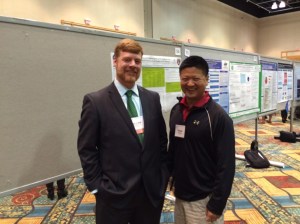
Drs. Bill Meehan of Boston Children’s and Frank Wang, Team Doc of Harvard: bringing a little Boston to Florida at #AMSSM15 (We approve of the ‘Stanley Cup’ beard Dr. Meehan)

As I wrap up my stay in Hollywood, Florida for the 24th meeting of the American Medical Society for Sports Medicine (AMSSM), it’s a strange realization I come to now sitting down to write a blog post:  how can four days pass so quickly?

One answer to that question:  if the days are packed full of interesting activities.

I can only attempt in this post to survey in brief just what the agenda has been.  That is my self-appointed task, in any case, as I indulge in the last few minutes of the sultry, southern Florida life before I jump a plane home.

I was struck  by just how strong the AMSSM leadership is as I sat through the organization’s ‘State of the Union’ address, delivered co-jointly by outgoing president Chris Madden and incoming president Jon Divine.  I am a member of AMSSM as well as the Emerging Media Editor of CJSM, and so I had a doubly strong interest in the talk.

I was struck, as well, by how strong the organization’s staff is–those folks have done a fabulous job organizing this meeting for what is now approaching almost 2o00 physicians!

The AMSSM is the largest primary care sports physician organization in the world.  It is one we are proud to represent as its official journal; one we are proud to include among our group of partner societies which span the globe (which include CASEM, ACSP, and the AOASM).  Both Drs. Madden and Divine delivered inspiring speeches, ones devoted at heart to a recognition that an organization represents the sum of its parts:  we imperfect human beings who, in this organization’s case, are working hard to define the best practices of primary care sports medicine.

I will hold close for some time, I hope, the words of the parting president of AMSSM, Dr. Madden, who used a quotation attributed to Gandhi:  “Be the change you want to see in the world.” Read more of this post
Let us now praise social media: #AMSSM15

pam and me

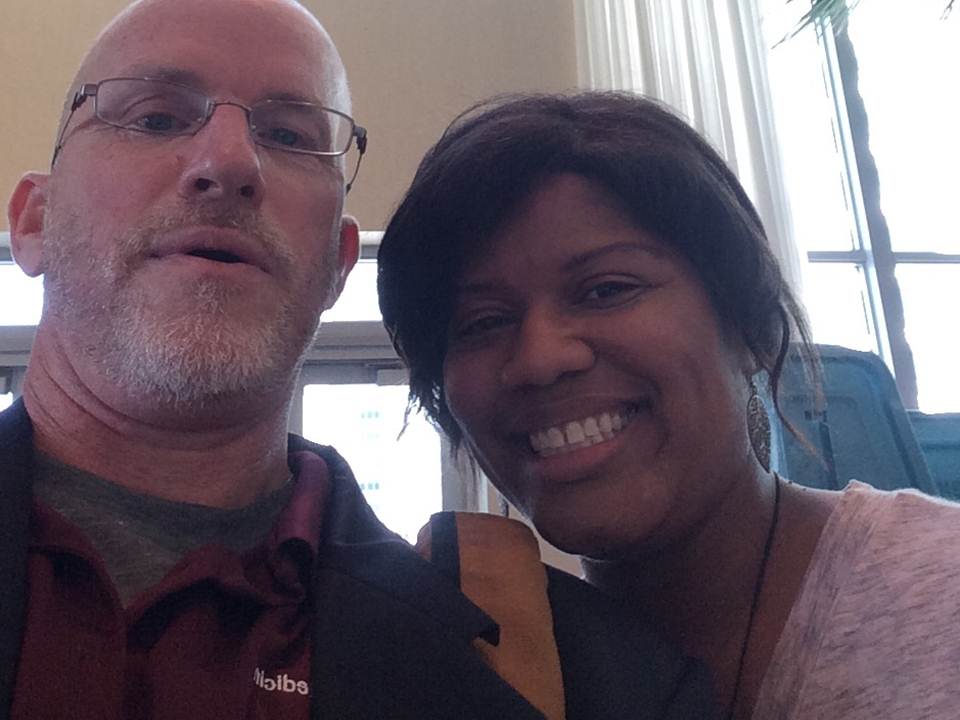
With a good friend….whom I just happened to meet in person today! Tekia Thompson, AMSSM

Much can be written–and has been written–about the perverse behaviors and relationships that can form around social media. Anyone who has spent time blogging or tweeting can tell you about being verbally blasted by trolls.

But I’m here to write about, briefly, the greatness of social media:  the way it can make the world flat, to borrow a concept of Thomas Friedman’s.

Time differences and geography need not be a barrier to forging powerful relationships, and I’m reminded of that strongly today.

It is the first day of the annual meeting of the American Medical Society for Sports Medicine, and it’s already shaped up to be a great one.  I just wrapped up a faculty development session and am soon to sit down and hear some of the world’s experts on football medicine (that’s soccer to us Yanks).

When I was checking in, the first person I wanted to meet was @TheAMSSM, a.k.a. @PamTekaDegraw…or, rather, Tekia Thompson, the communications manager and one member of the fabulous staff of the AMSSM. I’ve communicated with Pam for months via email at times, but mostly via direct message on Twitter; we’ve chatted about a variety of issues relating to AMSSM and CJSM. I feel as if I have come to know her.  Nothing can replace the excitement of finally meeting her first hand; but as I reflect on how we’ve become colleagues and friends, I realize the warmth of our greeting today was informed by a true sense of a relationship already formed…..thanks to Twitter.

The same situation applies to my growing collaborations with South Africa’s Jon Patricios, as I wrote in one of my more recent blog posts. We’ve skyped, and emailed, and tweeted; I’ve conducted a podcast interview with him.  We’ve worked on one talk and will do so with another at the American College of Sports Medicine (ACSM) in a month.  I’ll see him here in Florida (he is the South African travelling fellow to AMSSM) and I’ll get to see him later this year in South Africa (I’ll be one of two travelling fellows to SASMA).  But for all of this, I may have met Jon I think physically 2 or 3 times–the depth of our relationship owes to the ‘flatness’ of the virtual world.

The subject of that ACSM talk is the power of social media for sports medicine clinicians, and if you’re in San Diego for the conference be sure to hear from Jon, AMSSM member @MizzouSportsDoc (er, Aaron Gray, M.D.) and me about why a tool like Twitter should belong next to your goniometer.

IMG_1111

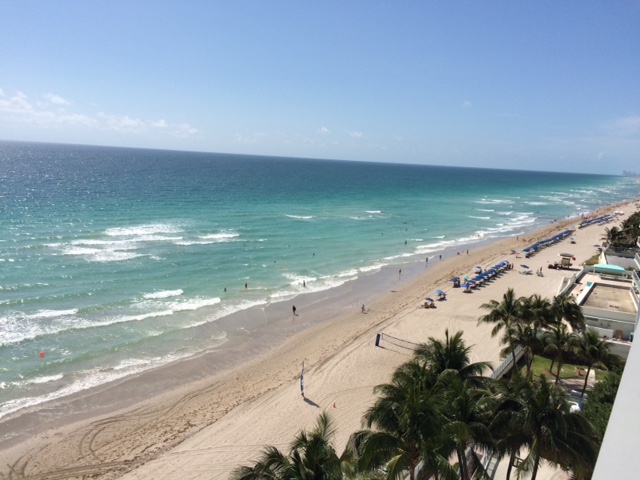
Beautiful Hollywood, Florida

So–here’s to social media and it’s power to influence for the better our profession of sports medicine! Make sure to follow the hashtag #AMSSM15 this week to stay on top of the proceedings even if you are not physically here in Hollywood, Florida. And take a look at our #ReturnToPlay collection, which we’ve made free until the end of the month to celebrate the theme of #AMSSM15

Cheers, and we (that is @CJSMonline) hope 2 c u on SoMe!


Super Bowl Aftermath

Julian_Edelman_2014

Julian Edelman, New England Patriots pic: Jeffrey Beall

It’s a Tuesday as I write, so literally (and figuratively) I do not propose to do any “Monday Morning Quarterbacking.”  I’ll leave it to others to deconstruct Pete Carroll’s decision at the end of the game (though I don’t think it was that crazy of a call, and was in keeping with other contrarian decisions he has made that actually got the Seahawks into the Super Bowl–like the fake field goal call against Green Bay in the NFC Championships).

The Russell Wilson interception obviously turned out badly for Seattle, and sent all of New England into a frenzied state of joy (though a snowstorm in the region is causing the fans there to hold off one more day from a celebratory parade through Boston).

No, I’m here to focus on sports medicine–specifically the management of Julian Edelman’s apparent concussion in the big game–and encourage you, the reader, to take a poll to stimulate conversation about the issue.

I’m sure a lot of us in the sports medicine world had a sense of deja vu when we saw Edelman stay in the game after what many viewers thought was a concussion:  in the 2014 FIFA World Cup there were several similar incidents, when several players had suspicious head injuries whose management was questionable.  In the aftermath of that tournament, we had a podcast with guests Matthew Gammons and Cindy Chang , physicians of the American Medical Society of Sports Medicine (AMSSM), exploring the issues involved with management of possible concussions in real time, in the setting of a highly visible sporting event…like the Super Bowl.

The NFL has, in the wake of much criticism, introduced new concussion protocols.  It is my understanding that “….. the NFL assigns an independent physician to each team to monitor head injuries, and there is another independent ‘spotter’ who watches players on both teams from a booth above the field and can radio to the sidelines if there is evidence of an on-field concussion.” [1] Additionally, each team has its own medical personnel to monitor the situation as well as do any necessary evaluations.

It is not clear to me, however, that there is an independent physician who is empowered to remove a player from the field of play; to mandate removal if necessary, and not just ‘monitor.’  Should there be a clinician who i) has no conflict of interest [as exists intrinsically in any dynamic that involves medical personnel employed by a team:  player safety comes first, but there are, inarguably, biases that can creep into our decisions when player performance, especially in the setting of the World Cup or the Super Bowl, is at a premium]; and ii) who has the power, and the backing from the league, to disregard the player’s opinion, the coaches’ opinions, etc. and can mandate even the removal of a key player like, say, Tom Brady, for suspicion of a concussion, on the biggest stage of their sport.

And so, today’s poll:


References

[1] The Super Bowl’s Concussion Calculation, The New Yorker, Ian Crouch.

http://www.newyorker.com/news/sporting-scene/super-bowls-concussion-calculation, accessed 2/3/15


Pediatric Overuse Injuries: A Closer Look

Babynew

Illustration by J.C. Leyendecker, Saturday Evening Post

The ringing in of the New Year is traditionally accompanied by pictures with some variation on the theme of a new baby’s arrival.  Witness the classic Saturday Evening Post cover accompanying this post.

For intentional or serendipitous reasons, we at CJSM have a habit of doing something of the same:  for two years running now the journal has our inaugural issue of the new year highlight studies looking into the phenomenon of overuse injuries in the pediatric athlete.  Our January 2014 issue was headlined by the American Medical Society for Sports Medicine (AMSSM) position statement on overuse injuries and burnout in youth sport, a study I got to follow up with an interview with lead author and then-President of the AMSSM, UCLA’s John DiFiori!

This year, one of our ‘Original Research’ papers comes from another AMSSM member, Andrea Stracciolini, from Boston Children’s Hospital.  She is the lead author on the paper, A Closer Look at Overuse Injuries in the Pediatric Athlete.

Landing on your doorstep in January:  not a baby from a stork but a pediatric overuse study by CJSM….2015 is going to be a good year!

Dr. Stracciolini and her team primarily set out to see whether there was a true difference in overuse injuries between male and female athletes after they had controlled for several confounding variables (e.g. BMI, presence of contact/collision in the sport, team vs. individual sport, etc.) Read more of this post