William P. Meehan III, M.D. guests on “5 questions with CJSM”

bill m stanley cup

Bill Meehan & The Stanley Cup
One of the few awards he has
not garnered in his career.

Readers of the blog will remember in August I was able to interview Dr. Jason Mihalik, University of North Carolina, about his work while using the ‘5 questions with CJSM’ format.  I’m happy to say I have another willing victim for this format.

I have known William P. Meehan III, M.D. for several years; we both did our sports medicine training in Boston under the illustrious doctors Lyle Micheli, M.D. and Pierre d’Hemecourt, M.D., authors whose names will be familiar to readers of the journal as they have both been published in CJSM numerous times.

Bill, as I know him, is likewise establishing his own enviable track record in the clinical management and study of sport-related concussions.    I have mentioned some of the work he has done in a recent blog post, and so in the spirit of brevity let’s get right to the interview.

_______________________________________________________________________

Five Questions with CJSM

WM:  Thanks so much for inviting me to be part of your blog, Jim.  You do great work here at the Clinical Journal Sports Medicine I appreciate your including me.

1)    CJSM:  Thanks for those kind words Bill, and congratulations on your receipt of the first AMSSM-ACSM Foundation’s Clinical Research Grant for your project titled “A Randomized, Double-Blind, Placebo-Controlled Trial of Transcranial Light Emitting Diode Therapy for the Treatment of Chronic Concussive Brain Injury.”  Can you tell us what potential you see for LED therapy in this arena

WM:  The idea of using light emitting diodes (LEDs) to treat concussive brain injury was brought to my attention by Margaret Naeser, PhD, who works at the VA Boston Healthcare System and Boston University School of Medicine. Dr. Naeser approached me one day after a lecture and suggested that perhaps LED therapy could help people suffering from concussive brain injury. To be honest, I was a bit skeptical at first. But she was passionate and convincing about it.  After reading some of the previous medical and scientific literature about light therapy, my mentor in the laboratory, Michael Whalen, MD at Massachusetts General Hospital conducted some experiments on mice that had suffered a traumatic brain injury.  The results were promising.  So the three of us, together with Rebekah Mannix, MD, MPH, Alex Taylor, PsyD, and Ross Zafonte, DO set out to conduct the study.

As you know, the current hypothesis of concussion is that a rapid rotational acceleration of the brain leads to changes in the ionic gradients across the axonal membrane. Those ionic gradients are restored to homeostasis by the action of the sodium-potassium pump. The sodium-potassium pump operates on adenosine triphosphate (ATP). It turns out that light in the red and near infrared spectrum when applied to cells in culture increases the activity of cytochrome C oxidase. This results in further ATP synthesis. Thus, some very astute researchers hypothesized that shining light in the red/near infrared spectrum on the brain would result in an increase in ATP production and perhaps decrease the healing times after certain brain injuries, including traumatic brain injury.

Dr. Whalen was nice enough to conduct an experiment in his laboratory using mice that had sustained brain injuries when we first heard about this.  Those experiments showed that treatment with laser in the red/near infrared spectrum resulted in better outcomes on measures of cognitive functioning, specifically the Morris water maze. After considering all of the evidence I followed up with Dr. Naeser. She informed me that she had an ongoing trial of light emitting diode therapy for people suffering from chronic traumatic brain injury. She had also published a case series of two patients who sustained concussions during motor vehicle collisions, athletic participation, and military service, who showed improvements of their cognitive functions after LED therapy. So we decided to conduct a randomized, double-blinded, placebo-controlled trial of LED as treatment for concussion.  Thus far, we have recruited half of our estimated sample size of 48 patients.

2) CJSM:  Congratulations as well for becoming Director for the Micheli Center.  If you had to compose a 140 character tweet to tell the world about the work you expect to accomplish there, what would it say?

WM:  Thank you.  I was delighted to become director of the Micheli Center for Sports Injury Prevention. We believe we are the first center in the world where athletes can come and learn which injuries they are at highest risk of sustaining, and what steps they can take to reduce the risk of those injuries.  The full Injury Prevention Evaluation takes about 3-3.5 hours.  It starts by collecting historical information, such as what sports the athletes play, what injuries the athletes have previously suffered, how many hours per week the athletes train, etc.   Then the athletes move out to the assessment floor where we measure bony angles, flexibility at the joints, strength in various muscle groups, speed, power, agility, and many other factors that are associated with the risk of injury.  The full evaluation includes over 300 data points, all based on the available medical and scientific evidence.  At the end of the evaluation, athletes are given a list of the injuries for which they are at highest risk, and an individualized prescription that outlines the steps they can take to reduce their risk of sustaining those injuries.

Our goal is to encourage safe participation in athletics while simultaneously decreasing the risk of injuries sustained during sports.

Although I don’t have twitter account, if I had to put out a 140 character tweet to the world I would say, “Our goal is to reduce the risk of sustaining sports injuries while simultaneously encouraging athletic participation.”

(CJSM:  21 characters to spare with that tweet!  Hey, Bill, with a name like yours, you can imitate RG3 and see if the twitter handle WM3 is available.  You can make the Micheli Center go viral!) Read more of this post

And We’re Off……

308627_10150325936247969_726779957_n

The author and colleague attending
to downed football player

The college football season began here in the USA last night, and the high school football season begins here in Ohio tonight.  I’ll be on the sidelines tonight and every week for the next 10 weeks….or more, if the team I cover makes the playoffs. Ohio Dominican University, the college whose sports our group covers, has been picked to do well this year, and I think the Panthers will, if they stay injury-free.    I hope all the players we’re involved with, high school and college, can stay as safe as can be expected.

The American football season represents the busiest time of our year. This stands to reason, of course, as both injury and participation rates in the sport consistently ‘top the charts’ in almost any study looking into the matter.  My friend and colleague R. Dawn Comstock, Ph.D., whom I mention frequently in these blog posts because of the many articles she has published, authored one such study in the Journal of Athletic Training, 2008:  ‘An Epidemiologic Comparison of High School Sports Injuries Sustained in Practice and Competition.’  Of all the sports studied, football had the highest competition and practice injury rates: 12.09 and 2.54 per 1000 athlete-exposures, respectively.  And as for participation, over 1 million high schoolers and nearly 80,000 college  students play football each year.   Combine these high participation rates and injury rates, and you have lots of bodies to attend to in the fall here in America.

It can be a brutal sport.  Boden et al. published a fine study in the American Journal of Sports Medicine this spring, “Fatalities in High School and College Football Players,” where he and his colleagues looked at the epidemiologic data from the National Center for Catastrophic Sports Injury Research from 1990 to 2010.  They found that football is associated with the highest number of fatalities for any sport reported to the Center, with 243 fatalities reported during the study period.  The reported rates of fatality were 1.0 per 100,000 participants.  They found, too, that college football was riskier, with 2.5 deaths per 100,000 participants for collegiate athletes, as compared with 0.9 deaths per 100,000 in high schoolers.

The theme for August here at the CJSM blog and at the mother journal herself has been “Concussion.”  The blog posts for this month have all focused on this issue, and the journal has made freely available this month a set of ten high quality concussion research articles it has published recently in a special concussion “collection.”  And so I would be remiss, with two days left in this month, if I did not briefly mention concussion injury rates in the sport of football.  Again, I will turn to the exceedingly productive Dr. Comstock, who reported in 2007 on “Concussions Among United States High School and Collegiate Athletes.”  Once again, the sport of football tops the injury rate charts, with Comstock’s group reporting rates for high school football players of  1.55 per 1000 athlete exposures; for the collegiate players the rates, as they are for fatalities, are higher, with 3.02 concussions per 1000 athlete exposures.

Time to start reviewing the Zurich consensus statement on Concussion in Sport.

With August’s end, we won’t stop talking about concussion, of course.  It is one of the most newsworthy items in the current field of clinical sports medicine, and I can tell you (having had a sneak peek at the upcoming September edition), that there are some excellent original research articles on the subject being published in CJSM in the next week.  I also have a “Question and Answer” blog post with the illustrious William Meehan, M.D., Director of the Sports Concussion Clinic at Boston Children’s Hospital, coming for the blog in September.  So keep your eyes on these pages, the journal’s website, and follow us on Twitter @cjsmonline (join the 2000+ who already do).  We’ll keep you up-to-date on the news and research relevant to you in your clinical practice of sports medicine.

800px-MT._CARMEL_062

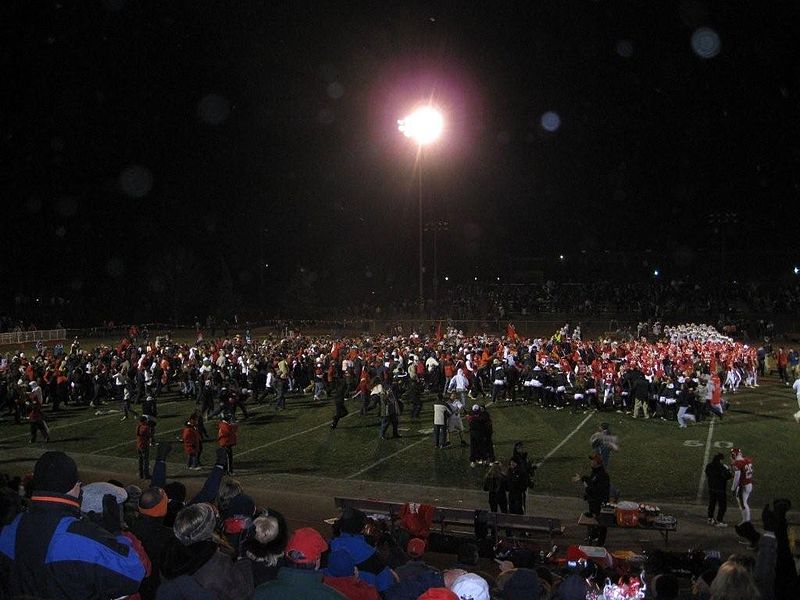
Friday Night Lights,
may you and yours be safe this season.

I sign off knowing that many of the readers of this blog will be on sidelines and in training rooms this fall, and I wish you all good luck.  All the fall sports, and especially football, will keep you busy I know.  May you, and the athletes you care for, enjoy health–or recover quickly from injury–under the lights this fall.

Computerized Neurocognitive Testing in the Management of Concussions, Part 2

Leather_football_helmet_(circa_1930's)

Concussion management for football,
c. 1930

I woke up this morning to my usual Sunday routine:  the New York Times Sports page and coffee.

Today’s sports section–and I don’t think the Times is alone in this regard–is devoted to the subject of the forthcoming American college football season.  The first games of the season will take place this Thursday, August 29.  As the Times puts it, “The nation’s annual rite of mayhem and pageantry known as the college football season begins this week…..”

When I’m not doing work with the Clinical Journal of Sports Medicine, I’m taking care of youth, high school and college athletes; for my colleagues and me, the football season has already begun, with the various teams we cover already having had weeks of steady, increasingly intense practices and scrimmages.  And we’re seeing the injury results of the sport, including an increase in volume of concussions.

I’ve mentioned this in my blog posts for this month, where the theme has been ‘concussions.’  Last week I wrote about the special set of CJSM concussion research articles we have made freely available for a limited time.  At the beginning of the month, I authored a post on the subject of computerized neurocognitive testing (e.g. ANAM4, CNS-Vital Signs, AxonSports,  ImPACT, etc.) and their use in managing concussions.  I want to return to that subject in today’s post.

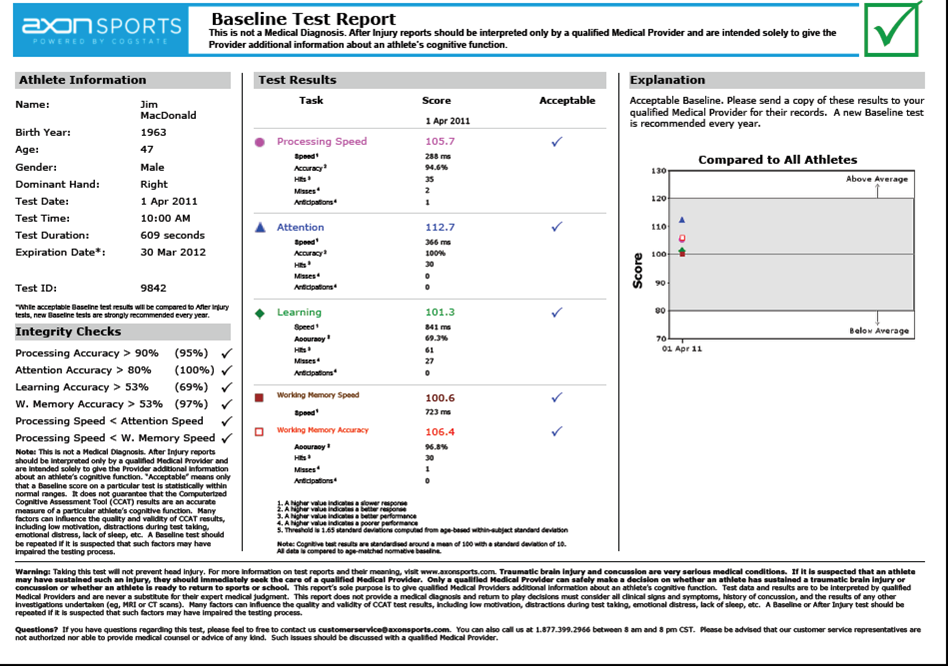
axon sport macdonald

The author’s baseline AxonSport report

A recent article from the Archives of Clinical Neuropscyhology was especially interesting, I thought. The authors looked at a military population while evaluating the test-retest reliability of four computerized neurocognitive assessment tools (NCATs):  Automated Neuropsychological Assessment Metrics 4 (ANAM4), CNS-Vital Signs, CogState (available now in the U.S. as ‘Axon Sports’), and ImPACT).  I’m familiar with these products, but most especially ‘know’ CogState, as this is the NCAT we use in our clinic.

The authors correctly assert that test-retest reliability is one of the “…fundamental psychometric characteristics that should be established in each NCAT,” and that “….reliability should be established before making conclusions about a test’s validity,” which is the psychometric construct that can indicate whether a test measures what one is truly trying to measure (for instance, ‘reaction time,’ or ‘memory’).  Reliability, is the “…extent to which the test produces consistent results across multiple administrations to the same individual.”

In this study of 215 individuals (mean age 34, range 19 to 59), Read more of this post

Concussion Research Offerings on CJSM

We’ve been profiling sports-related concussions (SRCs) in the August posts here on the CJSM blog.

We’ve taken a peek at the use of computerized neurocognitive tests in the diagnosis and management of SRCs; conducted a poll on the entity known as “Second Impact Syndrome”; and interviewed Dr. Jason Mihalik of the University of North Carolina, who is one of the principal developers of a celebrated app helping laypeople identify when an athlete might be concussed.

In this post, I wanted to alert the readership to a special set of journal articles CJSM is releasing for free for a limited time, a set devoted to this issue of SRCs.

chris hughes 2

No, that’s not “Big Brother,”
that’s the CJSM Editor-in-Chief,
Christopher Hughes MBBS, MSc

Our Editor-in-Chief, Dr. Chris Hughes, describes the special collection of ten journal articles in this YouTube video.

I am very excited to pass this information on to the readership, as I am sure you will find this collection quite interesting.  The articles range from the Zurich 2012 Consensus Statement to insightful offerings on the use of neuropsychological tests and the risk of chronic neurological impairment from SRCs.  Not only are the offerings diverse but, to repeat, they are freely available for a limited time.

I plan to return to the specific issue of the use of computerized neurocognitive tests in the diagnosis and management of SRCs in the next blog post.  I had broached this subject in my August 5 post.  My clinical group has been busy doing literally hundreds of baseline tests prior to and at the beginning of the American fall sports seasons.  It is a big business, quite frankly, and I have some concerns about the clinical utility of these tests.  I certainly appreciate them as one tool to use among others; but in America, at least, their routine use–their de facto emergence as standard of care–has given me some pause.  So, though I may be dipping my toes into the waters of controversy, I will be critically looking at the use of these instruments in my next post.

I will be looking specifically at the Ian Shrier, M.D., Ph.D. study in the CJSM concussion collection  and a new and excellent article on the reliability of computerized neurocognitive tests from the Archives of Clinical Neuropsychology:  ”Test-retest Reliability of Four Computerized Neurocognitive Assessment Tools in an Active Duty Military Population.” 

Won’t you look at them too so we can engage in an on-line conversation?  As ever, I stay busy responding to the comments on this blog, as well as chatting with you on Twitter and Facebook.

Until next time, stay well!