Computerized Neurocognitive Testing in the Management of Concussions, Part 2

Leather_football_helmet_(circa_1930's)

Concussion management for football,
c. 1930

I woke up this morning to my usual Sunday routine:  the New York Times Sports page and coffee.

Today’s sports section–and I don’t think the Times is alone in this regard–is devoted to the subject of the forthcoming American college football season.  The first games of the season will take place this Thursday, August 29.  As the Times puts it, “The nation’s annual rite of mayhem and pageantry known as the college football season begins this week…..”

When I’m not doing work with the Clinical Journal of Sports Medicine, I’m taking care of youth, high school and college athletes; for my colleagues and me, the football season has already begun, with the various teams we cover already having had weeks of steady, increasingly intense practices and scrimmages.  And we’re seeing the injury results of the sport, including an increase in volume of concussions.

I’ve mentioned this in my blog posts for this month, where the theme has been ‘concussions.’  Last week I wrote about the special set of CJSM concussion research articles we have made freely available for a limited time.  At the beginning of the month, I authored a post on the subject of computerized neurocognitive testing (e.g. ANAM4, CNS-Vital Signs, AxonSports,  ImPACT, etc.) and their use in managing concussions.  I want to return to that subject in today’s post.
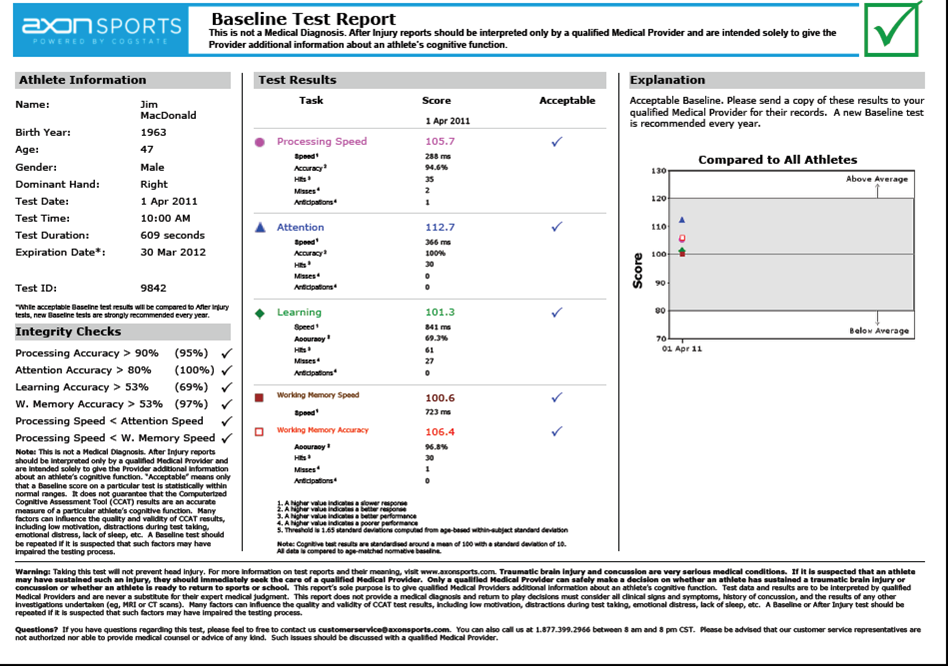
axon sport macdonald

The author’s baseline AxonSport report

A recent article from the Archives of Clinical Neuropscyhology was especially interesting, I thought. The authors looked at a military population while evaluating the test-retest reliability of four computerized neurocognitive assessment tools (NCATs):  Automated Neuropsychological Assessment Metrics 4 (ANAM4), CNS-Vital Signs, CogState (available now in the U.S. as ‘Axon Sports’), and ImPACT).  I’m familiar with these products, but most especially ‘know’ CogState, as this is the NCAT we use in our clinic.

The authors correctly assert that test-retest reliability is one of the “…fundamental psychometric characteristics that should be established in each NCAT,” and that “….reliability should be established before making conclusions about a test’s validity,” which is the psychometric construct that can indicate whether a test measures what one is truly trying to measure (for instance, ‘reaction time,’ or ‘memory’).  Reliability, is the “…extent to which the test produces consistent results across multiple administrations to the same individual.”

In this study of 215 individuals (mean age 34, range 19 to 59), Read more of this post

Concussion Research Offerings on CJSM

We’ve been profiling sports-related concussions (SRCs) in the August posts here on the CJSM blog.

We’ve taken a peek at the use of computerized neurocognitive tests in the diagnosis and management of SRCs; conducted a poll on the entity known as “Second Impact Syndrome”; and interviewed Dr. Jason Mihalik of the University of North Carolina, who is one of the principal developers of a celebrated app helping laypeople identify when an athlete might be concussed.

In this post, I wanted to alert the readership to a special set of journal articles CJSM is releasing for free for a limited time, a set devoted to this issue of SRCs.

chris hughes 2

No, that’s not “Big Brother,”
that’s the CJSM Editor-in-Chief,
Christopher Hughes MBBS, MSc

Our Editor-in-Chief, Dr. Chris Hughes, describes the special collection of ten journal articles in this YouTube video.

I am very excited to pass this information on to the readership, as I am sure you will find this collection quite interesting.  The articles range from the Zurich 2012 Consensus Statement to insightful offerings on the use of neuropsychological tests and the risk of chronic neurological impairment from SRCs.  Not only are the offerings diverse but, to repeat, they are freely available for a limited time.

I plan to return to the specific issue of the use of computerized neurocognitive tests in the diagnosis and management of SRCs in the next blog post.  I had broached this subject in my August 5 post.  My clinical group has been busy doing literally hundreds of baseline tests prior to and at the beginning of the American fall sports seasons.  It is a big business, quite frankly, and I have some concerns about the clinical utility of these tests.  I certainly appreciate them as one tool to use among others; but in America, at least, their routine use–their de facto emergence as standard of care–has given me some pause.  So, though I may be dipping my toes into the waters of controversy, I will be critically looking at the use of these instruments in my next post.

I will be looking specifically at the Ian Shrier, M.D., Ph.D. study in the CJSM concussion collection  and a new and excellent article on the reliability of computerized neurocognitive tests from the Archives of Clinical Neuropsychology:  ”Test-retest Reliability of Four Computerized Neurocognitive Assessment Tools in an Active Duty Military Population.” 

Won’t you look at them too so we can engage in an on-line conversation?  As ever, I stay busy responding to the comments on this blog, as well as chatting with you on Twitter and Facebook.

Until next time, stay well!

The Games We Play: From Open Water Swimming to Croquet

photo (20)

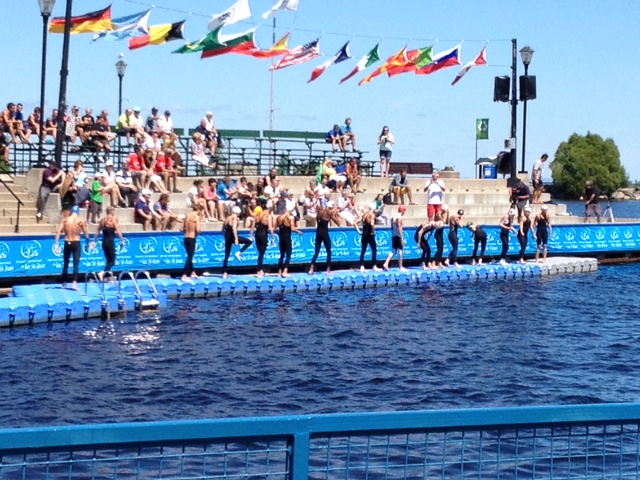
And they’re off:
the start of the 32K Traversee

The swimmers have entered the 19 C water and have begun their 6+ hour journey to Roberval:  the Traversee of Lac St. Jean, a FINA 32km open water swim has begun.

photo (14)

The start of the Lac St. Jean
10 K FINA event

I last wrote a post about the FINA World Cup 10km event that took place two days ago at the same venue.  The organizational structure, medical facilities, and WADA doping control stations are the same for the 32km Traversee.

photo (15)

The infirmary at Traversee Headquarters.


The 10km race was an exciting finish, and more importantly from the viewpoint of a sports medicine clinician, the event was safe.  By that I mean that the facilities and staff were well organized, and there were no major injuries to the athletes.  As expected, given the cold waters of the racing venue, a couple of swimmers were treated for mild hypothermia, but no one required anything more than passive warming and supportive care.

photo (19)

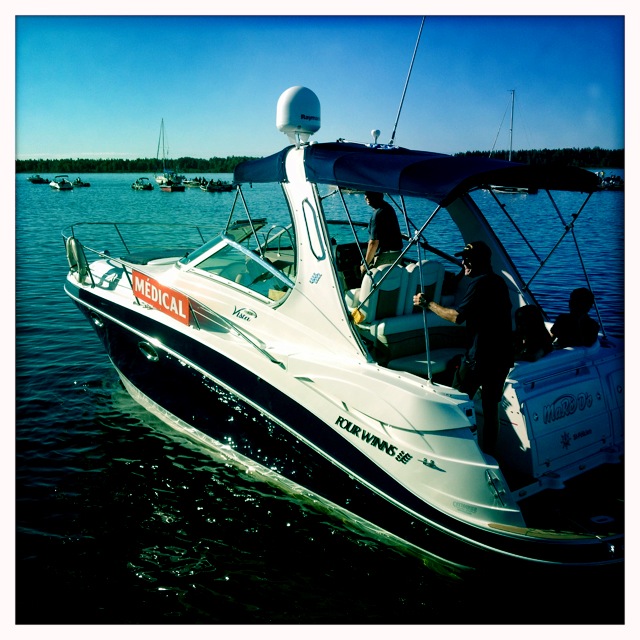
One of the Medical Boats accompanying
the swimmers as they make the 32K crossing

Hypothermia (body temperature < 35 C) can be a concern for any athlete (coach, athletic trainer, or physician) performing in an outdoor venue, but it is a special risk for open water swimmers.  FINA mandates that swims take place on courses with event-day water temperatures in a range from 16 to 31 C.  At the higher end of that range, swimmers may produce more heat than can be easily dissipated through convection and conduction, and may be at risk of hyperthermia.  Exertional Heat Illness is, of course, another environmental hazard sports medicine clinicians must be concerned with.  It is thought to have been one of the contributing causes to the worst outcome one can conceive in the field of sports medicine:  the death of an open water swimmer, Fran Crippen, occurred at a FINA event in the United Arab Emirates in 2010.

At this venue in Lac St. Jean, we have the opposite concern.  The early morning temperature on race day Thursday was 18 C, and I was happy to see the temperature climbed one more degree by race time.  The swimmers’ opinions of those conditions ranged from neutral to notable (cold!), but, as I said, only two swimmers needed attention.  The other 15 emerged from the water with their biggest concerns ranging from 1) washing the lanolin off of their bodies to 2) producing urine for doping control. Read more of this post

ACSM Annual Meeting in Indianapolis

Dan_Gurney_&_Crosthwaite

Vintage Indy 500: Dan Gurney

Indianapolis:  home of the Indy 500, that just took place last Sunday, and this week home of the 60th Annual Meeting of the American College of Sports Medicine (ACSM).

I’ve already enjoyed a couple of great days here, and I wanted to share some of the high points.

First, I attended a session on exercise therapy and youth, cleverly entitled, “Linking Health Care with Fitness Care in Youth to Prevent Generation XXL.”  The session was organized as a series of talks given as part of ACSM 2013 and the concurrently run 4th World Congress on Exercise is Medicine.  Among the speakers was Avery Faigenbaum, EdD, a professor of pediatric exercise science whom I have heard speak on several occasions over the years.

He is always a scintillating speaker.  Much of his work over the years has involved demonstrating the safety and effectiveness of resistance training in youth.  His talk here  as part of this session took on a different subject:   “Exercise Deficit Disorder in Youth:  Challenging Traditional Dogma.”  If you have not heard of “Exercise Deficit Disorder” (EDD) before, you will be hearing more about it in the future.

Read more of this post